

Product
PHP and Composer Support Is Now in Beta
Socket’s PHP and Composer support is now in Beta for all customers, with PHP reachability analysis generally available.
By Trevor Norris, Benjamin Barslev - Aug 21, 2026
@eclipsesource/review-guard-mcp
Advanced tools
MCP server that lets agents work on GitHub PR reviews behind a safety boundary: pending (draft) reviews by default, submitting as an explicit opt-in


MCP server (review-guard-mcp) that lets AI agents work on GitHub PR reviews behind a safety boundary. The server holds the write-enabled GitHub token and exposes only review operations, so the agent never sees the token. What those operations are allowed to do is fixed at server start, not negotiable by the agent.
A write-enabled GitHub token is needed to create review comments, but giving that token directly to an agent risks accidental or prompt-injected actions: submitting approvals, requesting changes, closing other people's review threads, or touching unrelated repositories. This server sits in between and narrows the token down to exactly the review capabilities you opt into.
The server supports two modes of use:
The agent reads PR discussion context and builds a pending (draft) review. Nothing it writes is visible to anyone else until a human opens the PR, inspects the draft comments, and submits the review themselves. Submission is structurally unreachable: the submit tool is not even registered, and the underlying client refuses every submit action.
Use this when an agent assists a human reviewer, for example in IDE setups (Claude Code, Codex, Theia) where the agent drafts inline comments and the human stays the reviewer of record.
--allow-submit)Started with --allow-submit, the server additionally registers a submit tool so the agent can post the review itself. Guardrails stay in place:
--allow-resolve lets the agent resolve its own review threads (never anyone else's), and --repo/--pr pin the server to a single pull request.Use this for unattended, autonomous review bots, for example a watcher that reviews every PR where a review is requested from the bot account and posts a real (comment-only) review.
Requires Node.js >= 22.
Install globally (makes review-guard-mcp available in PATH):
npm install -g @eclipsesource/review-guard-mcp
Or pin to a specific version:
npm install -g @eclipsesource/review-guard-mcp@<version>
The server is also listed in the MCP Registry
as com.eclipsesource/review-guard, so clients that browse the registry can find
and install it from there. The entry is metadata only, there is no hosted instance
to connect to: it describes the npm package above, which your client installs and
runs locally in the default pending mode.
Requires npm >= 12 and a Node version supported by it (see CONTRIBUTING.md):
git clone https://github.com/eclipsesource/review-guard.git
cd review-guard
npm ci
npm run build
npm link          # creates a global symlink to the binary
| Tool | Availability | Description |
|---|---|---|
get_pr_review_context | always | Get PR author/message, submitted review summaries, inline review threads with resolved state, reactions and permalinks, and general PR comments |
list_pending_review | always | List the authenticated user's pending draft review, including all current pending review comments and their permalinks |
add_review_comments | always | Add one or more comments to the authenticated user's pending review, creating the pending review if needed |
modify_review_comment | always | Update or delete one comment from the authenticated user's pending review |
delete_pending_review | always | Delete the authenticated user's pending review and all its comments |
submit | --allow-submit | Submit the pending review as a real, posted review. The action is limited to the allowed set and the review summary always starts with the fixed, server-configured disclaimer |
resolve_review_thread | --allow-resolve | Resolve one of the authenticated user's own review threads (e.g. a prior finding the latest push fixed). Refuses threads started by anyone else |
By default the server cannot submit reviews. To allow it, start the server with --allow-submit listing one or more of approve, comment, reject:
review-guard-mcp --port 4000 \
  --allow-submit approve,comment \
  --submit-body "This is an autonomous, AI-based review and may contain mistakes."
--allow-submit <csv> enables the submit tool and restricts its action enum to exactly these values. approve maps to APPROVE, comment to COMMENT, and reject to REQUEST_CHANGES. Invalid actions abort startup.--submit-body <text> sets the fixed review summary prefix posted with every submission. The agent cannot change or remove it and may only append its own summary below it. If omitted while --allow-submit is set, a built-in default disclaimer is used. Its wording adapts to the allowed actions (when approve is not allowed it states the review is not an approval, rather than caveating one). Requires --allow-submit and must not be empty.--allow-resolve registers the resolve_review_thread tool. The client resolves only threads whose first comment was authored by the authenticated user, so a bot can tidy up its own now-fixed findings on a re-review but never close another reviewer's conversation.Without --allow-submit, the submit tool is not registered and the submitReview client method refuses every action, so submission is structurally unreachable.
Start the server with --repo <owner/name> --pr <number> to pin it to one pull
request:
review-guard-mcp --port 4000 --repo eclipsesource/some-repo --pr 123
When scoped, every tool drops its owner/repo/pull_number arguments and
acts on that PR only. resolve_review_thread additionally checks that the
thread belongs to it. The client (github.ts) enforces this independently of
the tool schemas, so a caller cannot reach a different PR or repo the token can
otherwise write to. Use this whenever the server backs an automated review of a
known PR (typically together with submit mode), so a prompt-injected agent
cannot post to or resolve threads on unrelated PRs. Both flags are required
together. Omitting them leaves the server unscoped (the caller supplies the PR
per call).
The server runs as a child process managed by the IDE. No port configuration needed.
For MCP clients that use the common JSON config shape (Claude Code, VS Code, Theia):
{
  "mcpServers": {
    "review-guard": {
      "command": "npx",
      "args": ["-y", "@eclipsesource/review-guard-mcp", "--stdio"]
    }
  }
}
For Codex, add the server to ~/.codex/config.toml or a trusted project-local
.codex/config.toml:
[mcp_servers.review-guard]
command = "npx"
args = ["-y", "@eclipsesource/review-guard-mcp", "--stdio"]
Or pin to a specific version:
{
  "mcpServers": {
    "review-guard": {
      "command": "npx",
      "args": ["-y", "@eclipsesource/review-guard-mcp@<version>", "--stdio"]
    }
  }
}
The server runs standalone and exposes a Streamable HTTP endpoint.
Start the server:
review-guard-mcp --port 4000                     # bind to 127.0.0.1 (localhost only)
review-guard-mcp --port 4000 --host 172.17.0.1   # bind to a specific address instead
Then point your MCP client at the printed URL (e.g. http://127.0.0.1:4000/mcp). Each POST is an independent stateless request.
Codex HTTP configuration uses the same TOML shape:
[mcp_servers.review-guard]
url = "http://127.0.0.1:4000/mcp"
--host flagBy default the HTTP server binds to 127.0.0.1, which makes it unreachable from containers and other machines. Pass --host <address> to bind one specific address instead. Because the endpoint is unauthenticated, the unspecified addresses (0.0.0.0, ::) are rejected at startup.
The main use case is a reviewing agent that runs inside a container (e.g. a sandboxed agent runtime) and needs to reach the MCP server on the host. On Linux, bind the container network's gateway IP, e.g. for Docker's default bridge (typically 172.17.0.1):
review-guard-mcp --port 4000 \
  --host "$(docker network inspect bridge --format '{{(index .IPAM.Config 0).Gateway}}')"
The host firewall must also allow traffic on the MCP port from the container subnet, e.g. with ufw:
sudo ufw allow from 172.17.0.0/16 to any port 4000 proto tcp
From inside the container you can point the client at whichever local name reaches the host: the gateway IP itself, host.docker.internal (Docker) or host.containers.internal (Podman), or a localhost/127.0.0.1 alias that your runtime maps to the host. With a non-loopback --host the server accepts the Host header for any of these while still rejecting unknown hosts, so DNS-rebinding protection stays on.
If the GitHub CLI is installed and authenticated (gh auth login), no token configuration is needed. The server automatically retrieves the token via gh auth token.
If gh is not available, provide a token explicitly via the MCP config:
{
  "mcpServers": {
    "review-guard": {
      "command": "npx",
      "args": ["-y", "@eclipsesource/review-guard-mcp", "--stdio"],
      "env": { "GITHUB_TOKEN": "ghp_..." }
    }
  }
}
The full resolution order is:
GITHUB_TOKEN environment variableGH_TOKEN environment variablegh auth token, which reads the token from the GitHub CLIA fine-grained personal access token scoped to the repositories you review is recommended.
127.0.0.1 by default and validates the Host header
against the bound address (DNS rebinding protection), so a malicious website
cannot reach the server through a victim's browser./mcp endpoint itself is unauthenticated. Anyone who can reach the
port can use the configured capabilities. Keep it on localhost, or with a
non-loopback --host restrict the port to the intended subnet via firewall,
because every machine or container on that network can otherwise reach it.
Unspecified bind addresses (0.0.0.0, ::) are refused at startup.--repo/--pr scoping for automated setups.Please report vulnerabilities privately, as described in SECURITY.md.
The src/github.ts module is the only file that talks to GitHub. By default it cannot submit. Every capability beyond pending-review writes is gated at construction time. It enforces:
event field on comment/thread mutations. Draft comments always leave the review PENDING because event is omitted entirely.submitPullRequestReview mutation is called only inside submitReview, which refuses any action not in the allowSubmit set passed at construction. A client built without --allow-submit (the default) can never submit. DISMISS is never supported.--submit-body. Callers can only append below it, never replace or remove it.resolveReviewThread runs only when --allow-resolve is set and refuses threads not started by the authenticated user.--repo/--pr, every operation targeting a different PR or repository is refused inside the client, independent of the tool schemas.src/github.ts for submitPullRequestReview, dismiss, APPROVE, REQUEST_CHANGES. The mutation and events appear only inside submitReview. The gates are covered by unit tests in test/github.test.ts.PENDING. Unlike the gates above this detects rather than prevents: on a violation the tool call fails with an MCP error that tells the agent to stop and alert the human, because many MCP clients do not show tool errors to the user on their own.Development requires npm >= 12 and a Node version supported by it. See CONTRIBUTING.md for the full guide.
npm ci                           # install dependencies
npm run build                    # compile TypeScript to dist/
npm run dev                      # tsx watch mode
npm run typecheck                # type-check sources, tests, and configs
npm run lint                     # ESLint
npm run format:check             # Prettier
npm test                         # vitest suite
npm run test:integration         # manual suite against a real repo (see CONTRIBUTING.md)
src/
├── index.ts     # Entry point: token resolution, mode dispatch (--stdio / HTTP)
├── args.ts      # CLI parsing: every flag in one place, unknown flags abort startup
├── server.ts    # MCP server factory with tool schemas (shared by both transports)
├── stdio.ts     # Stdio transport (for IDE-managed lifetime)
├── http.ts      # HTTP transport (node:http, Streamable HTTP)
└── github.ts    # Safety boundary: GraphQL mutations + REST reads
test/            # vitest suite: CLI parsing, safety gates, tool registration
addPullRequestReview, addPullRequestReviewThread, updatePullRequestReviewComment, deletePullRequestReviewComment, deletePullRequestReview, and, behind their opt-in gates, submitPullRequestReview and resolveReviewThread).127.0.0.1 only (or the specific address given with --host).Contributions are welcome, see CONTRIBUTING.md. Contributors are required to sign a CLA, which is checked automatically on pull requests.
FAQs
MCP server that lets agents work on GitHub PR reviews behind a safety boundary: pending (draft) reviews by default, submitting as an explicit opt-in
The npm package @eclipsesource/review-guard-mcp receives a total of 63 weekly downloads. As such, @eclipsesource/review-guard-mcp popularity was classified as not popular.
We found that @eclipsesource/review-guard-mcp demonstrated a healthy version release cadence and project activity because the last version was released less than a year ago. It has 13 open source maintainers collaborating on the project.
Product
Socket’s PHP and Composer support is now in Beta for all customers, with PHP reachability analysis generally available.
Product
Socket is bringing experimental protection to Firefox, scanning 97,000+ extensions in Mozilla's official directory for malware and risky updates.
Research
/Security News
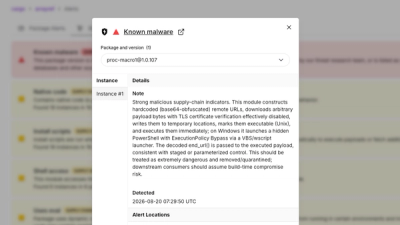
Three compromised Rust crates pulled in a malicious dependency that downloaded and executed cross-platform malware during Cargo builds.