
Research
/Security News
Popular npm Packages in the keyv and Cacheable Namespaces Compromised in Active Supply Chain Attack
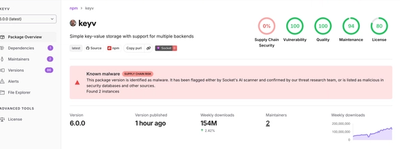
Popular npm packages keyv and cacheable compromised.
By Socket Research Team - Aug 04, 2026
@extentos/mcp-server
Advanced tools
Extentos MCP server — deterministic tools for building smart-glasses apps with AI agents.
MCP server for building Meta-glasses apps with Claude Code and other MCP-aware coding agents. Exposes a tight set of deterministic tools that prime the agent on what the glasses can do, return canonical SDK code patterns in Kotlin and Swift, scaffold a fresh project, and drive a browser-based simulator for testing without physical hardware.
The library itself is a pure Kotlin/Swift SDK — your handler code subscribes to capability primitives like glasses.audio.transcriptions(), glasses.camera.capturePhoto(), and glasses.audio.speak() directly. There is no spec runtime, no DSL, no manifest dispatch — the MCP server's job is to help an AI agent compose against the SDK quickly and correctly.
Register the server with Claude Code (or any MCP host) in one line:
claude mcp add extentos -- npx -y @extentos/mcp-server@latest
Restart Claude Code. /mcp should list extentos with all tools available.
Prerequisites: Node.js 20+ on PATH. That's it — npx fetches the package on first run and caches it.
The agent plans composition itself. Start with discovery, then scaffold, then write handler code.
Discovery (read these first; cheap, all local):
getPlatformInfo({ sections: ["version", "capabilities"], glasses: "meta_rayban" }) — what SDK features the glasses expose (transcription_incremental, capture_photo, speak, record_audio, …).getCapabilityGuide(feature) — per-feature minimal Kotlin + Swift snippet + gotchas. Read for each capability you plan to use.getCodeExample(pattern) — full canonical compositions. Start with assistant_agent_loop (the canonical voice-assistant flow) and agent_driven_e2e_full_loop (the agent-driven E2E test); the legacy compositions (voice Q&A, barge-in, photo + vision LLM + speak, live transcription UI, voice notes, connection-page bootstrap) are there too. Peel from these when writing your handler.searchDocs({ topic: "getting_started" }) — index of conceptual topics covering the connection state model, toggles, permissions, simulator behaviour, multi-platform projects, etc.Generation sequence (deterministic):
generateConnectionModule({ platform, glasses, appPackage }) — one-shot scaffold (bootstrap module, Gradle/SPM wiring, manifest, permissions). Returns a placement question the first time — surface it; the dev chooses where ExtentosConnectionPage should live.Application (Android) or @main App (iOS) using the patterns from getCodeExample.capabilities array with the SDK feature names your handler uses.validateIntegration — pre-test correctness gate. Re-run after structural changes.createSimulatorSession — provision a browser-hosted glasses surrogate.Iteration: rebuild + reinstall your app — the simulator picks up the new binary automatically thanks to auto-bind; the session URL is stable.
Debugging: getEventLog, getSimulatorStatus. Ship-readiness: getProductionChecklist. Credentials: getCredentialGuide (BYOK providers + Meta DAT registration).
createSimulatorSession call triggers the device-code flow — your agent surfaces a verification URL, you sign in once (Google or email, no payment), and simulator sessions are then unlimited. Discovery, scaffolding, and validation tools work without an account.createSimulatorSession returns the saved sim for (account, project, platform) if one already exists (status: "resumed"); first call from a project mints a new one (status: "active"). Saved sims live indefinitely on your account dashboard at https://extentos.com/s — Reset rotates the ID for a clean slate (resetFresh: true does the same from a tool call); Delete removes it. No 24-hour lifetime cap; sessions that go unused enter idle state and resume the moment the host app reconnects.127.0.0.1:31337/whoami localhost bridge. The running app auto-attaches to the saved sim on cold launch — no rebuild, no URL paste, no typed code in the happy path. Works on Android and iOS.com.extentos:glasses + com.extentos:glasses-ui) — it resolves from the default mavenCentral() repo, no extra setup.github.com/extentos/swift-glasses: add it with .package(url: "https://github.com/extentos/swift-glasses", from: "1.7.0") (products GlassesCore + GlassesUI). Both SDKs publish in lockstep. The same MCP tool surface and generated artifacts apply (extentos.session.plist instead of buildConfigField), and auto-bind works on iOS too.The MCP server is pre-1.0 (0.x) — APIs may shift between minor versions until the hardware test loop closes. The Android library line is 1.x on Maven Central. If you need reproducibility across sessions, pin to a specific version from the package's npm page instead of @latest.
MIT — see LICENSE. Issues and feedback: github.com/extentos/mcp-server.
FAQs
Extentos MCP server — deterministic tools for building smart-glasses apps with AI agents.
The npm package @extentos/mcp-server receives a total of 2,112 weekly downloads. As such, @extentos/mcp-server popularity was classified as popular.
We found that @extentos/mcp-server demonstrated a healthy version release cadence and project activity because the last version was released less than a year ago. It has 1 open source maintainer collaborating on the project.
Did you know?

Socket for GitHub automatically highlights issues in each pull request and monitors the health of all your open source dependencies. Discover the contents of your packages and block harmful activity before you install or update your dependencies.
Research
/Security News
Popular npm packages keyv and cacheable compromised.

Security News
A misconfiguration gave three Anthropic models internet access, and one, believing it was in a simulation, shipped a credential-stealing package to PyPI.

Security News
/Company News
Socket has joined the new Composer and Packagist sponsorship program as a launch sponsor, supporting the team that keeps PHP's package ecosystem secure.