
Product
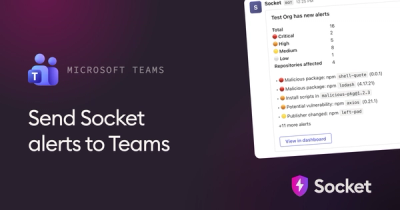
Microsoft Teams Notifications Are Now Available in Socket
Socket can now send alerts and supply chain attack notifications to Microsoft Teams, with filters that route the right updates to each channel.
By Jeppe Hasseriis - Sep 01, 2026
@fabriqa.ai/fabriqaoss
Advanced tools
Multi-agent orchestration system for AI-native software development. Delivers AI-DLC, Agile, and custom SDLC flows as markdown-based agent systems.
AI-native software development with multi-agent orchestration.
fabriqa-oss implements the AI-Driven Development Lifecycle (AI-DLC) methodology as a set of markdown-based agents that work with your favorite AI coding tools.


[!NOTE] Do not use npm if you want to always get the latest version. Use the npx command below.
npx @fabriqa.ai/fabriqaoss@latest install
The installer detects your AI coding tools (Claude Code, Cursor, GitHub Copilot) and sets up:
Open your AI Asisted Tool (Claude Code, Cursor, GitHub Copilot) and run the following commands:
# Start the Master Agent
/fabriqa-master-agent

# Then type:
project-init
This guides you through establishing:
/fabriqa-inception-agent intent-create
An Intent is your high-level goal:
The agent will:
# Plan bolts for your stories
/fabriqa-inception-agent bolt-plan

# Execute a bolt
/fabriqa-construction-agent bolt-start
Each bolt goes through validated stages:
Human validation happens at each stage gate.
AI-DLC is a reimagined software development methodology where AI drives the conversation and humans validate. Unlike traditional Agile where iterations span weeks, AI-DLC operates in Bolts - rapid iterations measured in hours or days.
"Traditional development methods were built for human-driven, long-running processes. AI-DLC reimagines the development lifecycle with AI as a central collaborator, enabling rapid cycles measured in hours or days rather than weeks."
| Aspect | Agile/Scrum | AI-DLC |
|---|---|---|
| Iteration duration | Weeks (Sprints) | Hours/days (Bolts) |
| Who drives | Human-driven, AI assists | AI-driven, human-validated |
| Design techniques | Out of scope | Integrated (DDD, TDD, BDD) |
| Task decomposition | Manual | AI-powered |
| Phases | Repeating sprints | Rapid three-phase cycles (Inception → Construction → Operations) |
| Rituals | Daily standups, retrospectives | Mob Elaboration, Mob Construction |
fabriqa-oss provides four specialized agents that guide you through the entire development lifecycle:
                    ┌─────────────────┐
                    │  Master Agent   │  Orchestrates & navigates
                    └────────┬────────┘
                             │
        ┌────────────────────┼────────────────────┐
        ▼                    ▼                    ▼
┌───────────────┐   ┌───────────────┐   ┌───────────────┐
│   Inception   │ → │ Construction  │ → │  Operations   │
│     Agent     │   │     Agent     │   │     Agent     │
└───────────────┘   └───────────────┘   └───────────────┘
  Capture intent      Execute bolts      Deploy & monitor
  Define units        Build & test       Verify & scale
  Plan stories        Validate stages
| Phase | Agent | Purpose | Key Outputs |
|---|---|---|---|
| Inception | Inception Agent | Capture intents, elaborate requirements, decompose into units | User stories, NFRs, Unit definitions, Bolt plans |
| Construction | Construction Agent | Execute bolts through domain design → logical design → code → test | Domain models, Technical designs, Code, Tests |
| Operations | Operations Agent | Deploy, verify, and monitor | Deployment units, Monitoring, Runbooks |
A high-level statement of purpose that encapsulates what needs to be achieved - whether a business goal, feature, or technical outcome. It serves as the starting point for AI-driven decomposition.
A cohesive, self-contained work element derived from an Intent. Units are loosely coupled and can be developed independently. Analogous to a Subdomain (DDD) or Epic (Scrum).
The smallest iteration in AI-DLC, designed for rapid implementation. Unlike Sprints (weeks), Bolts are hours to days. Each bolt encapsulates a well-defined scope of work.
| Type | Best For | Stages |
|---|---|---|
| DDD Construction | Complex business logic, domain modeling | Model → Design → ADR → Implement → Test |
| TDD Construction | Well-defined interfaces, test-first | Test → Implement → Refactor |
| BDD Construction | User-facing features, acceptance criteria | Scenario → Implement → Verify |
| Spike | Research, exploration, unknowns | Explore → Document |
File-based storage for all project artifacts. Maintains context across agent sessions and provides traceability between artifacts.
Project decisions that inform AI code generation. Standards ensure consistency across all generated code and documentation.
After installation:
.fabriqa/
├── manifest.yaml              # Installation manifest
└── aidlc/                     # AI-DLC flow
    ├── agents/                # Agent definitions
    ├── skills/                # Agent capabilities
    ├── templates/             # Artifact templates
    │   └── standards/         # Standards facilitation guides
    └── memory-bank.yaml       # Memory bank schema

memory-bank/                   # Created after project-init
├── intents/                   # Your captured intents
│   └── {intent-name}/
│       ├── requirements.md
│       ├── system-context.md
│       └── units/
├── bolts/                     # Bolt execution records
├── standards/                 # Project standards
│   ├── tech-stack.md
│   ├── coding-standards.md
│   └── ...
└── operations/                # Deployment context
/fabriqa-master-agent
| Command | Purpose |
|---|---|
project-init | Initialize project with standards |
analyze-context | View current project state |
route-request | Get directed to the right agent |
explain-flow | Learn about AI-DLC methodology |
answer-question | Get help with any fabriqa question |
/fabriqa-inception-agent
| Command | Purpose |
|---|---|
intent-create | Create a new intent |
intent-list | List all intents |
requirements | Elaborate intent requirements |
context | Define system context |
units | Decompose into units |
story-create | Create stories for a unit |
bolt-plan | Plan bolts for stories |
review | Review inception artifacts |
/fabriqa-construction-agent
| Command | Purpose |
|---|---|
bolt-start | Start/continue executing a bolt |
bolt-status | Check bolt progress |
bolt-list | List all bolts |
bolt-replan | Replan bolts if needed |
/fabriqa-operations-agent
| Command | Purpose |
|---|---|
build | Build the project |
deploy | Deploy to environment |
verify | Verify deployment |
monitor | Set up monitoring |
Built from the ground up for AI-driven development. AI-DLC is a reimagination based on first principles, not a retrofit of existing methods.
Validation at each stage catches errors early before they cascade downstream. Each validation transforms artifacts into rich context for subsequent stages.
DDD, TDD, and BDD are integral to the methodology - not optional add-ons. This addresses the "whitespace" in Agile that has led to quality issues.
Works with Claude Code, Cursor, GitHub Copilot, and other AI coding assistants. Markdown-based agents work anywhere.
Memory bank ensures AI agents have full project context across sessions. All artifacts are linked for backward and forward traceability.
| Tool | Status | Installation |
|---|---|---|
| Claude Code | Full support | Slash commands in .claude/commands/ |
| Cursor | Full support | Rules in .cursor/rules/ (.mdc format) |
| GitHub Copilot | Full support | Agents in .github/agents/ (.agent.md format) |
| Google Antigravity | Full support | Agents in .agent/agents/ |
Q: Agents don't seem to remember previous context? Each agent invocation starts fresh. Agents read context from the Memory Bank at startup. Ensure artifacts are saved after each step.
Q: How do I reset project state?
Clear the memory-bank/ directory to reset all artifacts. To remove fabriqa-oss entirely, delete the .fabriqa/ directory and tool-specific command files.
Q: Can I use fabriqa-oss with existing Agile workflows? AI-DLC is designed as a reimagination, not a retrofit. However, familiar concepts (user stories, acceptance criteria) are retained to ease transition.
Q: What project types is this suited for? fabriqa-oss is designed for building complex systems that demand architectural complexity, trade-off management, and scalability. Simpler systems may be better suited for low-code/no-code approaches.
MIT License - see LICENSE for details.
Built with AWS' AI-DLC methodology by the fabriqa team.
FAQs
Multi-agent orchestration system for AI-native software development. Delivers AI-DLC, Agile, and custom SDLC flows as markdown-based agent systems.
The npm package @fabriqa.ai/fabriqaoss receives a total of 4 weekly downloads. As such, @fabriqa.ai/fabriqaoss popularity was classified as not popular.
We found that @fabriqa.ai/fabriqaoss demonstrated a healthy version release cadence and project activity because the last version was released less than a year ago. It has 1 open source maintainer collaborating on the project.
Product
Socket can now send alerts and supply chain attack notifications to Microsoft Teams, with filters that route the right updates to each channel.
Security News
pnpm 12 rewrites the package manager in Rust, cutting install times by up to 90% while preserving pnpm 11 workflows and lockfiles.
Security News
Socket CTO Ahmad Nassri joins AppSec leaders at Black Hat to discuss active malware, package manager risks, and software supply chain defense.