
Security News
The Code You Didn't Write Is Still Yours to Defend
AI agents are pulling packages into environments no scanner is watching, creating exposure before security teams can see it.
By Brad Arkin - Jun 23, 2026
@filepad/mcp-server
Advanced tools
MCP server for Filepad Agent Access. Exposes Filepad workspaces as tools to Claude Desktop, Cursor, and other MCP clients.
MCP server for Filepad Agent Access. Exposes Filepad workspaces as tools to Claude Desktop, Cursor, Windsurf, and any other MCP-compatible client.
Model Context Protocol (MCP) is an open protocol for connecting AI assistants to external data sources and tools. This package implements an MCP server that speaks stdio JSON-RPC over Filepad Agent Access.
npm install -g @filepad/mcp-server
Requires Node.js 18+.
For first-time runtime setup, prefer the pairing CLI so you do not paste Agent Access secrets into chat:
npx -y @filepad/agent-connect pair ABC12345 --runtime openclaw
Pairing writes the MCP config and prints a concise pre-restart handoff. After
restarting or reloading your MCP host, call filepad_bootstrap.
Add to claude_desktop_config.json:
macOS: ~/Library/Application Support/Claude/claude_desktop_config.json
Windows: %APPDATA%\Claude\claude_desktop_config.json
{
  "mcpServers": {
    "filepad": {
      "command": "npx",
      "args": ["-y", "@filepad/mcp-server@latest"],
      "env": {
        "FILEPAD_BASE_URL": "https://app.filepad.ai/api",
        "FILEPAD_WORKSPACE_ID": "ws_xxxxxxxx-xxxx-xxxx-xxxx-xxxxxxxxxxxx",
        "FILEPAD_AGENT_KEY_ID": "ik_xxxxxxxx-xxxx-xxxx-xxxx-xxxxxxxxxxxx",
        "FILEPAD_AGENT_SECRET": "xxxxxxxxxxxxxxxxxxxxxxxxxxxxxxxxxxxxxxxxxxx"
      }
    }
  }
}
Restart Claude Desktop. Start with filepad_connect or filepad_bootstrap;
it returns identity, workspace, scopes, available RuntimeTools, agent home,
mailbox, recent outcomes, missing permissions, tool groups, and suggested
first actions in one response.
First prompt to send your agent:
Use Filepad now. Call filepad_connect first, read the bootstrap response, inspect the constitution and agent home, then tell me what you can do and what you recommend doing first.
For OpenClaw, Claude Code, Codex, Cursor, Windsurf, or custom agents, add the
runtime instruction pack from
docs/agent-access/runtime-native-onboarding.md
to the agent's native project rules, memory, skill, or instruction file. MCP
exposes tools; runtime instructions make Filepad part of the agent's startup
loop.
| Variable | Required | Description |
|---|---|---|
FILEPAD_BASE_URL | Yes | Filepad API base URL (e.g. https://app.filepad.ai/api) |
FILEPAD_WORKSPACE_ID | Yes | Workspace id (e.g. ws_...) |
FILEPAD_AGENT_KEY_ID | Yes | Agent Access key id (e.g. ik_...) |
FILEPAD_AGENT_SECRET | Yes | Agent Access secret (shown once on creation) |
| Tool | Scope | Description |
|---|---|---|
filepad_connect | None | Start-here onboarding/resume diagnostics with workspace identity, scopes, tools, agent home, mailbox, recent outcomes, and suggested first actions |
filepad_bootstrap | None | Alias for filepad_connect for MCP clients that look for bootstrap-style tools |
filepad_health | None | Check connection and report granted scopes |
filepad_list_tree | tools:call, env:read | Compatibility alias for canonical workspace file-tree listing |
filepad_read_file | tools:call, env:read | Compatibility alias for canonical workspace file reading |
filepad_search | tools:call, env:read | Compatibility alias for canonical workspace search |
filepad_create_artifact | tools:call, artifacts:direct_write | Compatibility alias for governed artifact creation |
filepad_create_artifact_from_file | tools:call, artifacts:direct_write | Read a local text/markdown file and create a governed artifact |
filepad_propose_edit | files:propose | Propose a reviewable edit |
filepad_emit_event | events.write | Emit an activity event |
filepad_create_signal | signals:write | Create a signal |
filepad_list_signals | env:read | Query visible workspace signals |
filepad_get_signal | env:read | Read one workspace signal by id |
filepad_ack_notification | notifications:read | Acknowledge mailbox notifications after processing |
filepad_get_profile | env:read | Read this integration's agent home profile files |
filepad_update_profile | env:read, files:propose | Propose a reviewable update to the agent profile |
gmail_search / gmail_get_message | tools:call, gmail:read | Read synced Gmail source records |
gmail_import_message | tools:call, gmail:write | Promote a synced Gmail source record into workspace knowledge through Temporal |
gmail_create_draft / gmail_send_with_approval | tools:call, gmail:write | Request governed Gmail outbound actions that wait for human approval |
Tools are automatically filtered by your key's granted scopes. If your key only has env:read, you will only see read tools. Provider tools such as Gmail are discovered from the backend canonical RuntimeTool catalog so MCP clients use the same policy path as FilepadAI and automations. Local filepad_* mutation helpers are compatibility aliases over the governed Agent Access/RuntimeTool path, not a separate write system.
The server also exposes:
filepad:// URIsfilepad://workspace/{workspaceId}/mailbox when notifications:read is grantedskills/*.md files in the workspaceagents/integrations/{keyId}/ for identity, learnings, goals, and timelineYou can also use the server class directly in your own code:
import { FilepadMcpServer } from '@filepad/mcp-server';

const server = new FilepadMcpServer({
  baseUrl: process.env.FILEPAD_BASE_URL!,
  workspaceId: process.env.FILEPAD_WORKSPACE_ID!,
  keyId: process.env.FILEPAD_AGENT_KEY_ID!,
  secret: process.env.FILEPAD_AGENT_SECRET!,
});

await server.initialize();

const response = await server.handleMessage({
  jsonrpc: '2.0',
  id: 1,
  method: 'tools/list',
  params: {},
});

console.log(response);
403MIT
FAQs
MCP server for Filepad Agent Access. Exposes Filepad workspaces as tools to Claude Desktop, Cursor, and other MCP clients.
We found that @filepad/mcp-server demonstrated a healthy version release cadence and project activity because the last version was released less than a year ago. It has 1 open source maintainer collaborating on the project.
Did you know?

Socket for GitHub automatically highlights issues in each pull request and monitors the health of all your open source dependencies. Discover the contents of your packages and block harmful activity before you install or update your dependencies.
Security News
AI agents are pulling packages into environments no scanner is watching, creating exposure before security teams can see it.

Security News
GitHub Actions checkout now blocks risky pull_request_target checkouts by default to help prevent pwn request supply chain attacks.
Product
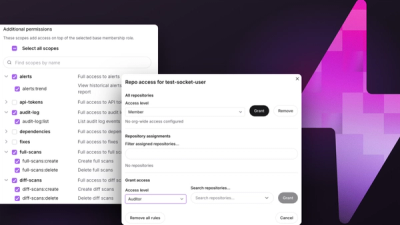
Socket now supports Custom Roles and Repository Access Permissions so organizations can control who can access specific repositories and actions.