Security News
Re-Enabled GitHub Actions Expose Thousands of Repositories to Mini Shai-Hulud
Two compromised GitHub Actions were re-enabled with malicious tags intact, exposing thousands of downstream repositories to Mini Shai-Hulud.
@fillgate/core
Advanced tools
Venue adapters with fee codes baked in, guardrails, fee ledger, geoblock. Zero runtime deps; venue SDKs are optional peers loaded lazily.
Venue adapters with fee codes baked in, plus the guardrails, fee ledger and geoblock that sit in
front of them. Zero runtime dependencies; venue SDKs (@solana/web3.js, @polymarket/clob-client-v2,
@nktkas/hyperliquid, viem) are optional peers, loaded lazily only for the venues you enable.
Most people want @fillgate/mcp — the MCP server
that exposes these adapters as tools to Claude and other agents. Use @fillgate/core directly only
if you are embedding the adapters in your own app.
import { loadConfig, enabledVenues, JsonlLedger } from '@fillgate/core'
const config = loadConfig(process.env) // reads DRY_RUN, MAX_NOTIONAL_USD, MAX_SLIPPAGE_BPS,
// RATE_LIMIT_PER_MIN, FILLGATE_VENUES, venue credentials
enabledVenues(config) // ['jupiter', ...] — only fully configured venues
const ledger = new JsonlLedger(config.ledgerPath) // daily YYYY-MM-DD.jsonl event files
ledger.readAll() // prepare / execute_attempt / fill / preview / guard_rejection
ledger.summary() // fills only — the fee-reconciliation view
Every money-moving path is two-step (prepare → execute) and passes through the guardrails in
guards.ts. DRY_RUN=true (the default) never broadcasts.
Docs: github.com/mineloop99/fillgate · MIT
FAQs
Venue adapters with fee codes baked in, guardrails, fee ledger, geoblock. Zero runtime deps; venue SDKs are optional peers loaded lazily.
We found that @fillgate/core demonstrated a healthy version release cadence and project activity because the last version was released less than a year ago. It has 1 open source maintainer collaborating on the project.

Security News
Two compromised GitHub Actions were re-enabled with malicious tags intact, exposing thousands of downstream repositories to Mini Shai-Hulud.

Research
/Security News
A malicious Firefox extension fetches its payload after installation to evade detection, steal Google session cookies, and automate account takeover.

Research
/Security News
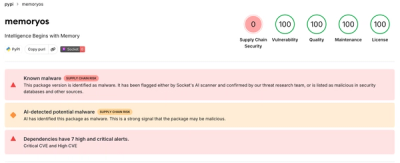
The compromise affects MemTensor's MemOS, an open source memory framework for large language models (LLMs) and AI agents. Both npm package @memtensor/memos-cloud-openclaw-plugin and the PyPI package MemoryOS are compromised. They drop cross-platform Go binaries that exfiltrate developer secrets.