
Research
/Security News
Miasma Mini Shai-Hulud Hits ImmobiliareLabs npm Packages
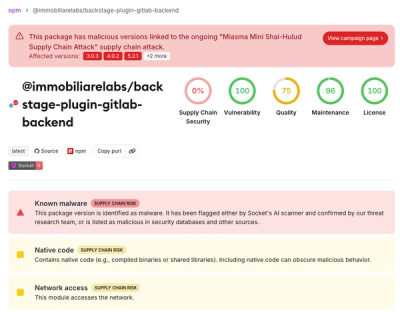
Miasma Mini Shai-Hulud hits @immobiliarelabs Backstage plugins, targeting GitLab and LDAP auth packages on npm.
By Socket Research Team - Jun 26, 2026
@frinkly/data-access
Advanced tools
@frinkly/data-access is a typescript library part of the Request Network protocol.
It is the default implementation of the Data Access layer. The Data Access layer is responsible for:
The indexing of the transactions is made by two mechanisms:
The channel in data-access allows to group several transactions under one string: the channel id.
This channel is indexed by several strings called topics.
There are two ways of getting transactions:
In the context of requests, all the transactions of a channel are the actions of a request. The channel id is the request id. It is possible to get a request from the request id thanks to this. The topics are for example, the identities of the stakeholders of the request. So, you can retrieve all the requests (channels) of an identity.
npm install @frinkly/data-access
import DataAccess from '@frinkly/data-access';
import { DataAccessTypes, SignatureTypes, StorageTypes } from '@frinkly/types';

// Any implementation of Storage layer, @frinkly/ethereum-storage for example
const storage: StorageTypes.IStorage;

const dataAccess = new DataAccess(storage);
await dataAccess.initialize();

const transactionData = JSON.stringify({
  attribut1: 'some value',
  attribut2: 'some other value',
});

const transactionDataSignature = {
  method: SignatureTypes.REQUEST_SIGNATURE_METHOD.ECDSA,
  value:
    '0xe649fdfe25c3ee33061a8159be9b941141121c5bed8d07664cb67b7912819b4539841a206636c190178ac58978926dad1fe3637a10b656705b71bda5e187510c1b',
};

const transaction: DataAccessTypes.ITransaction = {
  data: transactionData,
  signature: transactionDataSignature,
};

// Channel id is an identifer to group a list of transactions
const channelId = 'myRequest';

// Topics to index the channel
const channelTopics = ['stakeholder1', 'stakeholder2'];

const result = await dataAccess.persistTransaction(transaction, channelId, channelTopics);
import DataAccess from '@frinkly/data-access';
import { DataAccessTypes, SignatureTypes, StorageTypes } from '@frinkly/types';

const storage: StorageTypes.IStorage; // Any implementation of Storage layer, @frinkly/ethereum-storage for example

const dataAccess = new DataAccess(storage);
await dataAccess.initialize();

const transactionTopic = '010000000000000000000000000000000000000000';

const {
  result: { transactions },
} = await dataAccess.getTransactionsByTopic(transactionTopic);
import DataAccess from '@frinkly/data-access';
import { DataAccessTypes, SignatureTypes, StorageTypes } from '@frinkly/types';

const storage: StorageTypes.IStorage; // Any implementation of Storage layer, @frinkly/ethereum-storage for example

const dataAccess = new DataAccess(storage);
await dataAccess.initialize();

const topics = [
  '010000000000000000000000000000000000000000',
  '011111111111111111111111111111111111111111',
];

const {
  result: { transactions },
} = await dataAccess.getChannelsByMultipleTopics(topics);
import DataAccess from '@frinkly/data-access';
import { DataAccessTypes, SignatureTypes, StorageTypes } from '@frinkly/types';

const storage: StorageTypes.IStorage; // Any implementation of Storage layer, @frinkly/ethereum-storage for example

const dataAccess = new DataAccess(storage);
await dataAccess.initialize();

const channelId = 'myRequest';

const {
  result: { transactions },
} = await dataAccess.getTransactionsByChannelId(channelId);
Transactions are indexed with topics. When persisting a transaction on data-access, topics can be given as second parameters. These topics will allow retrieving transactions later. For example, each transaction made by @frinkly/request-logic are indexed with the requestId.
To save on costs, transactions are batched together. This is the responsibility of Data Access layer. This package creates blocks that are collections of transactions
In order to speed up recovery of transactions, data-access has a local cache of topics=>transaction. This is the reason why this package should be initialized with dataAccess.initialize() before being operational. This cache can be persisted in a file using a Keyv store.
Blocks can be added into the storage by other peers running their own data-access instance. Therefore, to remain consistent with the global state of the network, this package need to synchronize with these new blocks.dataAccess.synchronizeNewDataIds() allows to synchronize manually with all unsynchronized blocks. The synchronization can also be done automatically, dataAccess.startAutoSynchronization() allows to automatically synchronize with new blocks, the interval time between each synchronization can be defined in data-access constructor. dataAccess.stopAutoSynchronization() allows to stop automatic synchronization.
data-access implements the structure of the data on the blockchain.
The architecture is a sorted list of blocks. A block is a JSON (see packages/data-access/format/) object containing:
transactionsA transaction is an object containing the data as a string and the signature of these data. (the data will be the actions from the request logic layer)
{
   "header":{
      "index":{
         "0xaaaaaa":[
            0
         ],
         "0xccccccccccc":[
            0,
            1
         ],
         "0xe53f3ea2f5a8e5f2ceb89609a9c2fa783181e70f1a7508dccf5b770b846a6a8d":[
            0
         ],
         "0x320728cd4063b523cb1b4508c6e1627f497bde5cbd46b03430e438289c6e1d23":[
            1
         ]
      },
      "version":"0.1.0"
   },
   "transactions":[
      {
         "signature":{
            "method":"ecdsa",
            "value":"0x12345"
         },
         "transaction":"{\"attribut1\":\"plop\",\"attribut2\":\"value\"}"
      },
      {
         "signature":{
            "method":"ecdsa",
            "value":"0x12345"
         },
         "transaction":"{\"attribut1\":\"foo\",\"attribut2\":\"bar\"}"
      }
   ]
}
Pull requests are welcome. For major changes, please open an issue first to discuss what you would like to change. Read the contributing guide
FAQs
Main package for the Request Network data access layer.
We found that @frinkly/data-access demonstrated a not healthy version release cadence and project activity because the last version was released a year ago. It has 1 open source maintainer collaborating on the project.
Did you know?

Socket for GitHub automatically highlights issues in each pull request and monitors the health of all your open source dependencies. Discover the contents of your packages and block harmful activity before you install or update your dependencies.
Research
/Security News
Miasma Mini Shai-Hulud hits @immobiliarelabs Backstage plugins, targeting GitLab and LDAP auth packages on npm.

Security News
Rolldown paused Rust React Compiler integration after a 5MB binary size increase raised concerns about shipping React-specific code to all Vite users.

Security News
/Research
Mini Shai-Hulud expands into the Go ecosystem after hitting LeoPlatform npm packages and targeting GitHub Actions workflows.