


Security News
Federal Audit Finds NIST Wasted Funds With No Plan to Clear NVD Backlog
Federal audit finds NIST lacked a plan to clear the NVD backlog, wasted funds on duplicate work, and delayed use of CISA data.
By Sarah Gooding - Jun 03, 2026
@ftarganski/omni-ai
Advanced tools
Provider-agnostic AI agents and skills framework for TypeScript monorepos.
Configure any LLM provider — Anthropic, OpenAI, GitHub Copilot, Google Gemini, Groq, Ollama, or any self-hosted endpoint — and compose reusable agents for your projects via CLI or programmatic API.


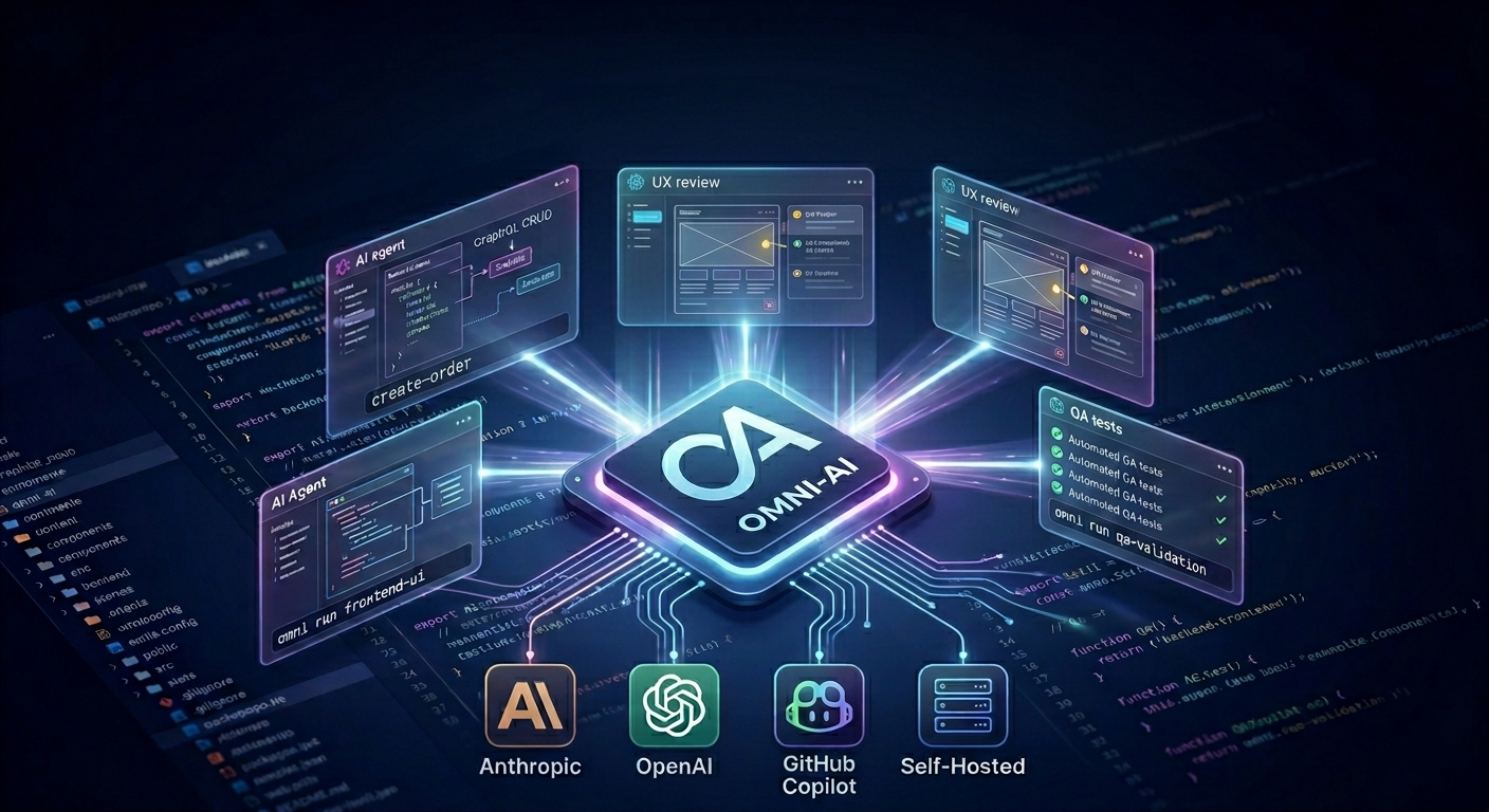
IProvidercd my-project
omni run backend-dev "create the orders module with CRUD and GraphQL"
│
▼
CLI (omni)
│ reads config/omni-ai.yaml ← provider, model, agentsDir
│ resolves "backend-dev" ← finds agents/**/*.yaml by name:
│ instantiates the provider ← AnthropicProvider / OpenAIProvider
│ builds the SkillRegistry ← read-file, write-file, search-code…
│ creates the Agent → agent.run()
│
└─ Agentic loop:
1. Sends systemPrompt + input to the LLM
2. LLM returns text or tool calls
3. Skills execute (read/write files in my-project/)
4. Results return to the LLM
5. Repeats until done or maxIterations reached
Skills always operate within the directory where you run the command (process.cwd()), never outside it.
npm install -g @ftarganski/omni-ai
omni init
The wizard asks for your provider and API key, then generates config/omni-ai.yaml and .env.
Or configure manually:
cp config/omni-ai.example.yaml config/omni-ai.yaml
cp .env.example .env
# edit both files with your provider and key
# enter your project directory
cd /path/to/my-project

# list available agents
omni list agents

# run an agent
omni run backend-dev "create the orders module with CRUD"

# chain agents in a pipeline
omni chain "create orders module" backend-schema backend-dev qa-backend
| Provider | Type | Key Required | Notes |
|---|---|---|---|
| GitHub Copilot | copilot | GitHub token | No separate account needed |
| Anthropic (Claude) | anthropic | Anthropic API key | Claude Opus, Sonnet, Haiku |
| OpenAI (GPT) | openai | OpenAI API key | GPT-4o, o1, o3-mini |
| Google Gemini | google | Google API key | Gemini 2.0 Flash, 1.5 Pro |
| Groq | groq | Groq API key | Llama, DeepSeek (free tier) |
| Ollama | ollama | None | Local models, no API key |
| Custom / Azure | custom | Varies | Any OpenAI-compatible endpoint |
GitHub Copilot (recommended if you already have a GitHub subscription):
# .env
GITHUB_TOKEN=ghp_...
# config/omni-ai.yaml
defaultProvider: copilot
providers:
  - name: copilot
    type: copilot
    apiKey: ${GITHUB_TOKEN}
    baseUrl: https://api.githubcopilot.com
    defaultModel: gpt-4o
Anthropic (Claude):
# .env
ANTHROPIC_API_KEY=sk-ant-api03-...
defaultProvider: anthropic
providers:
  - name: anthropic
    type: anthropic
    apiKey: ${ANTHROPIC_API_KEY}
    defaultModel: claude-sonnet-4-6
Multiple providers (each agent can use a different one):
defaultProvider: copilot
providers:
  - name: copilot
    type: copilot
    apiKey: ${GITHUB_TOKEN}
    defaultModel: gpt-4o

  - name: anthropic
    type: anthropic
    apiKey: ${ANTHROPIC_API_KEY}
    defaultModel: claude-sonnet-4-6

  - name: ollama
    type: ollama          # no API key required
    defaultModel: llama3.2
In any agent YAML, add provider: anthropic to override the default for that agent only.
omni run — Run a single agentomni run <agent> "<prompt>" [options]
| Option | Description |
|---|---|
--config <path> | Path to omni-ai.yaml (auto-detected by default) |
--session <id> | Session ID "resourceId:threadId" — enables SQLite memory across runs |
--output <file> | Save output to a file |
--verbose | Show each iteration, tool calls, and token count |
--stream | Stream tokens in real time |
omni run backend-dev "create the customers module with CRUD and GraphQL"
omni run frontend-dev "create the orders listing page with filters and pagination"
omni run ux-lead "audit the OrderForm component"
omni run qa-lead "validate all files in src/orders/"
omni run backend-dev "what did you implement in the last session?" --session dev1:orders
omni chain — Pipeline multiple agentsomni chain "<prompt>" <agent1> <agent2> [agent3...]
The output of each agent becomes the input of the next.
# Schema → implementation → validation
omni chain "create orders module" backend-schema backend-dev qa-backend

# Component generation + UX audit
omni chain "create orders listing page" frontend-dev ux-reviewer

# With output saved to file
omni chain "create customers module" backend-schema backend-dev qa-backend --output customers.md
Visual output:
◆ backend-schema  [anthropic / claude-sonnet-4-6]
  ... (3 iterations)

  ↓  output passed to: backend-dev

◆ backend-dev  [anthropic / claude-sonnet-4-6]
  ... (8 iterations)

  ↓  output passed to: qa-backend

◆ qa-backend  [anthropic / claude-sonnet-4-6]
  ... (4 iterations)

Tokens: 18,400 input · 5,200 output · ~$0.084
| Command | Description |
|---|---|
omni list agents | List all available agents with names and descriptions |
omni list skills | List all registered skills |
omni list providers | List registered providers and their types |
omni init | Interactive wizard to generate omni-ai.yaml and .env |
omni serve [--port N] | Start a local HTTP server (REST + SSE) to call agents via API |
omni watch <agent> "<prompt>" | Re-run an agent automatically on file changes |
omni eval <agent> <dataset.json> | Evaluate an agent against an (input, expected) dataset |
omni export <sessionId> | Export session history as Markdown or JSON |
omni mcp serve | Expose all registered skills as MCP tools over stdio |
| Agent | What it does |
|---|---|
backend-dev | Orchestrator — full NestJS feature: schema → service → resolver → listeners → tests |
backend-schema | DynamoDB OneTable schema with defineSchema() |
backend-service | NestJS service with CRUD, events, error helpers, caching |
backend-resolver | GraphQL resolver with federation pattern + SDL |
backend-listener | Event listeners with @OnEventCatcher |
backend-test | Jest integration tests with real local DynamoDB |
backend-atom-app | Atom framework connectors (sessions, ARNs, message routing) |
| Agent | What it does |
|---|---|
frontend-dev | Orchestrator — full React feature: route → components → hooks |
frontend-ui-component | Primitive UI components (shadcn/ui style, CVA + Radix) |
frontend-module-component | Feature components connected to data (TanStack Query) |
frontend-page-route | TanStack Router pages with responsive layouts |
frontend-custom-hook | Typed, SSR-safe custom React hooks |
| Agent | What it does |
|---|---|
ux-lead | Orchestrator — full UX audit across 10 dimensions, fixes critical issues |
ux-reviewer | Detailed UX review with findings by severity (Critical / Moderate / Low) |
ux-states | State components: Skeleton, Empty, Error, Success |
ux-forms | Forms with validation, autocomplete, accessibility, loading states |
ux-motion | Micro-interactions and transitions (always motion-safe:) |
| Agent | What it does |
|---|---|
qa-lead | Orchestrator — classifies files, delegates to specialists, emits merge verdict |
qa-frontend | Validates React/TypeScript: imports, Tailwind tokens, responsiveness, a11y |
qa-ux | Validates UX: feedback states, forms, motion, content tone |
qa-backend | Validates NestJS: services, resolvers, GraphQL schema, listeners, tests |
Skills are the tools agents call during the agentic loop. All operate within cwd — never outside the target project.
| Category | Subpath | Skills |
|---|---|---|
| Filesystem | /skills/fs | read-file, write-file, list-directory |
| Code | /skills/code | search-code (text/regex across TypeScript files) |
| UX | /skills/ux | audit-accessibility (heuristic a11y scan of TSX) |
| Git | /skills/git | git-status, git-diff, git-log, git-commit-message |
| HTTP | /skills/http | http-request (Bearer, Basic, OAuth2 client-credentials) |
| Multimodal | /skills/multimodal | analyze-image (screenshots, diagrams, mockups) |
| Backend | /skills/backend | find-code-pattern, analyze-nestjs-module, analyze-dynamo-schema, analyze-graphql-schema |
| Frontend | /skills/frontend | find-component-pattern, analyze-component, analyze-module-structure |
| QA | /skills/qa | find-test-pattern, analyze-test-coverage |
# First run — session is created and stored in ~/.omni-ai/sessions.db
omni run backend-dev "create the orders module with CRUD" --session dev1:orders

# Second run — agent loads session history as context
omni run backend-dev "add the search listener to the orders module" --session dev1:orders

# Query previous context
omni run backend-dev "which files did you create in the last session?" --session dev1:orders
Session ID format: "resourceId:threadId". Use resourceId for user/project and threadId for the feature or conversation.
import { createRuntime } from "@ftarganski/omni-ai";
import { SQLiteMemoryStore, ObservationMaskingCompactor } from "@ftarganski/omni-ai/memory";

const runtime = await createRuntime({ skills: [] });

// Simple run, no memory
const result = await runtime.run("backend-dev", "create the customers module");
console.log(result.output);

// With cross-session persistence
const store = new SQLiteMemoryStore({ path: "./sessions.db" });

const result2 = await runtime.run(
  "backend-dev",
  "add search to the customers module",
  {
    session: { resourceId: "user-42", threadId: "feature-customers" },
    memoryStore: store,
  }
);
Without compaction, each iteration re-sends the full history:
Iteration 1:  1,000 tokens
Iteration 2:  3,500 tokens
Iteration 3:  8,200 tokens    → Total: 26,700 tokens
Iteration 4: 14,000 tokens
With ObservationMaskingCompactor (zero LLM cost):
Iteration 1:  1,000 tokens
Iteration 2:  3,500 tokens
Iteration 3:  1,800 tokens    ← old tool results masked
Iteration 4:  2,100 tokens    → Total: 8,400 tokens  (68% reduction)
| Compactor | Strategy | LLM calls | Best for |
|---|---|---|---|
ObservationMaskingCompactor | Replaces old tool result bodies with [masked ~N tokens] | 0 | File-intensive agents |
SummaryCompactor | LLM summarizes old messages, keeps N recent verbatim | 1 per trigger | Long conversations, multi-step reasoning |
import { createRuntime, parallel } from "@ftarganski/omni-ai";
import { readFileSkill, writeFileSkill } from "@ftarganski/omni-ai/skills/fs";
import { searchCodeSkill } from "@ftarganski/omni-ai/skills/code";

const runtime = await createRuntime({
  skills: [readFileSkill, writeFileSkill, searchCodeSkill],
});

// Single agent run
const result = await runtime.run("backend-dev", "create the invoices module");
console.log(`Done in ${result.iterations} iterations`);
console.log(result.output);

// Run multiple agents in parallel
const outcome = await parallel(runtime, {
  agents: ["backend-dev", "qa-backend", "ux-reviewer"],
  input: "review the orders module for quality, tests, and accessibility",
});

for (const [agent, res] of Object.entries(outcome.results)) {
  if ("error" in res) console.error(`${agent}: ${res.error}`);
  else console.log(`${agent} (${res.iterations} iterations):\n${res.output}`);
}
# agents/my-domain/my-agent.yaml
name: my-agent
description: What this agent does in one line
# provider: anthropic   # optional — inherits defaultProvider
# model: gpt-4o-mini    # optional — inherits defaultModel
systemPrompt: |
  You are a specialist in...
  Describe constraints, output format, and behavior.
skills:
  - read-file
  - search-code
  - write-file
maxIterations: 10
temperature: 0.2
Available immediately via omni run my-agent "..." — no rebuild required.
import type { ISkill } from "@ftarganski/omni-ai";
import { z } from "zod";

const InputSchema = z.object({
  query: z.string().describe("Search term"),
});

export const myDatabaseSkill: ISkill<z.infer<typeof InputSchema>, string[]> = {
  name: "search-database",
  description: "Searches records in an external database",

  async execute(input) {
    const { query } = InputSchema.parse(input);
    return await fetchFromExternalApi(query);
  },
};

// Register when creating the runtime
const runtime = await createRuntime({ skills: [myDatabaseSkill] });
import type { IProvider, CompletionRequest, CompletionResponse } from "@ftarganski/omni-ai";
import { registerProvider } from "@ftarganski/omni-ai";

class MyProvider implements IProvider {
  readonly name: string;
  readonly capabilities = {
    chat: true, embedding: false, streaming: false, toolUse: true, vision: false,
  };

  constructor(private readonly config: { apiKey: string; name: string }) {
    this.name = config.name;
  }

  async complete(request: CompletionRequest): Promise<CompletionResponse> {
    const response = await callMyApi(request);
    return {
      content: response.text,
      toolCalls: [],
      usage: { inputTokens: response.in, outputTokens: response.out },
      model: request.model ?? "my-model",
      provider: this.name,
    };
  }
}

registerProvider("my-provider", (config) => new MyProvider(config));
# config/omni-ai.yaml
providers:
  - name: my-provider
    type: my-provider
    apiKey: ${MY_API_KEY}
    defaultModel: my-model-v1
Configurable interception around every skill call — logging, rate-limiting, caching, auditing.
import type { SkillMiddlewareFn } from "@ftarganski/omni-ai";

const loggingMiddleware: SkillMiddlewareFn = async (name, input, ctx, next) => {
  console.time(`skill:${name}`);
  const result = await next();
  console.timeEnd(`skill:${name}`);
  return result;
};

const result = await runtime.run("backend-dev", "review src/", {
  middleware: [loggingMiddleware],
});
Expose skills as MCP tools:
import { createMcpServer } from "@ftarganski/omni-ai/mcp";
import { StdioServerTransport } from "@modelcontextprotocol/sdk/server/stdio.js";
import { readFileSkill, writeFileSkill } from "@ftarganski/omni-ai/skills/fs";

const server = createMcpServer([readFileSkill, writeFileSkill], { name: "omni-ai" });
await server.connect(new StdioServerTransport());
Or via CLI:
omni mcp serve
Claude Desktop integration (claude_desktop_config.json):
{
  "mcpServers": {
    "omni-ai": {
      "command": "omni",
      "args": ["mcp", "serve"]
    }
  }
}
Consume an external MCP server as skills:
import { connectMcpSkills } from "@ftarganski/omni-ai/mcp";
import { StdioClientTransport } from "@modelcontextprotocol/sdk/client/stdio.js";

const transport = new StdioClientTransport({ command: "npx", args: ["-y", "@my/mcp-server"] });
const mcpSkills = await connectMcpSkills(transport);

const runtime = await createRuntime({ skills: mcpSkills });
import type {
  IProvider, ISkill, IAgent, IMemoryStore,
  CompletionRequest, CompletionResponse,
  AgentConfig, AgentRunOptions, AgentRunResult,
  SessionId, SkillMiddlewareFn,
} from "@ftarganski/omni-ai";

interface IProvider {
  readonly name: string;
  readonly capabilities: ProviderCapabilities;
  complete(request: CompletionRequest): Promise<CompletionResponse>;
  embed?(request: EmbeddingRequest): Promise<EmbeddingResponse>;
}

interface ISkill<TInput = unknown, TOutput = unknown> {
  readonly name: string;
  readonly description: string;
  execute(input: TInput, ctx: SkillContext): Promise<TOutput>;
}

interface AgentConfig {
  name: string;
  description: string;
  provider?: string;        // optional — inherits defaultProvider
  model?: string;           // optional — inherits defaultModel
  systemPrompt: string;
  skills?: string[];
  maxIterations?: number;   // default: 10
  temperature?: number;
  middleware?: SkillMiddlewareFn[];
}

interface AgentRunOptions {
  input: string;
  context?: Record<string, unknown>;
  session?: SessionId;
  onToken?: (chunk: string) => void;  // enables real-time token streaming
}

interface AgentRunResult {
  output: string;
  iterations: number;
  usage?: { inputTokens: number; outputTokens: number };
}

interface SessionId {
  resourceId: string;  // stable identifier (e.g. user ID, workspace ID)
  threadId: string;    // conversation or feature identifier
}
@ftarganski/omni-ai              ← core: Agent, Runtime, ISkill, IProvider…
@ftarganski/omni-ai/skills/fs    ← read-file, write-file, list-directory
@ftarganski/omni-ai/skills/code  ← search-code
@ftarganski/omni-ai/skills/ux    ← audit-accessibility
@ftarganski/omni-ai/skills/git   ← git-diff, git-log, git-status, git-commit-message
@ftarganski/omni-ai/skills/http  ← http-request
@ftarganski/omni-ai/skills/multimodal  ← analyze-image
@ftarganski/omni-ai/skills/backend    ← analyze-dynamo-schema, analyze-graphql-schema…
@ftarganski/omni-ai/skills/frontend   ← analyze-component, analyze-module-structure…
@ftarganski/omni-ai/skills/qa         ← analyze-test-coverage, find-test-pattern
@ftarganski/omni-ai/memory       ← SQLiteMemoryStore, SemanticMemoryStore, compactors, VectorIndex
@ftarganski/omni-ai/mcp          ← createMcpServer, connectMcpSkills
@ftarganski/omni-ai/provider-anthropic  ← AnthropicProvider
@ftarganski/omni-ai/provider-openai     ← OpenAIProvider (+ Copilot, Groq, Ollama)
@ftarganski/omni-ai/provider-google     ← GoogleProvider
bin: omni                               ← full CLI
omni: command not found
The CLI is not globally linked. Run npm install -g @ftarganski/omni-ai.
Provider "anthropic" not found in config
config/omni-ai.yaml does not exist or does not declare the provider. Run omni init.
Error: ANTHROPIC_API_KEY is not set
The environment variable is not loaded. Verify .env exists and contains the key. The CLI loads .env automatically.
maxIterations exceeded
The agent hit the iteration limit without finishing. Increase maxIterations in the agent YAML or make the prompt more specific.
High token consumption
Use ObservationMaskingCompactor via the programmatic API. Reduces context by up to 70% for file-intensive agents.
Access denied: path resolves outside the working directory
The agent attempted to access a file outside cwd. Run the command from inside the target project directory.
Build fails with Cannot find module
A referenced package has not been built yet. Run pnpm build at the root.
MIT — © Francis Targanski
FAQs
Provider-agnostic AI agents and skills framework
The npm package @ftarganski/omni-ai receives a total of 674 weekly downloads. As such, @ftarganski/omni-ai popularity was classified as not popular.
We found that @ftarganski/omni-ai demonstrated a healthy version release cadence and project activity because the last version was released less than a year ago. It has 1 open source maintainer collaborating on the project.
Did you know?

Socket for GitHub automatically highlights issues in each pull request and monitors the health of all your open source dependencies. Discover the contents of your packages and block harmful activity before you install or update your dependencies.
Security News
Federal audit finds NIST lacked a plan to clear the NVD backlog, wasted funds on duplicate work, and delayed use of CISA data.
Research
/Security News
A mini Shai-Hulud campaign compromised Red Hat Cloud Services npm packages to steal developer and CI/CD secrets during installation.
Research
/Security News
The North Korean malware loader hides in a Packagist-listed package and its GitHub branch to fetch and execute remote code in a likely Contagious Interview-style lure.