
Product
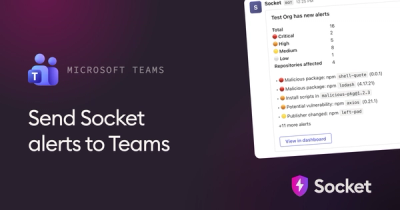
Microsoft Teams Notifications Are Now Available in Socket
Socket can now send alerts and supply chain attack notifications to Microsoft Teams, with filters that route the right updates to each channel.
By Jeppe Hasseriis - Sep 01, 2026
@guolei1994/tool
Advanced tools
A toolbox for opencode: declarative provider definitions and one-command installs on any machine
A toolbox for opencode: declarative provider definitions, installed on any machine with one command. No config file editing, no hardcoded provider IDs.
npx @guolei1994/tool
Or install the CLI globally for repeat runs:
npm install -g @guolei1994/tool
oct
Then restart opencode. The provider appears in the model picker:
opencode models kuaipao
kuaipao/gpt-5.4
kuaipao/gpt-5.4-mini
kuaipao/gpt-5.5
kuaipao/gpt-5.6-sol
kuaipao/gpt-5.6-terra
Note: models are only listed if the provider currently serves them. Kuaipao removed
gpt-5.6-luna; any stale picker entry for it fails with HTTP 503model_not_found. If you see a dead model, update the provider file or use thepiscript (toolbox pi fix) which syncs live model lists.
The same menu includes Manage Codex endpoints, with built-in templates for
RawChat, OpenCode Go, and DeepSeek. API keys are never included in the package:
enter a key only when first selecting an endpoint. Keys are saved in local
~/.codex/endpoints.json and written into each endpoint's
[model_providers.<id>] section in ~/.codex/config.toml as
experimental_bearer_token. Endpoint sections are only ever added or updated,
never deleted, so any number of endpoints can coexist in one config. Endpoints
without a saved key fall back to their environment variable
(RAWCHAT_API_KEY, CODEX_API_KEY, DEEPSEEK_API_KEY; custom endpoints
default to CODEX_API_KEY). The config is parsed with smol-toml, modified
as a TOML object, and serialized back; existing keys and sections are
preserved, but comments and manual formatting in config.toml are not kept
across a switch. Switching an endpoint only updates the root
model_provider / model / model_catalog_json values (model_catalog_json
is written as a relative per-endpoint file such as deepseek.json, resolved
by Codex against ~/.codex). GPT models (gpt-*) do not need a model
catalog, so the model_catalog_json line is only written for non-GPT models
like deepseek-v4-flash; switching to a GPT endpoint removes a stale catalog
line from the root config.
Switching an endpoint installs all known endpoints into
~/.codex/config.toml under [model_providers.<id>] and writes one profile
file per endpoint: ~/.codex/<id>.config.toml. Start Codex with:
codex --profile <id>
Running plain codex keeps using the most recently switched endpoint.
Endpoints that need custom model metadata (OpenCode Go, DeepSeek) also get the
packaged catalog installed to a per-endpoint file such as
~/.codex/opencode-go.json or ~/.codex/deepseek.json, with a matching
model_catalog_json entry written into the profile, so Codex uses the
correct model metadata instead of fallback defaults.
| Command | Description |
|---|---|
oct | Interactive: pick providers to install or scripts to run |
oct <script> | Run a script directly (optional) |
oct list | List providers and scripts |
oct --force | Overwrite local edits |
OPENCODE_CONFIG_DIR=/x oct | Install into a custom config dir |
oct pi ... | Manage the pi coding agent's default provider/model pair |
Interactive selection mixes both kinds — providers are marked [p], scripts
[s]. Pick a number to install a provider or run a script; a does all:
$ oct
Available:
  1) [p] kuaipao
  2) [p] rawchat
  3) [s] hello
Select (numbers, e.g. 1,2 | a = all | q = quit): 1,3
+ C:\Users\you\.config\opencode\plugins\provider-registry.js
+ C:\Users\you\.config\opencode\providers\kuaipao.json
hello from toolbox (configDir: C:\Users\you\.config\opencode)
pi stores the default model as two separate settings (defaultProvider +
defaultModel). Switching only one leaves a dead pair — e.g. provider=kuaipao
with model=deepseek-v4-flash gets rejected with HTTP 503 model_not_found, and
pi silently falls back to the old model. oct pi switch always writes both
fields together and validates the model against the provider's live model
list first:
$ oct pi list                       # current default + live model sources
$ oct pi models kuaipao             # live API model list for a provider
$ oct pi switch kuaipao gpt-5.6-terra   # set provider+model atomically
$ oct pi switch kuaipao gpt-5.6-luna    # REJECTED: luna is no longer served
$ oct pi fix --apply                # migrate a dead default to a live model
$ oct pi install-ext                # install missing pi provider extensions
provider-registry.js) is copied into
~/.config/opencode/plugins/ and auto-loaded at startup (no plugin:
entry needed in opencode.json).~/.config/opencode/providers/<id>.json.--force.Add a JSON file to providers/ in this package, then republish and re-run
oct on each machine. For a machine-local one-off provider, just drop the
file into ~/.config/opencode/providers/ yourself:
{
  "npm": "@ai-sdk/openai",
  "name": "My Endpoint",
  "options": {
    "baseURL": "https://example.com/v1"
  },
  "models": {
    "my-model": {
      "name": "My Model",
      "reasoning": true,
      "tool_call": true,
      "limit": { "context": 128000, "output": 65536 },
      "modalities": { "input": ["text"], "output": ["text"] }
    }
  }
}
Scripts are plain .mjs modules in scripts/ of this package. The filename
is the command name. Run them on any machine with:
oct <script-name> [args...]
Convention: export a default async function; it receives the positional arguments and a context object:
// scripts/hello.mjs
export default async function hello(args, { configDir }) {
  console.log(`hello from toolbox (configDir: ${configDir})`)
}
Scripts can import anything from node: built-ins (or add dependencies to
package.json). Republish and every machine gets the new script via
npx @guolei1994/tool <name>.
npm version patch
npm stage publish
Then approve the staged version on the npm website (Staged Packages page).
MIT
FAQs
A toolbox for opencode: declarative provider definitions and one-command installs on any machine
The npm package @guolei1994/tool receives a total of 34 weekly downloads. As such, @guolei1994/tool popularity was classified as not popular.
We found that @guolei1994/tool demonstrated a healthy version release cadence and project activity because the last version was released less than a year ago. It has 1 open source maintainer collaborating on the project.
Product
Socket can now send alerts and supply chain attack notifications to Microsoft Teams, with filters that route the right updates to each channel.

Security News
pnpm 12 rewrites the package manager in Rust, cutting install times by up to 90% while preserving pnpm 11 workflows and lockfiles.

Security News
Socket CTO Ahmad Nassri joins AppSec leaders at Black Hat to discuss active malware, package manager risks, and software supply chain defense.