

Security News
Federal Audit Finds NIST Wasted Funds With No Plan to Clear NVD Backlog
Federal audit finds NIST lacked a plan to clear the NVD backlog, wasted funds on duplicate work, and delayed use of CISA data.
By Sarah Gooding - Jun 03, 2026
@hazeljs/messaging
Advanced tools
Multichannel messaging for HazelJS - WhatsApp, Telegram, Viber with LLM-powered bot responses
Multichannel messaging for HazelJS: WhatsApp, Telegram, Viber with LLM-powered bot responses.



IncomingMessage / OutgoingMessage@hazeljs/ai providers (OpenAI, Anthropic, etc.) for conversational responsesnpm install @hazeljs/messaging @hazeljs/ai @hazeljs/core
For Redis context (horizontal scaling):
npm install ioredis
For Kafka async processing (horizontal scaling):
npm install @hazeljs/kafka
For Viber support:
npm install viber-bot
import { HazelApp } from '@hazeljs/core';
import { MessagingModule } from '@hazeljs/messaging';
import { OpenAIProvider } from '@hazeljs/ai';

const app = new HazelApp({
  imports: [
    MessagingModule.forRoot({
      aiProvider: new OpenAIProvider(process.env.OPENAI_API_KEY),
      systemPrompt: 'You are a helpful support assistant. Keep responses concise.',
      model: 'gpt-4o-mini',
      channels: {
        telegram: { botToken: process.env.TELEGRAM_BOT_TOKEN! },
        whatsapp: {
          accessToken: process.env.WHATSAPP_ACCESS_TOKEN!,
          phoneNumberId: process.env.WHATSAPP_PHONE_NUMBER_ID!,
        },
      },
    }),
  ],
});

app.listen(3000);
For horizontal scalability, use Redis for context and Kafka for async processing:
import Redis from 'ioredis';

MessagingModule.forRoot({
  aiProvider: new OpenAIProvider(),
  channels: { telegram: { botToken: process.env.TELEGRAM_BOT_TOKEN! } },
  redis: {
    host: process.env.REDIS_HOST ?? 'localhost',
    port: parseInt(process.env.REDIS_PORT ?? '6379', 10),
    password: process.env.REDIS_PASSWORD,
    ttlSeconds: 86400, // 24h
  },
  kafka: {
    brokers: (process.env.KAFKA_BROKERS ?? 'localhost:9092').split(','),
  },
});
| Channel | Method | URL |
|---|---|---|
| Telegram | POST | /api/messaging/webhook/telegram |
| GET | /api/messaging/webhook/whatsapp (verification) | |
| POST | /api/messaging/webhook/whatsapp | |
| Viber | POST | /api/messaging/webhook/viber |
aiProvider – IAIProvider from @hazeljs/ai (e.g. OpenAIProvider)systemPrompt – System prompt for the LLMmodel – Model name (default: gpt-4o-mini)temperature – 0–1 (default: 0.7)maxTokens – Max response tokens (default: 500)maxContextTurns – Conversation turns to keep (default: 10)customHandler – Override LLM with a custom (msg) => string | Promise<string>channels – Channel config (see below)WHATSAPP_VERIFY_TOKEN in env for webhook verificationaccessToken, phoneNumberId from Meta for Developershttps://api.telegram.org/bot<token>/setWebhook?url=https://your-domain/api/messaging/webhook/telegramnpm install viber-botUse a knowledge base to ground responses. Compatible with @hazeljs/rag RAGService:
import { RAGService } from '@hazeljs/rag';
// ... set up RAGService with vector store, embeddings, etc.

MessagingModule.forRoot({
  aiProvider: new OpenAIProvider(),
  ragService: myRAGService,
  ragTopK: 5,
  ragMinScore: 0.5,
  channels: { telegram: { botToken: process.env.TELEGRAM_BOT_TOKEN! } },
});
Wire your CSRService or AgentRuntime for full control—tools, RAG, external lookups:
import { MessagingModule } from '@hazeljs/messaging';
import { CSRService } from './csr'; // your CSRService like hazeljs-csr-example

const csrService = new CSRService(...);

MessagingModule.forRoot({
  agentHandler: async ({ message, sessionId }) => {
    const result = await csrService.chat(message.text, sessionId, message.userId);
    return { response: result.response, sources: result.sources };
  },
  channels: { telegram: { botToken: process.env.TELEGRAM_BOT_TOKEN! } },
});
The agent handler receives { message, sessionId, conversationTurns } and can:
AgentRuntime.execute() with tools and RAGstring or { response, sources }MessagingModule.forRoot({
customHandler: async (msg) => {
if (msg.text === '/help') return 'Available commands: /help, /status';
return 'Use /help for commands.';
},
});
Implement IChannelAdapter and register via providers.
FAQs
Multichannel messaging for HazelJS - WhatsApp, Telegram, Viber with LLM-powered bot responses
We found that @hazeljs/messaging demonstrated a healthy version release cadence and project activity because the last version was released less than a year ago. It has 1 open source maintainer collaborating on the project.
Did you know?

Socket for GitHub automatically highlights issues in each pull request and monitors the health of all your open source dependencies. Discover the contents of your packages and block harmful activity before you install or update your dependencies.
Security News
Federal audit finds NIST lacked a plan to clear the NVD backlog, wasted funds on duplicate work, and delayed use of CISA data.
Research
/Security News
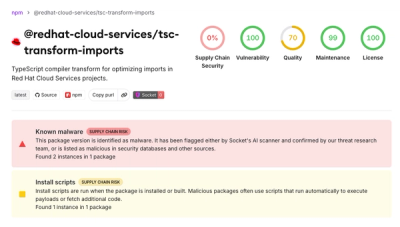
A mini Shai-Hulud campaign compromised Red Hat Cloud Services npm packages to steal developer and CI/CD secrets during installation.

Research
/Security News
The North Korean malware loader hides in a Packagist-listed package and its GitHub branch to fetch and execute remote code in a likely Contagious Interview-style lure.