

Product
PHP and Composer Support Is Now in Beta
Socket’s PHP and Composer support is now in Beta for all customers, with PHP reachability analysis generally available.
By Trevor Norris, Benjamin Barslev - Aug 21, 2026
The official Hlix Model Context Protocol server. It exposes a deliberately
bounded set of project, task, cycle, comment, and review tools through the
same authenticated @hlix/sdk used by the CLI.
Node.js 22.13 or newer is required by Mastra's MCP runtime. The Hlix CLI and SDK retain their Node.js 20 floor.
MCP clients launch the server themselves — see the configuration below. There is nothing to install by hand.
Run the normal CLI setup once:
hlix auth login --workspace <workspace-id>
hlix import .
When an MCP client launches the server from that project, it reuses the
owner-only CLI credential and imported .hlix/config.json project binding. The MCP configuration
contains no API key.
For CI or a global MCP configuration, set HLIX_API_KEY and
HLIX_WORKSPACE_ID. HLIX_BASE_URL and HLIX_PROJECT_ID are optional.
{
  "mcpServers": {
    "hlix": {
      "command": "npx",
      "args": ["-y", "@hlix/mcp@0.2.0"]
    }
  }
}
Cursor stores project configuration in .cursor/mcp.json. Claude Code can use
the repository-level .mcp.json. Restart the client or begin a new agent
session after adding the server.
The default server is read-only. It can list and read projects, tasks, cycles, comments, and verified review evidence.
To expose the bounded additive tools that create tasks, add comments, and propose cycles, opt in when the server process starts:
{
  "mcpServers": {
    "hlix": {
      "command": "npx",
      "args": ["-y", "@hlix/mcp@0.2.0"],
      "env": {
        "HLIX_MCP_ALLOW_WRITES": "1"
      }
    }
  }
}
Tool annotations and host confirmation dialogs are advisory. The startup flag
is the enforcement boundary: without the exact value 1, mutation tools do not
exist. Even in write mode, the server does not expose project deletion, the
project-start endpoint, invoice actions, arbitrary task-status mutation, bundle
import, protected files, local paths, or command execution. Proposing a cycle
to an active autonomous project can resume planning and lead to task dispatch.
FAQs
Official Hlix MCP server for project, task, cycle, and review workflows.
We found that @hlix/mcp demonstrated a healthy version release cadence and project activity because the last version was released less than a year ago. It has 1 open source maintainer collaborating on the project.
Product
Socket’s PHP and Composer support is now in Beta for all customers, with PHP reachability analysis generally available.
Product
Socket is bringing experimental protection to Firefox, scanning 97,000+ extensions in Mozilla's official directory for malware and risky updates.
Research
/Security News
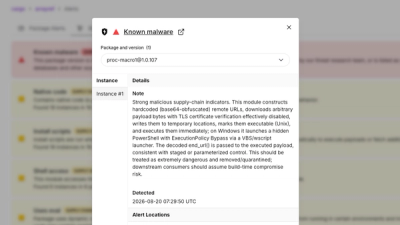
Three compromised Rust crates pulled in a malicious dependency that downloaded and executed cross-platform malware during Cargo builds.