

Company News
AWS Security Hub Adds Socket for Supply Chain Security
Socket is now in the AWS Security Hub Extended plan. Adopt it through AWS, apply committed spend, and block malicious open source packages.
By Feross Aboukhadijeh - Aug 04, 2026
@honcho-ai/paperclip-honcho
Advanced tools
Add Honcho memory to Paperclip while keeping Paperclip as the system of record.
This package targets the current public/latest Paperclip host surface. It supports tools, sync, migration import, and manual prompt previews without depending on automatic prompt-context injection hooks, run transcript import, or legacy workspace file import.
Instance Settings -> Plugins.Install Plugin.@honcho-ai/paperclip-honcho.Self-hosted / local and set the base URL.
localhost reliably. This can be fixed via a tunnel to the port Honcho runs on.Honcho API Key field.
ctx.secrets.resolve) is currently disabled platform-wide pending company-scoped plugin config upstream, so this field is used as a literal value rather than a secret reference. Do not treat it as more protected than plaintext plugin config.HONCHO_API_KEY environment variable (and optionally HONCHO_API_BASE_URL) on the plugin worker process instead.~/.honcho/config.json those tools already use.Save settings.Initialize Honcho memory.Paperclip memory is organized around company, issue, and agent boundaries:
The current plugin exposes explicit observation settings:
observe_me defaults to trueobserve_others defaults to trueThat means agent peers can both be observed by Honcho and form representations of other peers they interact with.
honcho_get_hierarchy_context is available, but delegated-work context depends on the Paperclip host providing lineage metadata. The tool degrades gracefully when that metadata is unavailable.
Prompt context is still conservative on the public-host-compatible path. The recommended starting configuration keeps enablePromptContext: false, and operators use manual prompt previews instead of relying on automatic injection hooks.
The integration breaks down into four parts:
Memory tab.The current operator flow is intentionally narrow:
| Action | What it does |
|---|---|
Save settings | Persists the current plugin configuration after validation. |
Initialize Honcho memory | Validates config, tests the Honcho connection, creates core mappings, imports baseline issue memory, and verifies the initialization path. |
Resync this issue | Replays sync for the current issue from the issue Memory tab. |
| Setting | Default | Use when |
|---|---|---|
honchoApiKey | — | Required for cloud-based setups. Leave it unset for local development. |
honchoApiBaseUrl | https://api.honcho.dev | Override this for self-hosted or non-default Honcho deployments. |
workspacePrefix | paperclip | Change this if you want a different workspace namespace. |
syncIssueComments | true | Turn this off if you do not want comment history imported into Honcho. |
syncIssueDocuments | true | Turn this off if you do not want issue document revisions imported. |
enablePeerChat | true | Required for the peer chat tool surface. |
enablePromptContext | false | Keep this off on the public-host-compatible path and use manual prompt previews instead. |
observe_me | true | Controls whether agent peers are observed by Honcho. |
observe_others | true | Controls whether agent peers form representations of other peers they interact with. |
The plugin also accepts additional advanced fields in the settings page, including noise-pattern and metadata-strip controls. Most setups can ignore those and start with the defaults above.
The plugin registers the following Honcho tools for Paperclip agents:
honcho_get_issue_contexthoncho_search_memoryhoncho_search_messageshoncho_search_conclusionshoncho_get_workspace_contexthoncho_get_sessionhoncho_get_agent_contexthoncho_get_hierarchy_contexthoncho_ask_peerpnpm install
pnpm build
pnpm test
pnpm typecheck
This repo keeps dist/ checked in so local path installs and tarball validation work without extra publish-time build assumptions.
FAQs
Honcho memory integration for Paperclip
The npm package @honcho-ai/paperclip-honcho receives a total of 20 weekly downloads. As such, @honcho-ai/paperclip-honcho popularity was classified as not popular.
We found that @honcho-ai/paperclip-honcho demonstrated a healthy version release cadence and project activity because the last version was released less than a year ago. It has 2 open source maintainers collaborating on the project.
Did you know?

Socket for GitHub automatically highlights issues in each pull request and monitors the health of all your open source dependencies. Discover the contents of your packages and block harmful activity before you install or update your dependencies.
Company News
Socket is now in the AWS Security Hub Extended plan. Adopt it through AWS, apply committed spend, and block malicious open source packages.
Research
/Security News
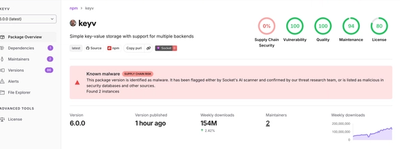
Popular npm packages keyv and cacheable compromised.

Security News
A misconfiguration gave three Anthropic models internet access, and one, believing it was in a simulation, shipped a credential-stealing package to PyPI.