

Company News
AWS Security Hub Adds Socket for Supply Chain Security
Socket is now in the AWS Security Hub Extended plan. Adopt it through AWS, apply committed spend, and block malicious open source packages.
By Feross Aboukhadijeh - Aug 04, 2026
@ios-web-bluetooth/core
Advanced tools
The only Web Bluetooth polyfill for Safari iOS — make navigator.bluetooth work on iPhone. Scan, connect, read/write BLE devices from any browser

The Web Bluetooth API (
navigator.bluetooth) is not available in Safari. This SDK fixes that. One import and your BLE web app works on iPhone.On Chrome, Edge, and other browsers with native Web Bluetooth support, the SDK uses the native API directly — zero overhead.
npm install @ios-web-bluetooth/core
Add the polyfill import in your app entry point. The package no longer prints a postinstall reminder, so setup lives here in the README instead:
import '@ios-web-bluetooth/core/auto';
// navigator.bluetooth now works everywhere — Safari iOS, Chrome, Edge.
@ios-web-bluetooth/core.import '@ios-web-bluetooth/core/auto'; to the first browser entry file that runs in your app.requestDevice() only from a direct user gesture such as a button click.button.addEventListener('click', async () => {
const device = await ble.requestDevice({
filters: [{ services: ['heart_rate'] }],
});
});
// Wrong on Safari iOS: not a user gesture.
setTimeout(() => {
ble.requestDevice({ filters: [{ services: ['heart_rate'] }] });
}, 0);
Or use the explicit API for full control:
import { WebBLE } from '@ios-web-bluetooth/core';

const ble = new WebBLE();
const device = await ble.requestDevice({
  filters: [{ services: ['heart_rate'] }],
});
await device.connect();
const value = await device.read('heart_rate', 'heart_rate_measurement');
For direct browser-script usage, load the browser bundle from a CDN package root or dist/browser.global.js. It exposes the full core API as window.WebBLECore.
Zero dependencies. sideEffects: false enables tree-shaking — only what you import ships to the browser.
// Full SDK (~4KB gzipped)
import { WebBLE, WebBLEDevice, WebBLEError } from '@ios-web-bluetooth/core';

// Just UUID helpers (~1KB gzipped)
import { resolveUUID, getServiceName } from '@ios-web-bluetooth/core';

// Just platform detection (~0.5KB gzipped)
import { detectPlatform } from '@ios-web-bluetooth/core';
You do not need @ios-web-bluetooth/profiles or @ios-web-bluetooth/react-sdk for basic BLE operations. @ios-web-bluetooth/core is fully self-contained.
import { WebBLE } from '@ios-web-bluetooth/core';

const ble = new WebBLE();
const device = await ble.requestDevice({
  filters: [{ services: ['heart_rate'] }],
});
// Exact name match
const device = await ble.requestDevice({
  filters: [{ name: 'MyDevice' }],
  optionalServices: ['heart_rate'],
});

// Name prefix (matches "MyDevice-001", "MyDevice-002", etc.)
const device = await ble.requestDevice({
  filters: [{ namePrefix: 'My' }],
  optionalServices: ['heart_rate'],
});
const device = await ble.requestDevice({
  filters: [
    { services: ['heart_rate'] },
    { name: 'MyDevice', services: ['battery_service'] },
  ],
});
const device = await ble.requestDevice({
  acceptAllDevices: true,
  optionalServices: ['heart_rate', 'battery_service'],
});
import { WebBLE, WebBLEError } from '@ios-web-bluetooth/core';

const ble = new WebBLE();
try {
  const device = await ble.requestDevice({
    filters: [{ services: ['heart_rate'] }],
  });
} catch (err) {
  if (err instanceof WebBLEError) {
    switch (err.code) {
      case 'USER_CANCELLED':
        // User dismissed the device picker
        break;
      case 'DEVICE_NOT_FOUND':
        // No matching devices in range
        break;
      case 'BLUETOOTH_UNAVAILABLE':
        // Bluetooth is off or unsupported
        break;
      case 'EXTENSION_NOT_INSTALLED':
        // iOS Safari: WebBLE extension not active
        break;
    }
    console.log(err.suggestion); // Human-readable recovery hint
  }
}
iOS Safari note: The WebBLE Safari extension must be installed and enabled under Settings > Apps > Safari > Extensions. Use
@ios-web-bluetooth/detectto auto-prompt users when the extension is missing.
await device.connect();
const value = await device.read('heart_rate', 'heart_rate_measurement');
console.log('Heart rate:', value.getUint8(1));
const data = new Uint8Array([0x01, 0x00]);
await device.write('battery_service', 'battery_level', data);
You can use Bluetooth SIG short names or full 128-bit UUIDs interchangeably:
// These are equivalent:
await device.read('heart_rate', 'heart_rate_measurement');
await device.read('0000180d-0000-1000-8000-00805f9b34fb', '00002a37-0000-1000-8000-00805f9b34fb');
Use resolveUUID() to convert names to full UUIDs:
import { resolveUUID, getServiceName } from '@ios-web-bluetooth/core';

resolveUUID('heart_rate');               // '0000180d-0000-1000-8000-00805f9b34fb'
getServiceName('0000180d-0000-1000-8000-00805f9b34fb'); // 'heart_rate'
Service discovery note: The SDK handles GATT tree traversal internally. You don't need to manually discover services or get characteristic handles -- just pass the service and characteristic identifiers to
read(),write(), orsubscribe().
const unsub = device.subscribe('heart_rate', 'heart_rate_measurement', (value) => {
  console.log('Heart rate:', value.getUint8(1));
});

// Later: clean up before disconnecting
unsub();
Use subscribe() when you want an unsubscribe function immediately for UI cleanup paths. Use subscribeAsync() when setup success matters and you want notification enablement failures to throw at the call site:
const unsub = await device.subscribeAsync('heart_rate', 'heart_rate_measurement', (value) => {
  console.log('Heart rate:', value.getUint8(1));
});
for await (const value of device.notifications('heart_rate', 'heart_rate_measurement', { maxQueueSize: 32 })) {
  console.log('Heart rate:', value.getUint8(1));
  if (shouldStop) break;
}
Use the async iterator when you want sequential backpressure-aware processing instead of callback fan-out. Break the loop as soon as the screen unmounts, the reading mode changes, or the user navigates away so Safari does not keep a hot notification stream alive longer than needed.
notifications() requires an explicit maxQueueSize. When the queue overflows, the SDK always emits a 'queue-overflow' device event. With the default overflowStrategy: 'error', the iterator rejects instead of silently dropping values.
device.on('queue-overflow', (event) => {
  console.warn('Notification queue overflow', event);
});
For long-running monitors, start with the smallest queue that still covers your UI update latency and move parsing work out of the loop body if notifications arrive faster than you can render them. More guidance: POWER_MANAGEMENT.md.
If your app fans out across several peripherals, you can set a soft SDK-side pool limit up front:
const ble = new WebBLE({ maxConnections: 2 });
When that limit is reached, connect() and connectWithRetry() throw CONNECTION_LIMIT_REACHED with a suggestion to disconnect another device or raise the limit.
Always clean up subscriptions before disconnecting. disconnect() is synchronous and device.on('disconnected', ...) receives 'intentional' or 'unexpected' so callers can distinguish user-initiated teardown from link loss:
const unsub = device.subscribe('heart_rate', 'heart_rate_measurement', callback);

// When done:
unsub();             // 1. Remove subscription
device.disconnect(); // 2. Then disconnect
device.on('disconnected', () => {
  console.log('Device disconnected');
  // Fires for both intentional disconnect() calls and unexpected drops
});
Use device.getLastDisconnectReason() to query the most recent disconnect cause, and device.getActiveSubscriptions() to inspect which subscriptions are currently active or waiting for auto-recovery.
For transient link drops, use the built-in retry helper instead of hand-rolled retry loops:
await device.connectWithRetry({
  maxAttempts: 4,
  delayMs: 500,
  backoffMultiplier: 2,
});
The SDK keeps write() as the single primary write API. The default mode is 'with-response'; pass { mode: 'without-response' } for commands that should not wait for an ACK.
await device.write('uart_service', 'tx_characteristic', payload, {
  mode: 'without-response',
  timeoutMs: 500,
});
For payloads that may or may not fit in a single ATT write, use writeAuto() to pick the smallest correct path based on negotiated limits and MTU:
const result = await device.writeAuto('uart_service', 'tx_characteristic', payload, {
  mode: 'without-response',
  maxRetries: 2,
  retryDelayMs: 100,
});

console.log(result.fragmented, result.chunkCount);
For fully manual control, use writeLarge() or writeFragmented():
const result = await device.writeFragmented('uart_service', 'tx_characteristic', payload, {
  maxRetries: 2,
  retryDelayMs: 100,
});

console.log(result.bytesWritten, result.retryCount);
Partial transfer failures throw WebBLEError with code WRITE_INCOMPLETE and retry metadata when available. Use device.getWriteLimits(), device.getMtu(), or device.getEffectiveMtu() when you need to choose chunk sizes explicitly.
import { withRetry } from '@ios-web-bluetooth/core';

await withRetry(async () => {
  const value = await device.read('heart_rate', 'heart_rate_measurement');
  return value.getUint8(1);
}, {
  maxAttempts: 4,
  delayMs: 250,
  backoffMultiplier: 2,
});
withRetry() automatically stops on non-retriable WebBLEErrors and prefers error.retryAfterMs when the SDK can infer a safer retry delay.
import { WebBLE, WebBLEError } from '@ios-web-bluetooth/core';

const ble = new WebBLE({ maxConnections: 2 });

// 1. Check availability
if (!ble.isSupported) {
  console.log('Web Bluetooth not available');
  // On iOS Safari, suggest installing the WebBLE extension
}

// 2. Scan
const device = await ble.requestDevice({
  filters: [{ services: ['heart_rate'] }],
});

// 3. Connect
await device.connectWithRetry({ maxAttempts: 3, delayMs: 500 });

// 4. Subscribe
const unsub = await device.subscribeAsync('heart_rate', 'heart_rate_measurement', (value) => {
  console.log('Heart rate:', value.getUint8(1));
});

// 5. Handle disconnection
device.on('disconnected', () => {
  console.log('Connection lost');
});

// 6. Clean up when done
unsub();
await device.disconnect();
requestDevice() still must run inside a user gesture on Safari iOS. If you call it during page load, inside setTimeout, or from a framework lifecycle hook, the SDK surfaces that failure as PERMISSION_DENIED and the suggestion points back to a click/tap handler.
All SDK errors are WebBLEError instances with a typed code and a human-readable suggestion:
import { WebBLEError } from '@ios-web-bluetooth/core';

try {
  await device.connect();
  const value = await device.read('heart_rate', 'heart_rate_measurement');
} catch (err) {
  if (err instanceof WebBLEError) {
    console.log(err.code);       // e.g. 'SERVICE_NOT_FOUND'
    console.log(err.message);    // Technical detail
    console.log(err.suggestion); // User-facing recovery hint
    console.log(err.retryAfterMs); // Suggested retry delay for transient failures
  }
}
Error codes:
| Code | When |
|---|---|
BLUETOOTH_UNAVAILABLE | Bluetooth is off or not supported |
EXTENSION_NOT_INSTALLED | iOS Safari: extension not active |
PERMISSION_DENIED | User denied Bluetooth permission |
USER_CANCELLED | User dismissed the device picker |
DEVICE_NOT_FOUND | No matching devices in range |
DEVICE_DISCONNECTED | Device disconnected during operation |
CONNECTION_TIMEOUT | Connection attempt timed out |
SERVICE_NOT_FOUND | Requested GATT service not on device |
CHARACTERISTIC_NOT_FOUND | Requested characteristic not on device |
CHARACTERISTIC_NOT_READABLE | Characteristic doesn't support read |
CHARACTERISTIC_NOT_WRITABLE | Characteristic doesn't support write |
CHARACTERISTIC_NOT_NOTIFIABLE | Characteristic doesn't support notifications |
GATT_OPERATION_FAILED | Generic GATT operation failure |
SCAN_ALREADY_IN_PROGRESS | Another scan is already running |
CONNECTION_LIMIT_REACHED | The current WebBLE instance has already reached maxConnections |
TIMEOUT | Operation timed out |
WRITE_INCOMPLETE | A multi-part or interrupted write transferred only part of the payload |
WebBLE| Member | Description |
|---|---|
new WebBLE(options?) | Create SDK instance |
requestDevice(options?): Promise<WebBLEDevice> | Scan and select a BLE device |
getDevices(): Promise<WebBLEDevice[]> | Return already-granted devices when supported by the browser |
getAvailability(): Promise<boolean> | Check if Bluetooth is available |
maxConnections: number | null | Optional SDK-managed connection pool limit |
platform: Platform | Current platform ('ios-safari', 'chrome', 'unsupported') |
isSupported: boolean | Whether Web Bluetooth is available |
WebBLEDevice| Member | Description |
|---|---|
id: string | Unique device identifier |
name: string | undefined | Advertised device name |
connect(): Promise<void> | Connect to the device |
connectWithRetry(options?): Promise<void> | Connect with retry/backoff using SDK retry metadata |
disconnect(): void | Disconnect from the device |
read(service, characteristic): Promise<DataView> | Read a characteristic value |
write(service, characteristic, value): Promise<void> | Write a value (ArrayBuffer or Uint8Array) |
writeAuto(service, characteristic, value, options): Promise<WriteAutoResult> | Auto-select single vs fragmented write based on current limits |
writeFragmented(service, characteristic, value, options): Promise<WriteFragmentedResult> | Chunked write with retry metadata |
writeLarge(service, characteristic, value, options): Promise<WriteLargeResult> | Chunked write helper |
subscribe(service, characteristic, callback): () => void | Subscribe to notifications; returns unsubscribe function |
subscribeAsync(service, characteristic, callback): Promise<() => void> | Await notification setup and get unsubscribe function |
notifications(service, characteristic, { maxQueueSize, ... }): AsyncIterable<DataView> | Async iterable of notification values with explicit queue bound |
getWriteLimits(): Promise<WriteLimits> | Report transport write limits when available |
getMtu(): Promise<number | null> | Return negotiated MTU when exposed by the platform |
getEffectiveMtu(): Promise<number> | Return a best-effort MTU, defaulting to 23 |
getLastDisconnectReason(): DisconnectReason | null | Return the most recent disconnect reason |
getActiveSubscriptions(): ActiveSubscription[] | Inspect active or auto-recovering subscriptions |
on('disconnected' | 'queue-overflow' | 'subscription-lost' | 'reconnected', listener): void | Listen for device lifecycle events |
addErrorListener(listener): () => void | Subscribe to internal async callback errors |
WebBLEError| Member | Description |
|---|---|
code: WebBLEErrorCode | Typed error code (see table above) |
message: string | Error detail |
suggestion: string | Human-readable recovery hint |
isRetriable: boolean | Whether the failure is safe to retry automatically |
retryAfterMs?: number | Suggested delay before retrying when known |
WebBLEError.from(error, fallbackCode) | Wrap unknown errors |
| Function | Description |
|---|---|
resolveUUID(name): string | Convert Bluetooth SIG name to full 128-bit UUID |
getServiceName(uuid): string | undefined | Get human-readable service name from UUID |
getCharacteristicName(uuid): string | undefined | Get human-readable characteristic name from UUID |
detectPlatform(): Platform | Returns 'ios-safari', 'chrome', or 'unsupported' |
withRetry(fn, options): Promise<T> | Retry a BLE operation using WebBLEError retry metadata |
MCP server for coding agents (Claude Code, Cursor, Copilot):
npx -y @ios-web-bluetooth/mcp
Full SDK reference for LLM context: https://ioswebble.com/llms-full.txt
The @ios-web-bluetooth/* packages (core, profiles, react) are the cross-browser BLE SDK -- they work on any platform with Web Bluetooth support (Chrome, Edge, iOS Safari via the extension). The @ios-web-bluetooth/* packages (detect, cli, mcp, skill) handle iOS-specific extension detection, install prompts, and agent tooling. Use both together for full iOS Safari coverage.
FAQs
The only Web Bluetooth polyfill for Safari iOS — make navigator.bluetooth work on iPhone. Scan, connect, read/write BLE devices from any browser
The npm package @ios-web-bluetooth/core receives a total of 9 weekly downloads. As such, @ios-web-bluetooth/core popularity was classified as not popular.
We found that @ios-web-bluetooth/core demonstrated a healthy version release cadence and project activity because the last version was released less than a year ago. It has 1 open source maintainer collaborating on the project.
Did you know?

Socket for GitHub automatically highlights issues in each pull request and monitors the health of all your open source dependencies. Discover the contents of your packages and block harmful activity before you install or update your dependencies.
Company News
Socket is now in the AWS Security Hub Extended plan. Adopt it through AWS, apply committed spend, and block malicious open source packages.
Research
/Security News
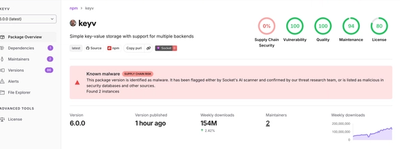
Popular npm packages keyv and cacheable compromised.

Security News
A misconfiguration gave three Anthropic models internet access, and one, believing it was in a simulation, shipped a credential-stealing package to PyPI.