


Company News
AWS Security Hub Adds Socket for Supply Chain Security
Socket is now in the AWS Security Hub Extended plan. Adopt it through AWS, apply committed spend, and block malicious open source packages.
By Feross Aboukhadijeh - Aug 04, 2026
@itunified.io/mcp-postgres
Advanced tools
PostgreSQL MCP Server — 27 tools for schema introspection, queries, CRUD, and server management via Model Context Protocol

A comprehensive PostgreSQL MCP (Model Context Protocol) server providing 27 tools for database management and administration.
npm install @itunified.io/mcp-postgres
Or run directly:
npx @itunified.io/mcp-postgres
Set one of the following environment variables:
# Option 1: Connection string (preferred)
export POSTGRES_CONNECTION_STRING="postgresql://myuser:mypassword@your-database.example.com:5432/mydb"

# Option 2: Individual variables
export PGHOST="your-database.example.com"
export PGPORT="5432"
export PGUSER="myuser"
export PGPASSWORD="mypassword"
export PGDATABASE="mydb"
export PGSSLMODE="require"  # optional
Create a config file at ~/.config/mcp-postgres/databases.yaml:
databases:
  production:
    host: db.example.com
    port: 5432
    user: admin
    password: ${DB_PROD_PASSWORD}
    database: myapp
    ssl: true
  staging:
    host: staging-db.example.com
    port: 5432
    user: admin
    password: ${DB_STAGING_PASSWORD}
    database: myapp
default: production
Environment variables in ${VAR_NAME} syntax are automatically expanded.
Config file discovery order:
POSTGRES_CONFIG_FILE env var (explicit path)~/.config/mcp-postgres/databases.yaml or databases.jsonPOSTGRES_CONNECTION_STRING env var (single database)PG* env vars (single database)Override the config path with POSTGRES_CONFIG_FILE env var:
{
  "mcpServers": {
    "postgres": {
      "command": "npx",
      "args": ["@itunified.io/mcp-postgres"],
      "env": {
        "POSTGRES_CONFIG_FILE": "/path/to/databases.yaml"
      }
    }
  }
}
Use pg_list_connections to see all configured databases, pg_switch_database to change the active one.
mcp-postgres supports opportunistic secret loading from HashiCorp Vault via AppRole authentication. When configured, it fetches PostgreSQL credentials from a KV v2 path — so you never need to put database passwords in environment variables or config files.
How it works:
NAS_VAULT_ADDR, NAS_VAULT_ROLE_ID, and NAS_VAULT_SECRET_ID in the environmentPOSTGRES_CONNECTION_STRING and PG* env vars from the Vault secret — but only for vars not already setPrecedence: Explicit env vars → Vault → config file fallback → (error if nothing set)
| Variable | Required | Description |
|---|---|---|
NAS_VAULT_ADDR | Yes* | Vault server address (e.g., https://vault.example.com:8200) |
NAS_VAULT_ROLE_ID | Yes* | AppRole role ID for this server |
NAS_VAULT_SECRET_ID | Yes* | AppRole secret ID for this server |
NAS_VAULT_KV_MOUNT | No | KV v2 mount path (default: kv) |
* Only required if using Vault. Without these, the server uses env vars / config files directly.
Vault KV v2 secret structure:
# Path: kv/your/postgres/secret
{
  "connection_string": "postgresql://myuser:mypassword@your-database.example.com:5432/mydb",
  "host": "your-database.example.com",
  "port": "5432",
  "user": "myuser",
  "password": "mypassword",
  "database": "mydb"
}
Key mapping: connection_string → POSTGRES_CONNECTION_STRING, host → PGHOST, port → PGPORT, user → PGUSER, password → PGPASSWORD, database → PGDATABASE
Tip: You can store either
connection_string(for single-database setups) or individual fields (host/port/user/password/database), or both. The loader maps whatever keys are present.
Vault setup steps:
Write PG credentials to a KV v2 path:
vault kv put kv/your/postgres/secret \
  connection_string="postgresql://myuser:mypassword@your-database.example.com:5432/mydb" \
  host="your-database.example.com" \
  port="5432" \
  user="myuser" \
  password="mypassword" \
  database="mydb"
Create a read-only policy:
path "kv/data/your/postgres/secret" {
  capabilities = ["read"]
}
Create an AppRole and get credentials:
vault write auth/approle/role/mcp-postgres \
  token_policies="mcp-postgres" token_ttl=1h
vault read auth/approle/role/mcp-postgres/role-id
vault write -f auth/approle/role/mcp-postgres/secret-id
Configure the server with Vault env vars (no PG creds needed):
{
  "mcpServers": {
    "postgres": {
      "command": "npx",
      "args": ["@itunified.io/mcp-postgres"],
      "env": {
        "NAS_VAULT_ADDR": "https://vault.example.com:8200",
        "NAS_VAULT_ROLE_ID": "your-role-id",
        "NAS_VAULT_SECRET_ID": "your-secret-id"
      }
    }
  }
}
Note: Config file options (
POSTGRES_CONFIG_FILE,databases.yaml) andPGSSLMODEare not loaded from Vault — set them via env vars if needed.
Add to your settings.json:
{
  "mcpServers": {
    "postgres": {
      "command": "npx",
      "args": ["@itunified.io/mcp-postgres"],
      "env": {
        "POSTGRES_CONNECTION_STRING": "postgresql://myuser:mypassword@your-database.example.com:5432/mydb"
      }
    }
  }
}
| Tool | Description |
|---|---|
pg_connect | Connect to a database (default or named) |
pg_disconnect | Disconnect from a database or all |
pg_connection_status | Pool health for active or named database |
pg_list_connections | List all configured databases and status |
pg_switch_database | Switch the active database context |
| Tool | Description |
|---|---|
pg_query | Execute parameterized SELECT/DML query |
pg_query_explain | Run EXPLAIN ANALYZE on a query |
pg_query_prepared | Manage named prepared statements (PREPARE/EXECUTE/DEALLOCATE) |
| Tool | Description |
|---|---|
pg_schema_list | List all schemas |
pg_table_list | List tables (with optional schema filter) |
pg_table_describe | Describe table columns, types, defaults, constraints |
pg_index_list | List indexes for a table |
pg_constraint_list | List constraints (PK, FK, unique, check) |
pg_view_list | List views with definitions |
pg_function_list | List functions/procedures with signatures |
pg_enum_list | List enum types and values |
pg_extension_list | List installed extensions |
| Tool | Description |
|---|---|
pg_insert | Insert row(s) with parameterized values |
pg_update | Update rows (requires confirm: true) |
pg_delete | Delete rows (requires confirm: true) |
pg_upsert | Insert or update on conflict (requires confirm: true) |
| Tool | Description |
|---|---|
pg_version | PostgreSQL version |
pg_settings | Show/search server configuration |
pg_reload_config | Reload configuration (requires confirm: true) |
pg_uptime | Server uptime and start time |
| Tool | Description |
|---|---|
pg_replication_status | Streaming replication state and lag |
pg_replication_slots | List replication slots |
pg_wal_status | WAL generation rate and archive status |
pg_standby_status | Primary vs standby detection |
| Tool | Description |
|---|---|
pg_database_size | Size of all databases |
pg_table_sizes | Table sizes with index/toast breakdown |
For advanced PostgreSQL operations, mcp-postgres-enterprise extends this server with:
Available as a private GitHub package. Contact itunified.io for access.
pg_insert, pg_update, pg_delete, pg_upsert): All use parameterized queries ($1, $2, ...) — safe from SQL injection. Destructive operations require confirm: true.pg_query: Unrestricted raw SQL runner by design — intended for power users who need full SQL flexibility. No injection protection is applied because the tool's purpose is to execute arbitrary SQL.pg_query_explain: Defaults to safe plan mode (EXPLAIN only, no execution). mode=analyze always requires confirm: true because EXPLAIN ANALYZE executes the statement.pg_query_prepared: Deprecated. Prepared statements are session-local in PostgreSQL and unreliable with connection pools. Statement names are validated as SQL identifiers. Use parameterized pg_query instead.These tools require confirm: true to execute:
pg_update, pg_delete, pg_upsert — data modificationpg_reload_config — server configurationpg_query_explain (analyze mode) — statement executionThis project is dual-licensed:
See COMMERCIAL_LICENSE.md for details.
Contributions are welcome! Please open an issue first to discuss proposed changes.
FAQs
PostgreSQL MCP Server — 27 tools for schema introspection, queries, CRUD, and server management via Model Context Protocol
The npm package @itunified.io/mcp-postgres receives a total of 22 weekly downloads. As such, @itunified.io/mcp-postgres popularity was classified as not popular.
We found that @itunified.io/mcp-postgres demonstrated a healthy version release cadence and project activity because the last version was released less than a year ago. It has 1 open source maintainer collaborating on the project.
Did you know?

Socket for GitHub automatically highlights issues in each pull request and monitors the health of all your open source dependencies. Discover the contents of your packages and block harmful activity before you install or update your dependencies.
Company News
Socket is now in the AWS Security Hub Extended plan. Adopt it through AWS, apply committed spend, and block malicious open source packages.
Research
/Security News
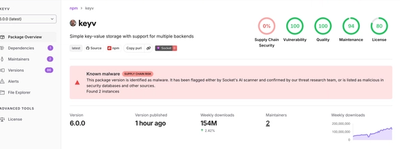
Popular npm packages keyv and cacheable compromised.

Security News
A misconfiguration gave three Anthropic models internet access, and one, believing it was in a simulation, shipped a credential-stealing package to PyPI.