

Company News
AWS Security Hub Adds Socket for Supply Chain Security
Socket is now in the AWS Security Hub Extended plan. Adopt it through AWS, apply committed spend, and block malicious open source packages.
By Feross Aboukhadijeh - Aug 04, 2026
@kage-core/kage-graph-mcp
Advanced tools
Agent memory on Google's Open Knowledge Format (OKF). Kage maintains your coding agents' OKF memory bundle in git and verifies every concept against your code, deterministically. The verification and freshness layer OKF leaves out. MCP server, no account,
Local-first repo memory, code graph, and recall tools for MCP-capable coding agents (Codex, Claude Code, Cursor, etc.).
Kage helps agents stop rediscovering the same project context. It stores reviewable repo memory, builds generated recall/code indexes, and exposes the result through an MCP server plus a CLI.
Run this inside your repo, then restart your agent. That is the whole setup. Node.js 18+. No account, no API key, no config file to write.
npx -y @kage-core/kage-graph-mcp install
It creates .agent_memory/, builds the code and recall indexes, writes the
AGENTS.md / CLAUDE.md policy so your agents know to use Kage, auto-detects and
wires the agents on your machine, and configures .gitignore plus the packet
merge driver.
It also captures one starter memory from your repo immediately, so there is
something to recall before you have run a single session. install prints the
exact command to try — on a fresh repo it looks like this:
kage context "how do I run the tests" --project .
#   1. Team memory: How to run, build and test <your-repo>
#      Verified commands from package.json: npm run test
"Installed" and "live in your agent session" are different states, and only one of them helps you. After restarting the agent:
kage setup verify-agent --agent claude-code --project .
Supported targets include Claude Code, Codex, Cursor, Windsurf, Gemini CLI,
OpenCode, Cline, Goose, Roo Code, Kilo Code, Claude Desktop, Aider, and generic
MCP — run kage setup list for the full set, or kage setup <agent> --project . --write to wire one by hand.
npm install -g @kage-core/kage-graph-mcp   # installs the `kage` and `kage-graph-mcp` binaries
cd your-repo && kage install
.agent_memory/reports/memory-access.json
so agents can learn which memories are reused and recommend what to verify,
ground, or clean up without changing shareable packet files on every recall..agent_memory/reports/lifecycle.json so
teammates can review healthy, hot, stale, disputed, ungrounded, pending, and
generated packets with concrete actions..agent_memory/reports/timeline.json so
handoffs show recently added, updated, pending, and retired repo knowledge..agent_memory/reports/lineage.json so
superseded packets point at the current replacement memory agents should use..agent_memory/audit/events.jsonl and
.agent_memory/reports/memory-audit.json so memory mutations are reviewable..agent_memory/reports/handoff.json so the next
teammate or agent gets one queue across inbox, lifecycle, audit, timeline,
lineage, and distillable session learnings..agent_memory/reports/profile.json so agents
get a compact orientation across repo shape, top concepts, key files,
commands, memory focus, and next actions..agent_memory/reports/capabilities.json so
teams can see evidence-backed readiness across memory, collaboration,
benchmark proof, and dashboard/viewer proof..agent_memory/slots/slots.json so teams can review
tiny always-relevant repo guidance that Kage includes before task-specific
recall..agent_memory/reports/replay.json so teams can
review observed agent timelines, paths, commands, durable candidates, and
distill actions without exposing raw transcript text.No hosted service, external database, or API key is required.
kage context "how do I run tests" --project .   # validate + recall + code graph in one call
kage code-graph "auth routes tests" --project .
kage risk --project . --targets src/auth.ts --json
kage profile --project . --json
kage capabilities --project . --json
kage slots set --project . --label project_context --content "Always run retry tests after changing retry modules." --paths src/retry.ts --tags retry,tests
kage slots --project . --json
kage learn --project . --learning "Use npm test after parser changes."
kage sessions --project . # observed sessions and distillation actions
kage replay --project . # privacy-preserving observed-session timeline
kage memory-access --project . # hot/cold memories and review actions
kage memory-audit --project . # auditable memory mutations
kage handoff --project . # combined teammate/agent handoff queue
kage lifecycle --project . # memory health, freshness, grounding, and feedback
kage timeline --project . # recent memory changes for handoff
kage lineage --project . # current replacements for retired memories
kage supersede --project . --packet <old-id> --replacement <new-id> --reason "why"
kage benchmark --memory-quality # coding-memory retrieval proof
kage benchmark --scale --sizes 240,1000,5000 # large-memory recall proof
kage refresh --project .
kage embeddings build --project . # optional dense local recall
kage hook install --project .
kage pr check --project .
kage viewer --project .
Full CLI surface: kage help --all. Two guides cover the rest:
MCP agents should start with kage_context. When the query or target list
mentions file paths, it also includes risk and dependency-path context.
Normal recall is local and dependency-free. For repos that need denser semantic
matching, install @xenova/transformers in the same Node environment as Kage,
then run kage embeddings build --project .. The default lexical layer is
Unicode-aware and adds CJK bigrams for memory written without spaces. Dense
embeddings write an optional rebuildable
.agent_memory/indexes/embeddings-local.json artifact, and
kage recall "query" --project . --embeddings --explain uses it. (recall is
deprecated in favour of context, but still owns --embeddings and --explain, which
context does not accept.)
For stale or wrong memory:
kage feedback --project . --packet <packet-id> --kind stale
kage gc --project . --dry-run
For the full CLI and MCP reference, see the docs.
kage setup codex --project . --write
kage setup claude-code --project . --write
kage setup generic-mcp --project .
kage setup claude-code --write installs the MCP server plus SessionStart,
UserPromptSubmit, PostToolUse, PostToolUseFailure, PreCompact, Stop, and
SessionEnd hooks. The hooks observe reusable work signals, inject relevant
repo memory on new prompts, and distill durable learnings before compaction or
handoff.
kage setup verify-agent --agent claude-code --project . checks those hooks,
not only the MCP config. If a teammate has the server configured but missing
ambient hooks, verification reports the missing events and tells them to rerun
setup.
kage setup doctor --project . --json also includes the Claude hook summary,
so teams can audit partial installs before relying on automatic capture.
MCP agents can call kage_setup_doctor for the same audit without shelling out.
HTTP-only agents can use the same memory system through the local daemon:
kage daemon start --project .
curl -X POST http://127.0.0.1:3111/kage/context \
  -H 'content-type: application/json' \
  -d '{"query":"how does auth work?","limit":5}'
Useful endpoints:
POST /kage/context - combined recall, graph facts, validation, risk, and dependency context.POST /kage/recall - repo memory recall.POST /kage/capture and POST /kage/learn - write durable repo memory.POST /kage/feedback - mark recalled memory helpful, wrong, or stale.POST /kage/observe and POST /kage/distill - session observation and durable learning distillation.GET /kage/replay - privacy-preserving session replay digest without raw transcript text.GET /kage/setup-doctor - supported-agent setup and Claude hook readiness.GET /kage/profile - compact project profile for agent orientation.GET /kage/capabilities - evidence-backed memory system readiness across memory, collaboration, benchmarks, and viewer proof.GET /kage/context-slots, POST /kage/context-slots, DELETE /kage/context-slots/:label - pinned repo context slots.GET /kage/metrics, /kage/quality, /kage/inbox, /kage/benchmark, /kage/handoff, /kage/lifecycle, /kage/timeline, /kage/lineage, /kage/memory-audit - human and agent review reports.Kage writes to .agent_memory/. Packets are durable repo memory; everything
else is rebuildable with kage refresh.
| Path | Purpose |
|---|---|
.agent_memory/packets/ | durable repo memory |
.agent_memory/graph/ | memory graph (rebuildable) |
.agent_memory/code_graph/ | source-derived code facts (rebuildable) |
.agent_memory/structural/ | files, symbols, imports |
.agent_memory/slots/ | pinned repo context slots |
.agent_memory/indexes/ | recall indexes, including optional embeddings |
.agent_memory/reports/ | profile, capabilities, context-slots, replay, risk, contributors, decisions, module health, workspace, quality, benchmark, handoff, lifecycle, timeline, lineage |
Repo-local packets are git-visible and reviewable. Generated indexes and graphs are rebuildable.
kage viewer --project .
The local viewer loads graph artifacts plus .agent_memory/reports/*.json.
It opens with a dashboard for repo readiness, memory coverage, graph health,
risks, review, and workspace links, then jumps to focused Graph, Memory,
Risks, and Review pages. Use it when you need to:
Hosted demo: https://kage-core.github.io/Kage/viewer/
npm install
npm test
npm run build
npm pack --dry-run
GPL-3.0-only.
FAQs
Agent memory on Google's Open Knowledge Format (OKF). Kage maintains your coding agents' OKF memory bundle in git and verifies every concept against your code, deterministically. The verification and freshness layer OKF leaves out. MCP server, no account,
The npm package @kage-core/kage-graph-mcp receives a total of 313 weekly downloads. As such, @kage-core/kage-graph-mcp popularity was classified as not popular.
We found that @kage-core/kage-graph-mcp demonstrated a healthy version release cadence and project activity because the last version was released less than a year ago. It has 1 open source maintainer collaborating on the project.
Did you know?

Socket for GitHub automatically highlights issues in each pull request and monitors the health of all your open source dependencies. Discover the contents of your packages and block harmful activity before you install or update your dependencies.
Company News
Socket is now in the AWS Security Hub Extended plan. Adopt it through AWS, apply committed spend, and block malicious open source packages.
Research
/Security News
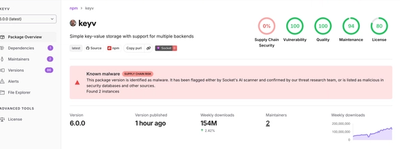
Popular npm packages keyv and cacheable compromised.

Security News
A misconfiguration gave three Anthropic models internet access, and one, believing it was in a simulation, shipped a credential-stealing package to PyPI.