
Research
/Security News
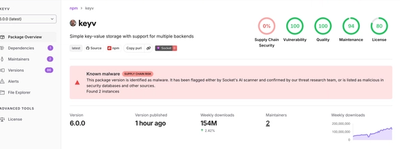
Popular npm Packages in the keyv and Cacheable Namespaces Compromised in Active Supply Chain Attack
Popular npm packages keyv and cacheable compromised.
By Socket Research Team - Aug 04, 2026
@kawacode/mcp
Advanced tools
Team-aware memory for Claude Code, Cursor, and other AI coding assistants — intent tracking, decision history, real-time team conflict detection.
Team-aware memory for AI coding assistants. Track intent, record decisions, and see when a teammate is editing the same code — in real time, before commit.
@kawacode/mcp is the official Model Context Protocol (MCP) server for Kawa Code. It lets Claude Code, Cursor, and any MCP-compatible AI assistant:
gh) — enables richer data tiers (PR descriptions, review comments, issue discussions). Without gh, tiers 2 and 4 are skipped automaticallyAdd the MCP in your AI configuration, for example on Claude Code:
claude mcp add -s user kawa-intents -- npx -y @kawacode/mcp
For Cursor AI, install the MCP with npm install -g @kawacode/mcp and add it to ~/.cursor/mcp.json.
{
  "mcpServers": {
    "kawa-intents": {
      "command": "kawacode-mcp"
    }
  }
}
Note that the MCP will not be automatically updated to future versions in this scenario.
To upgrade to a newer release, run npm update -g @kawacode/mcp.
For the project you want Kawa Code to run on, create a .mcp.json file in your project root (recommended for teams — commit it to git):
{
  "mcpServers": {
    "kawa-intents": {
      "type": "stdio",
      "command": "npx",
      "args": ["-y", "@kawacode/mcp"]
    }
  }
}
The MCP server works together with the Kawa Code application, Kawa Code IDE extensions, and AI code generators such as Cursor AI and Claude Code.
Optional. When the agent is about to edit code that has prior recorded reasoning attached (an overlapping intent's blocks, or a constraint with the file in relatedFiles), the hook surfaces it before the Edit fires. Recommendation maps to action: silent (proceed), advisory context injected (review), or blocked with stderr message (investigate-upstream).
Wire it as a Claude Code PreToolUse hook in your ~/.claude/settings.json or project .claude/settings.json:
{
  "hooks": {
    "PreToolUse": [
      {
        "matcher": "Edit|Write",
        "hooks": [
          { "type": "command", "command": "npx -y -p @kawacode/mcp kawacode-on-pre-edit" }
        ]
      }
    ]
  }
}
Override paths when blocked:
record_decision(type: "fork", supersedes: ["<surfaced-decision-id>"], rationale: "...")
pre_edit_acknowledge(decisionIds: ["<surfaced-decision-id>"]), then retry the Edit — that decision won't block again for the rest of the session. The acknowledgment is read back from your session transcript, so it needs no session token and is unaffected by daemon or session restarts within the same conversation.force: true to the Edit tool args to proceed a single time.Disable the hook for a session with KAWA_PRE_EDIT_CHECK=off.
Every pre-edit check fire (and force-override) appends a JSON line to a daily-rotated file at ~/.kawa-code/logs/pre-edit-decision-check-YYYY-MM-DD.jsonl. Logs are local only — nothing leaves your machine. The defaults keep the last 30 days, capped at 100 MB total (oldest files dropped first).
Each line records what fired, why, and what was filtered out — useful for tuning the recommendation thresholds and spotting false positives over time.
Disable telemetry with KAWA_PRE_EDIT_TELEMETRY=off.
git log shows what changed; Kawa shows why.Because the reasoning behind your work — your intents and recorded decisions — lives in Kawa Code rather than in the chat log, a teammate can pick up where you left off from a single prompt. No transcript sharing, no session restore.
check_active_intent, or you can find it in the Kawa Code app.Follow up on intent <intent-id>: <what's left to do>.resume_intent(<id>) — one call that adopts the intent as their current focus and loads its recorded decisions — resuming the thread with full context, even though it never saw your chat.What transfers: the intent, its decisions, and (once committed) its code. What doesn't: your chat transcript and any session-local state. An acknowledgment you made to a pre-edit block is your judgment in your session, so your teammate re-evaluates it rather than inheriting it — which is what you want.
Teams: to make the handoff seamless, add one line to your shared CLAUDE.md so the agent always treats a follow-up prompt as resuming the named intent instead of opening a new one:
When a prompt says "follow up on intent
<id>" (or similar), callresume_intent(<id>)to adopt that intent and load its decisions — do not create a new intent for it.
When you port a codebase to a new language or rebuild it in a fresh repository, the code moves — but the reasoning usually doesn't. The source repo's decision history knows why retired approaches were retired, which constraints are load-bearing, and where the security landmines are. With Kawa Code, that history becomes a first-class migration input.
Decisions are scoped per repository, so the new repo won't surface the old repo's history automatically. Transplant them slice by slice as you port — this is the recall-transplant workflow:
get_relevant_context against the source repo with a description of the subsystem you're about to port (name its key files). This surfaces the forks, constraints, trade-offs, and discoveries that shaped it.get_decision_detail on the load-bearing hits for the full rationale and consequences.record_decision, citing provenance in the summary or rationale (e.g. [transplanted from <source-repo> <decision-id>]). Merge decisions that form one lineage into a single record.The payoff compounds: the port doesn't re-litigate settled arguments or faithfully reproduce old bugs, negative knowledge survives even though the code that motivated it was deleted long ago, and at cutover the new repo starts with a curated decision corpus instead of an empty one.
The CLAUDE.md template ships a compact version of this workflow, so agents set up through the Kawa Code welcome flow follow it automatically.
# Watch mode (auto-rebuild on file changes)
npm run dev

# Build TypeScript to JavaScript
npm run build

# Clean build artifacts
npm run clean

# Run the MCP server directly
npm start
To test the MCP server without integrating it into an AI assistant:
npm run buildnpm startnpm run dev to auto-rebuild during developmentClaude Code / Cursor AI
↓ MCP Protocol (stdio)
kawa.mcp (this server)
↓ Huginn IPC (Unix socket / Named pipe)
Kawa Code Desktop App
└─ HTTP Client
↓ REST + SSE
Kawa API (cloud)
└─ Team sync & zero-knowledge encryption
Contributions are welcome. Please read CONTRIBUTING.md and CLA.md.
This project is source-available under the Kawa Code Source Available License.
You may run and modify the software for personal or internal use.
See LICENSE for details.
FAQs
Team-aware memory for Claude Code, Cursor, and other AI coding assistants — intent tracking, decision history, real-time team conflict detection.
The npm package @kawacode/mcp receives a total of 383 weekly downloads. As such, @kawacode/mcp popularity was classified as not popular.
We found that @kawacode/mcp demonstrated a healthy version release cadence and project activity because the last version was released less than a year ago. It has 1 open source maintainer collaborating on the project.
Did you know?

Socket for GitHub automatically highlights issues in each pull request and monitors the health of all your open source dependencies. Discover the contents of your packages and block harmful activity before you install or update your dependencies.
Research
/Security News
Popular npm packages keyv and cacheable compromised.

Security News
A misconfiguration gave three Anthropic models internet access, and one, believing it was in a simulation, shipped a credential-stealing package to PyPI.

Security News
/Company News
Socket has joined the new Composer and Packagist sponsorship program as a launch sponsor, supporting the team that keeps PHP's package ecosystem secure.