

Company News
AWS Security Hub Adds Socket for Supply Chain Security
Socket is now in the AWS Security Hub Extended plan. Adopt it through AWS, apply committed spend, and block malicious open source packages.
By Feross Aboukhadijeh - Aug 04, 2026
@leakferret/mcp
Advanced tools
MCP (Model Context Protocol) server for leakferret. Stops AI agents from committing live secrets.

An MCP server that lets a coding agent scan, verify, and rewrite secrets before it writes a commit.



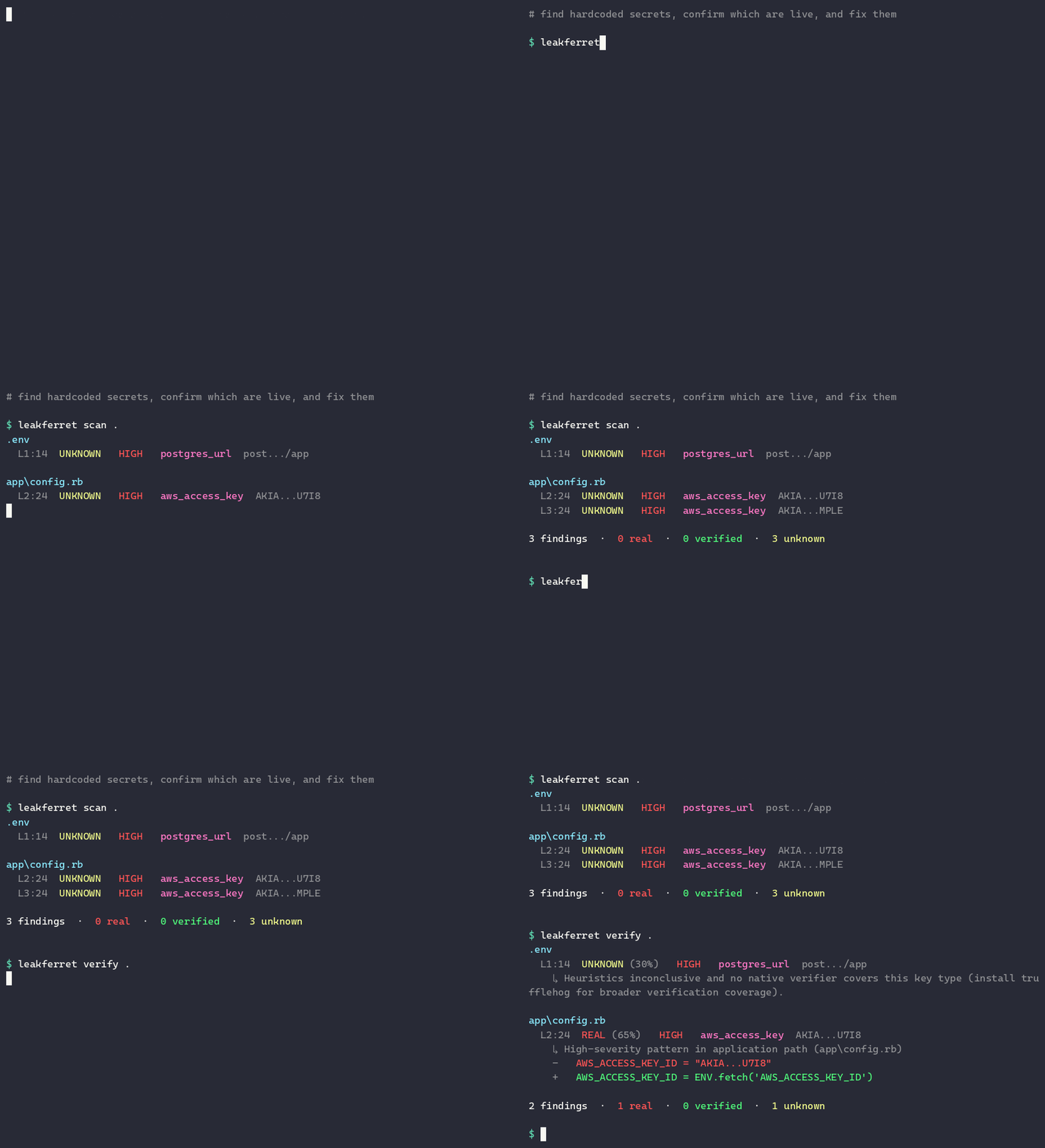
A Model Context Protocol server for
leakferret. The pitch: agents
hardcode secrets too, and nobody reviews their diffs line by line the way they
review a human pull request. This gives the agent tools to self-check — scan,
classify, verify against the provider, and rewrite — so a live key never makes
it into the commit. Works with Claude Code, Cursor, Continue, and Claude Desktop.
Listed in the official MCP Registry as io.github.leakferrethq/leakferret,
so registry-aware clients can discover it.
npm install @leakferret/mcp     # pulls in @leakferret/cli + the native binary
npx @leakferret/mcp             # JSON-RPC 2.0 over stdio
Running it in a terminal looks like a hang — that's correct. It's a stdio JSON-RPC server waiting for an editor or agent to connect.
Claude Code — one line:
claude mcp add leakferret -- npx -y @leakferret/mcp
Any MCP client (Cursor, Continue, Claude Desktop) — add to .mcp.json /
claude_desktop_config.json:
{
  "mcpServers": {
    "leakferret": {
      "command": "npx",
      "args": ["@leakferret/mcp"]
    }
  }
}
Cursor: Settings → MCP Servers → add command npx @leakferret/mcp.
| Tool | Purpose |
|---|---|
scan_repository | Walk a path, return regex pre-filter candidates |
classify_candidates | Apply offline heuristic REAL/FIXTURE/UNKNOWN verdicts |
verify_finding | Live HTTP verification against the provider |
propose_rewrite | Propose an env-var replacement for a real finding |
baseline_diff | Diff a scan against the repo baseline |
Plus a classify prompt — the system prompt the host model uses to classify
candidates inline using the model the agent already has, with no extra API key.
Finds hardcoded secrets and API keys and confirms which are live: it
regex-scans files (respecting .gitignore), marks documented public examples as
FIXTURE via a signed catalog, classifies each candidate, and verifies real
findings with a harmless API call to the provider (AWS SigV4, GitHub, GitLab,
Stripe, OpenAI, Anthropic, Slack, Twilio, SendGrid, Mailgun, Datadog, Heroku,
npm, PyPI, DigitalOcean), with a trufflehog fallback.
Privacy invariant: the full secret value never leaves your machine. Only a
redacted first-4-plus-last-4 preview (e.g. AKIA...4XYZ) is ever written to a
report, log, network message, or model prompt. Verification calls go straight
from your machine to the provider — leakferret has no servers.
The same engine is a CLI: @leakferret/cli
(npx @leakferret/cli scan .), plus a GitHub Action and a VS Code extension.
MIT for this package and the bundled binary. The fixture catalog data is
CC-BY-SA-4.0 — see leakferret-catalog.
Part of leakferret · leakferret.com · maintained by Maria Khan.
FAQs
MCP (Model Context Protocol) server for leakferret. Stops AI agents from committing live secrets.
The npm package @leakferret/mcp receives a total of 43 weekly downloads. As such, @leakferret/mcp popularity was classified as not popular.
We found that @leakferret/mcp demonstrated a healthy version release cadence and project activity because the last version was released less than a year ago. It has 1 open source maintainer collaborating on the project.
Did you know?

Socket for GitHub automatically highlights issues in each pull request and monitors the health of all your open source dependencies. Discover the contents of your packages and block harmful activity before you install or update your dependencies.
Company News
Socket is now in the AWS Security Hub Extended plan. Adopt it through AWS, apply committed spend, and block malicious open source packages.
Research
/Security News
Popular npm packages keyv and cacheable compromised.

Security News
A misconfiguration gave three Anthropic models internet access, and one, believing it was in a simulation, shipped a credential-stealing package to PyPI.