


Company News
AWS Security Hub Adds Socket for Supply Chain Security
Socket is now in the AWS Security Hub Extended plan. Adopt it through AWS, apply committed spend, and block malicious open source packages.
By Feross Aboukhadijeh - Aug 04, 2026
@llmintel/mcp
Advanced tools
MCP server for AI model lifecycle data — check whether a model id is deprecated or retiring, and what to migrate to, across OpenAI, Anthropic, Azure, AWS Bedrock, Google, and Cohere.
An MCP server that tells your coding agent whether a model id is safe to use.
LLMs are trained on a snapshot of the world and will confidently write gpt-4-32k into your code
long after it stops answering. This server gives the agent a live lookup for whether a model is
deprecated and when it stops working. It returns the replacement too. Answers are normalized across
OpenAI, Anthropic, Azure AI Foundry, AWS Bedrock, Google, and Cohere, and parsed from each
provider's own deprecation pages.
No API key, no signup. The catalog is public.

Add it to any MCP host. The package runs straight from npm via npx.
In .cursor/mcp.json:
{
  "mcpServers": {
    "llmintel": {
      "command": "npx",
      "args": ["-y", "@llmintel/mcp"]
    }
  }
}
claude mcp add llmintel -- npx -y @llmintel/mcp
Same shape as the Cursor block above, in claude_desktop_config.json.
The same five tools are served over Streamable HTTP at https://llmintel.ai/v1/mcp. Hosts that take
a URL need no Node and no package:
{
  "mcpServers": {
    "llmintel": {
      "url": "https://llmintel.ai/v1/mcp"
    }
  }
}
The endpoint is stateless and read-only. It answers from the same catalog the npm package queries.
| Tool | Returns |
|---|---|
check_model | Whether one model id is safe to use: lifecycle state, the retirement deadline in days, the replacement, and the source link. |
list_retiring_models | What breaks in the next 90 days. Past-due models are listed first, then upcoming ones soonest-first. |
suggest_replacement | The provider's own recommendation for what to move to. Falls back to same-provider active models when none was published. |
search_models | Catalog search filtered by provider and lifecycle state. |
recent_lifecycle_changes | The change feed across all providers, for questions like "what was deprecated this month". |
You: Before we ship this, check the model ids in
src/agents/.
The agent calls check_model for each one and gets back:
DO NOT USE — this model is retired; API calls to it fail.

"claude-sonnet-4-20250514" resolves to the tracked model anthropic/claude-sonnet-4-20250514.
Model: claude-sonnet-4-20250514 (anthropic/claude-sonnet-4-20250514)
Provider: anthropic
Lifecycle state: retired — retired; calls fail
Deprecated: 2026-04-14 (105 days ago)
Retirement: 2026-06-15 (43 days ago)

The provider has not named a replacement. Use suggest_replacement for options.
Pricing/limits: $3/1M in · $15/1M out

Source: https://docs.anthropic.com/en/docs/about-claude/model-deprecations
Provider's own term: "Retired"
Deadlines are always given in days, because a model cannot reliably judge whether 2026-07-30 is
soon.
A failed lookup is never a safety verdict. If the catalog is unreachable, the tool returns an MCP error and says so. An agent that read a network failure as "no deprecation found" would happily ship a retired model id. A model that simply isn't tracked gets the same treatment: it returns "not in the catalog, verify with the provider", never "OK".
Pass whatever string is literally in the code (gpt-4o, anthropic/claude-opus-4-1, azure/gpt-4o)
and it resolves to the canonical tracked model.
When the provider's own deprecation notice names a successor, that is what you get. Otherwise the fallback list of same-provider active models is labelled as candidates to evaluate, so an agent can tell the two apart.
Anything past its retirement date is broken now, so it gets its own heading instead of sitting in "retiring soon".
Both variables are optional.
| Variable | Default | Purpose |
|---|---|---|
LLMINTEL_API_KEY | none | Raises the rate-limit budget. The catalog itself is public, so you do not need this. |
LLMINTEL_BASE_URL | https://llmintel.ai | Point at a self-hosted or staging catalog. |
Anonymous callers get 30 requests/minute per IP, enough for interactive agent use.
Every record links to the provider page it was parsed from and preserves the provider's verbatim
lifecycle term (sourceTerm), so a normalization decision is always auditable. Changes go through a
human verification queue before publication. Collector freshness is public at
/v1/status.
The same data is available as a plain REST API, also without a key. See llmintel.ai/docs.
pnpm --filter @llmintel/mcp build
pnpm exec vitest run packages/mcp        # protocol-level tests against a fake catalog

# Drive the built binary against a live catalog
pnpm --filter @llmintel/mcp smoke
LLMINTEL_BASE_URL=http://localhost:3000 pnpm --filter @llmintel/mcp smoke
MIT © LLMIntel
FAQs
MCP server for AI model lifecycle data — check whether a model id is deprecated or retiring, and what to migrate to, across OpenAI, Anthropic, Azure, AWS Bedrock, Google, and Cohere.
We found that @llmintel/mcp demonstrated a healthy version release cadence and project activity because the last version was released less than a year ago. It has 1 open source maintainer collaborating on the project.
Did you know?

Socket for GitHub automatically highlights issues in each pull request and monitors the health of all your open source dependencies. Discover the contents of your packages and block harmful activity before you install or update your dependencies.
Company News
Socket is now in the AWS Security Hub Extended plan. Adopt it through AWS, apply committed spend, and block malicious open source packages.
Research
/Security News
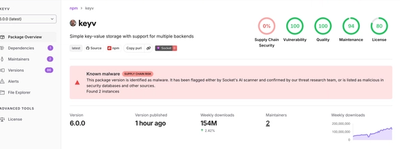
Popular npm packages keyv and cacheable compromised.

Security News
A misconfiguration gave three Anthropic models internet access, and one, believing it was in a simulation, shipped a credential-stealing package to PyPI.