

Security News
Deno Goes the Way of the Dinosaur
Cloudflare is acquiring Deno’s team, which will provide another year of bug fixes and security updates before ending support for the runtime.
By Sarah Gooding - Oct 16, 2026
@maple-kit/classifier
Advanced tools
Model-backed classifier connectors for Maple's assist tier. It does two jobs, both from the server route:
Pre-release. Every package here is 0.x and makes no compatibility promise.
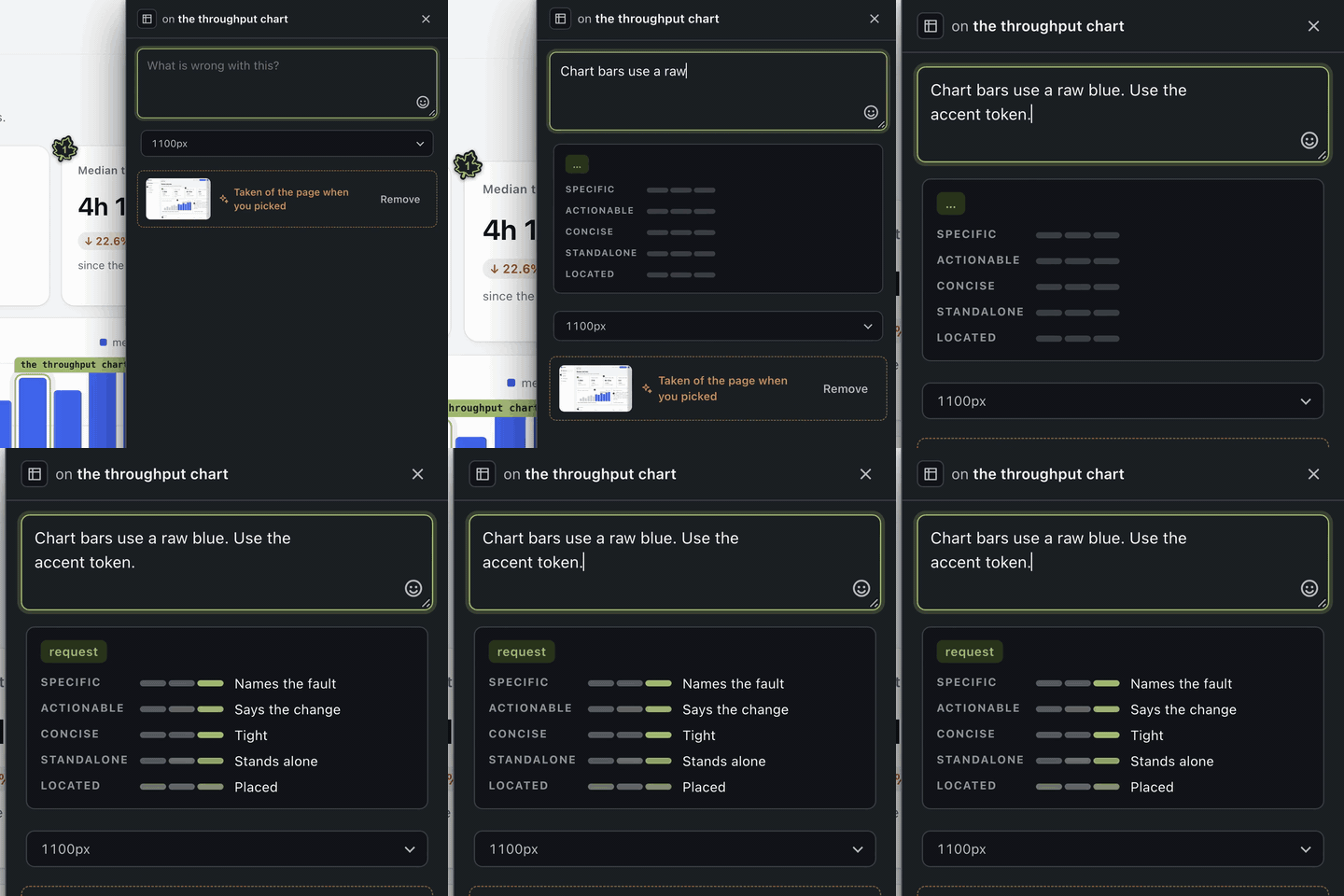
A comment an agent can act on names the fault, says the change and reads without the page in front of it. The composer shows where the draft sits on each of five pillars, so a reviewer can tighten it before it is sent. The score advises; it never blocks a send.
| Pillar | The question it asks | Levels, worst to best |
|---|---|---|
specific | Does the comment name what is wrong, rather than only that something is? | Names nothing · Names the thing · Names the fault |
actionable | Would a reader know what to change after reading this? | Reports only · Implies a direction · Says the change |
concise | Is the comment as short as its point allows? | Rambling · Padded · Tight |
standalone | Does the comment read correctly without the page in front of you? | Needs the screen · Partly anchored · Stands alone |
located | Do the words say where on the page this is? | Unplaced · Roughly placed · Placed |
These are DEFAULT_PILLARS from @maple-kit/core/connectors. The host can
replace them; a reviewer never can, because a pillar a reviewer can move
measures nothing.
The kind is one of bug, copy, question, request, praise or other,
where other means no kind stood out rather than a verdict.
Each pillar comes back with the level it reached, the probability of every level, and a confidence, so a surface can say how nearly it was a different level instead of presenting a guess as a fact:
{
  "scores": [
    { "pillar": "specific", "level": 2, "distribution": [0.02, 0.1, 0.88], "confidence": 0.81 },
    // …one per pillar
  ],
  "kind": {
    "kind": "request",
    "distribution": {
      "request": 0.84,
      "bug": 0.1,
      "copy": 0.03,
      "question": 0.01,
      "praise": 0.01,
      "other": 0.01,
    },
    "confidence": 0.77,
  },
}
The probabilities are jev's own, passed through. The one adjustment is arithmetic: jev rounds to two places, so three near-equal levels can arrive summing to 0.99, and the contract promises one.
Measured on thirty review comments written against a running application, by
evals/assist.eval.test.ts. Kind is exact match; pillars is the share of
labelled rungs hit.
| Tier | Kind | Pillars | CI threshold |
|---|---|---|---|
keywordClassifier(), the word list | 40.0% | 60.4% | 35% / 55% |
jevClassifier() | 73.3% | 89.9% | 65% / 82% |
The word list runs on every CI run and is the floor: a model that cannot beat it is not worth its latency. A threshold is raised when the code improves and never lowered.
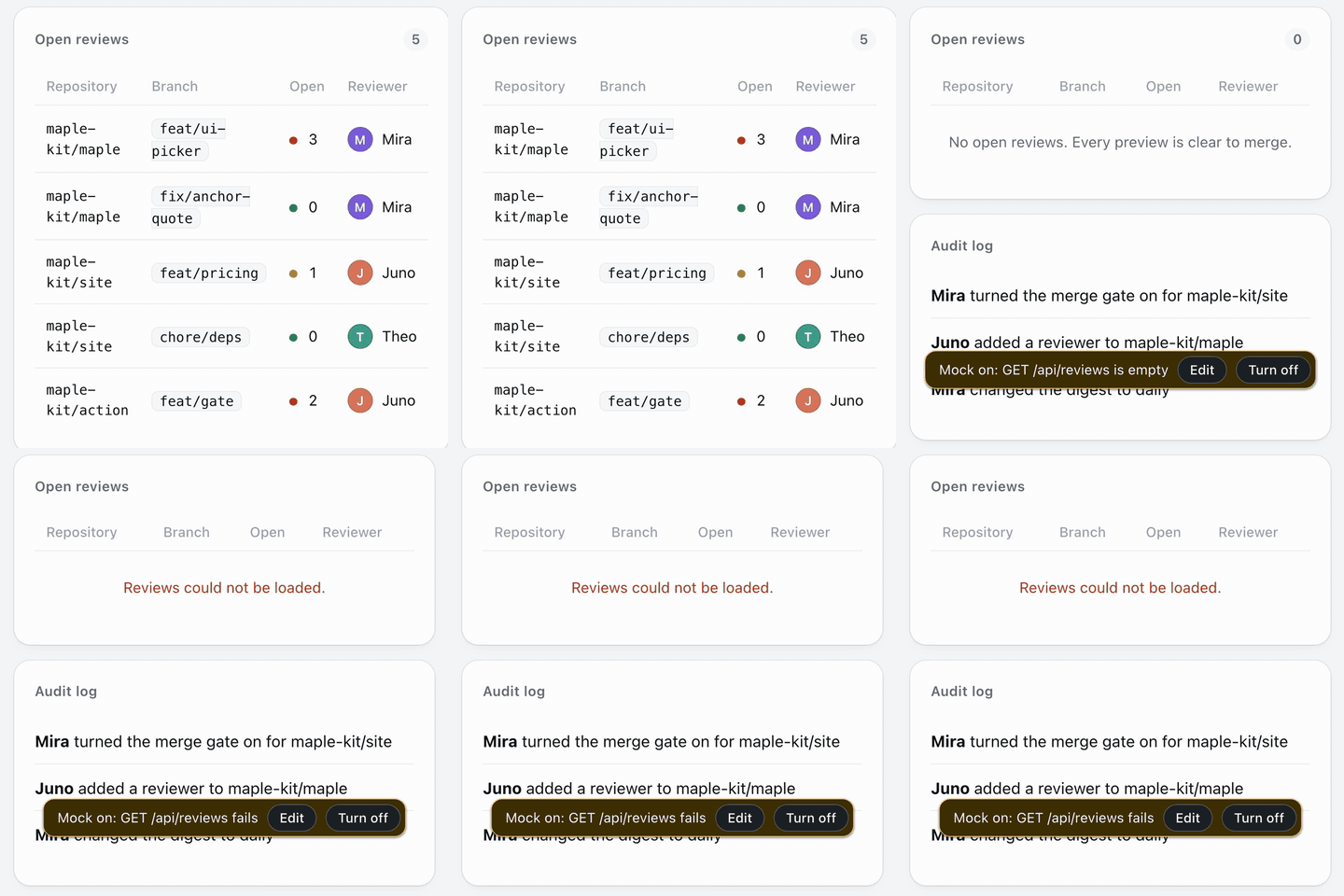 A sentence such as "the reviews list fails" becomes the error state on the one call it concerns. | 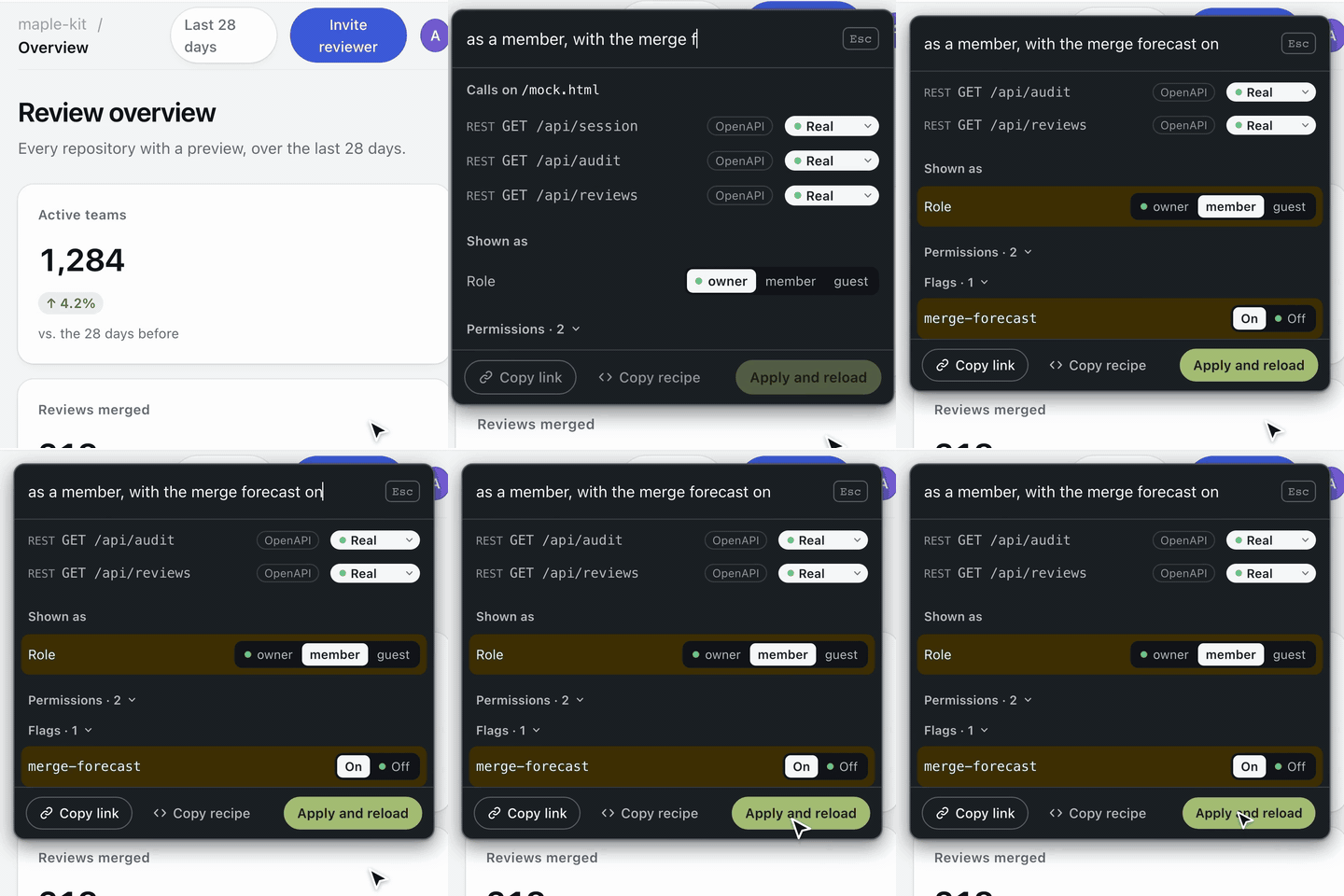 "As a member, with the merge forecast on" sets the role and turns one flag on, for the reviewer to check before the page reloads. |
Maple Mock sends the reviewer's sentence, the page's route and its
calls to the route's /mock/plan, and the classifier answers with a plan:
{
  "state": "empty",
  "distribution": { "empty": 0.91, "error": 0.03, "none": 0.02 /* …every state */ },
  "confidence": 0.86,
  "calls": [
    { "key": "rest:GET /api/reviews", "concerned": true, "p": 0.94 },
    { "key": "rest:GET /api/audit", "concerned": false, "p": 0.08 },
  ],
  "flags": [{ "key": "merge-forecast", "value": true, "concerned": true, "p": 0.88 }],
  "role": { "role": "member", "p": 0.9 },
}
The model picks; it never writes a response body. @maple-kit/mock
reshapes the response the page already received, or one sampled from its
schema, so the app's own parser still accepts it.
Measured on 94 sentences against seven pages' calls, by
evals/mock-plan.eval.test.ts, as state accuracy / call F1 / layer accuracy:
| Tier | Data set (65) | Layers set (29) | Values set (36) |
|---|---|---|---|
| keyword | 92.3 / 69.0 / 97.0 | 100 / 66.7 / 82.8 | 94.4 / 61.8 / 100 |
| jev | 94.4 / 76.6 / 98.0 | 87.4 / 69.8 / 93.1 | 88.9 / 81.7 / 92.2 |
evals/cases/mock-plan/README.md
has the thresholds and what the set still needs.
npm install @maple-kit/classifier effect@rc @effect/ai-typesafe@rc
effect and @effect/ai-typesafe are peers. This package is the only one in
the Maple workspace on the Effect v4 release-candidate line; @maple-kit/core
stays on v3 and nothing published there moves.
One connector serves both jobs. Hand it to the route's assist for scoring
and to mock.plan for planning:
import { jevClassifier } from "@maple-kit/classifier";
import { keywordClassifier } from "@maple-kit/core/connectors";
import { createMapleHandler } from "@maple-kit/core/route";

const apiKey = process.env.TYPESAFE_API_KEY;
const classifier = apiKey ? jevClassifier({ apiKey }) : undefined;

const handler = createMapleHandler({
  store,
  ...(classifier ? { assist: { classifier } } : {}),
  mock: {
    preview: true,
    plan: { classifier: classifier ?? keywordClassifier() },
  },
});

export { handler as GET, handler as POST };
Without assist, /assist answers 404 and the composer is unchanged: the
whole tier is off unless switched on. keywordClassifier() plans offline with
no credential, which is what the examples fall back to.
The connector is reached from the server route and never from the browser.
A model credential in a preview bundle is the failure this architecture exists
to prevent, and routing through the same origin is what leaves the host's
connect-src unchanged.
| Option | Default | What it is |
|---|---|---|
apiKey | — | The credential. Server-side only. |
baseUrl | https://api.typesafe.ai/v1 | The API root /systemone is appended to. A local reimplementation goes here. |
model | jev-latest | An alias or a pinned version id. |
pillars | DEFAULT_PILLARS | What to judge against. The host configures these; a reviewer never does. |
timeoutMs | 8000 | How long one judgement may take before it is abandoned as stale. |
The route adds a cache (200 judgements) and a rate limit (40 calls a minute
per session) in front of the connector; assist.cacheSize and assist.rate
change them.
Every pillar's question and the kind's travel in one request. jev reads the comment once and answers each question against it in parallel, which is what makes scoring on a keystroke affordable: five pillars plus the kind is a single call of roughly 1,300 input tokens.
A mock plan is one request as well: the state as a choice, and one noul
question per call the page made. Flags and the role, when the page has any, go
in a second request, so the state and the calls are judged exactly as they are
without them.
There are no retries. This runs on a keystroke — a retry holds the request open
past the moment its answer was wanted, and the next keystroke is a better retry
than any schedule. A request is abandoned when its signal aborts, and a
failure is the caller's to swallow: the field keeps working, the score just
does not arrive.
The seam is ClassifierConnector, not a vendor SDK: optional score,
classify and plan methods, detected by presence. A new backend is a new
implementation of the same contract, run against runClassifierContract from
@maple-kit/core/testing like every other connector. See the
contribute-connector skill.
Apache-2.0. See LICENSE and NOTICE.
FAQs
Model-backed classifier connectors for Maple's assist tier
The npm package @maple-kit/classifier receives a total of 669 weekly downloads. As such, @maple-kit/classifier popularity was classified as not popular.
We found that @maple-kit/classifier demonstrated a healthy version release cadence and project activity because the last version was released less than a year ago. It has 1 open source maintainer collaborating on the project.
Security News
Cloudflare is acquiring Deno’s team, which will provide another year of bug fixes and security updates before ending support for the runtime.

Security News
Anthropic’s free OSS Scanner uses Mythos and other Claude models to find open source vulnerabilities and send maintainers reports with proposed fixes.

Security News
On Front Lines’ Early Adopters: CISO podcast, Andrew Becherer shares lessons from Datadog, weighs the long-term costs of AI-built tools, and explains how founders can actually gain a CISO’s trust.