
Security News
The Code You Didn't Write Is Still Yours to Defend
AI agents are pulling packages into environments no scanner is watching, creating exposure before security teams can see it.
By Brad Arkin - Jun 23, 2026
@marklogic-community/grove-core-api
Advanced tools
core OpenAPI 3.0 specifications for Grove-compliant middle-tiers
This project provides OpenAPI v3 specifications for Grove-compliant middle-tier implementations. It concerns the public-facing REST endpoints.
Design principles:
The baseline for Grove middle-tiers consists of 4 sets of endpoints:
By convention, Grove middle-tier implementations include CRUD and Search for the (pseudo-)type 'all'.
Authentication is specified in spec/auth-api.json.
CRUD is specified in spec/crud-api.json.
Search is specified in spec/search-api.json.
Three endpoints are specified for /search, allowing the consumer to request results-only, facets-only, or the combination of the two:
/search/{type}/results
/search/{type}/facets
/search/{type}
The type parameter allows several different searches to be mounted. By convention, Grove middle-tiers, out-of-the-box, will support an all pseudo-type that implements generic search-and-discovery against documents stored in the database (potentially within a "data" collection). Particular applications can modify the search or mount additional search endpoints, perhaps changing the type to entities like "patients" or concepts like "raw" or "harmonized". The exact meaning of those types (and implementation of typed searches) will be up to the middle-tier implementation.
All requests against these endpoints are POST requests, allowing the search filters and options to be arbitrarily large in the request body. The request and response bodies are very similar for each of the three endpoints.
A search request includes two top-level properties: options and filters.
options includes start and pageLength for pagination, and can be arbitrarily expanded to cover other concepts understood by both the UI and the middle-tier.
filters specify the search query.
In the Grove search API, "filters" refer to values applied, typically by a user through the UI, against "constraints", which are filter capabilities known to the middle-tier.
In Grove, "filter" and "constraint" are broad terms which do not specify how a particular constraint operates. They could be backed by a MarkLogic Search API constraint, a MarkLogic REST extension using cts queries, or even some Elasticsearch implementation.
In this spec, we aim to strike a balance between expressive power and convenience for UI developers. Most filter interfaces will be fairly simple, such as a search bar or selectable list of facets. Authors of such components should not be burdened with complicated filter structures. Advanced search interfaces, however, are possible within the Grove search spec as recursive combinations of simpler filters.
The basic filter types described by this spec include:
QueryTextFilter. Yes, even qtext is treated as a filter value matched against a search constraint. This is typically a simple string for full-text searching, though it can optionally include a "constraint" name. A middle-tier implmentation could use that "constraint" name to handle the queryText in a special way, such as searching against a field in MarkLogic that is narrower than full-text search.
SelectionFilter. This filter allows for individual values to be ANDed or ORed (but not both) together against a search constraint. The values can optionally be negated. A SelectionFilter is only one level deep, which corresponds to simple facet UIs. More complicated selections can be modeled using the CombinedFilter described below.
RangeFilter. This filter allows ranges of values to be matched against a search constraint. It is designed to support most types of dynamic inequalities, like date or number ranges, mins or maxes. Like SelectionFilter, it is intentionally simple and tailored for ease of use in creating range-selection UI components.
These three basic filter types can be combined recursively using AND, OR, NOT, and NEAR in order to populate the "filters" field (called "CombinedFilter" in the spec document). The UI thus has control over how individual filters should be combined and can encode advanced queries. CombinedFilter uses the expressiveness of MarkLogic's REST API search grammar as a model.
Additional filter types can easily be plugged into a Grove Project as needed. These could be highly specialized or very generic like the ones above.
The specified SearchResponse is mostly a subset of the response from the MarkLogic Search API. (The one addition is an "id" field, which may differ from document URI, allowing the application to express search over higher-level concepts or entities, rather than individual documents.) Results from other sources could be marshalled into the same structure. It covers some metadata, such as total and pagination properties, as well as facets and results.
We only specified certain properties used in out-of-the-box Grove UI implementations. The response can be expanded with additional properties by middle-tier implementations.
This project comes with a small VueJS page that can be used to run a quick test against your middle-tier of choice. It may require CORS to be disabled on that middle-tier.
You can validate changes to spec/auth-api.json, spec/crud-api.json, and spec/search-api.json by running npm test. This will use the swagger-cli to validate changes.
If you add new spec files, you need to add them to the test script in package.json.
FAQs
core OpenAPI 3.0 specifications for Grove-compliant middle-tiers
We found that @marklogic-community/grove-core-api demonstrated a not healthy version release cadence and project activity because the last version was released a year ago. It has 10 open source maintainers collaborating on the project.
Did you know?

Socket for GitHub automatically highlights issues in each pull request and monitors the health of all your open source dependencies. Discover the contents of your packages and block harmful activity before you install or update your dependencies.
Security News
AI agents are pulling packages into environments no scanner is watching, creating exposure before security teams can see it.

Security News
GitHub Actions checkout now blocks risky pull_request_target checkouts by default to help prevent pwn request supply chain attacks.
Product
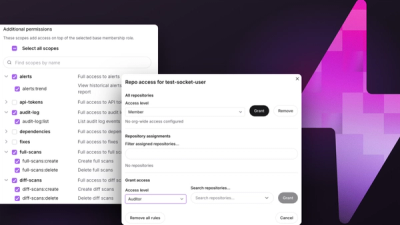
Socket now supports Custom Roles and Repository Access Permissions so organizations can control who can access specific repositories and actions.