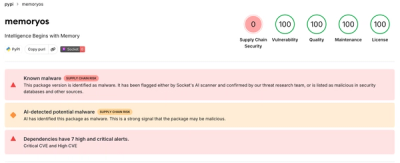
@memofs/adapter-turso






Turso/libSQL metadata adapter for MemoFS remote blob memory stores.
What is this?
Turso/libSQL metadata adapter for MemoFS's remote-blob memory store. It
implements core's provider-neutral MetadataStore contract over the cloud's
existing project_files table so the MemoFS runtime can track which canonical
.memofs/ files exist and where their bytes live — running the same runtime
on hosted infra as on a local filesystem.
This package owns metadata storage only. The matching blob adapter
(createR2BlobClient) lives in @memofs/adapter-r2. The two
are intentionally decoupled — a clean adapter shape, not a bundled N×M
adapter — so a Node self-hoster can pair this metadata store with any
BlobClient (S3, GCS, MinIO) without touching the runtime.
Installation
npm install @memofs/adapter-turso
Requires Node.js >= 22.
Peer dependency: @libsql/client (for the metadata client type). It is an
optional peer — you only need it where you author against the libSQL client.
Quick Start
import { RemoteBlobMemoryStore } from "@memofs/core";
import { createR2BlobClient } from "@memofs/adapter-r2";
import { createTursoMetadataStore } from "@memofs/adapter-turso";
const store = new RemoteBlobMemoryStore({
blobClient: createR2BlobClient({ binding: env.BLOBS }),
metadata: createTursoMetadataStore({ client: db.$client, projectId }),
rootKey: projectId,
});
API
createTursoMetadataStore(options)
Creates a MetadataStore backed by a Turso/libSQL project_files table,
scoped to one project.
client | Client | Yes | The raw libSQL client (the cloud passes db.$client). |
projectId | string | Yes | The project id scoping this manifest. |
Returns a MetadataStore with getEntry, upsertEntry, and removeEntry —
the three methods core's RemoteBlobMemoryStore calls.
Reuse, not reinvent
The metadata store reads/writes the existing project_files table
(project_id, path, sha256, r2_key, size_bytes, updated_at with a
unique (project_id, path) index) — the exact layout the cloud file-replica
sync handler manages. One set of files; the runtime is a new reader/writer over
them, not a parallel store.
The adapter issues raw SQL (not drizzle) against the libSQL client, so it
stays free of the cloud's drizzle schema and stays portable to Node
self-hosters. It owns no migrations — the project_files schema is owned by
the cloud's drizzle layer.
Boundary
This package owns the Turso/libSQL metadata store implementation. It does not
own the MemoFS core contracts (BlobClient / MetadataStore /
RemoteBlobMemoryStore), the blob adapter, the project_files schema/migrations,
other adapters, or the Turso service itself.
Contributing
See our central Contributing Guide and development
scripts for details on formatting, linting, and testing within the monorepo.
License
MIT