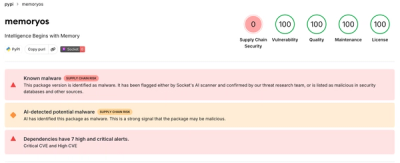
@memofs/connectors






Local connector framework for ingesting external sources into MemoFS memory.
What is this?
The local connector framework for MemoFS. Connectors ingest external sources (GitHub, Notion, …) into .memofs/ through the local engine. The cloud only replicates the resulting files — connectors never run server-side. This is the git/GitHub-Actions model: the config is synced, the credential is fetched live, the work happens on your machine.
Each source is a plugin implementing the provider-neutral Connector interface — the same adapter pattern MemoFS uses for embedders and extractors. Adding a connector later means writing a new adapter, not refactoring the framework.
Installation
npm install @memofs/connectors @memofs/core
Requires Node.js >= 22.
Quick Start
import { MemoFS } from "@memofs/core";
import { createNodeFsMemoryStore } from "@memofs/core/node-fs";
import { runConnectors, EnvSecretResolver } from "@memofs/connectors";
const store = createNodeFsMemoryStore({ rootDir: "./.memofs" });
const memo = new MemoFS({ store, projectId: "my-app" });
const result = await runConnectors({
rootDir: "./.memofs",
memo,
secretResolver: new EnvSecretResolver({ rootDir: "./.memofs" }),
});
console.log(result.written);
console.log(result.skipped);
How it works
.memofs/connectors.json ──► runConnectors() ──► .memofs/notes.md (+ derived indexes)
 (config, no tokens)         (local engine)      (source: "connector")
- Config lives in
.memofs/connectors.json — one of MemoFS's 11 canonical sync units. Each connector row carries an opaque secretRef, never the token.
- Secrets are resolved at run time through an injected
SecretResolver. The token lives in memory only and is never written to disk. The v1 dev fallback reads .memofs/secrets.json (a separate, gitignored, non-synced file); production wires a CloudSecretResolver against GET /v1/projects/:projectId/connectors/:connectorId/secret when the cloud app ships.
- Ingestion runs locally: each connector fetches its source, normalizes items into
ConnectorRecords, and the runner writes them through the local engine with the connector-write discipline (see below).
- The resulting files sync back to the cloud like any other memory file.
The connector-write discipline
Every connector-emitted note is written with three guarantees:
source | "connector" | Discriminates connector content from human-authored notes inside notes.md (no new region). |
sourceRefs[0].sourceId | stable external id ("issue:42") | The dedup key — re-ingest skips already-seen items. |
id | conn_<sha256(externalId:content)[:16]> | Content-derived, no wall-clock. Re-ingesting identical content reproduces identical bytes → the sync manifest reports "no change" → no phantom conflict, no needless upload. |
.memofs/connectors.json
{
 "connectors": [
 {
 "id": "github-main",
 "type": "github",
 "enabled": true,
 "schedule": "@hourly",
 "sourceMapping": { "repository": "owner/repo", "kinds": ["issues", "prs"] },
 "secretRef": "ss_abc123"
 }
 ]
}
The schema ({ id, type, enabled, schedule, sourceMapping, secretRef }) is locked. A row carrying a token/secret/apiKey field is rejected — tokens never ride in the file replica.
Secret resolution
import { EnvSecretResolver, StaticSecretResolver } from "@memofs/connectors";
const resolver = new EnvSecretResolver({ rootDir: "./.memofs" });
const testResolver = new StaticSecretResolver({ ss_abc123: "test-token" });
Implement the SecretResolver interface to wire any backend (a cloud fetch, a vault, a password manager).
Built-in connectors
| GitHub | "github" | Issues, PRs, discussions (GraphQL API) | ✅ Shipped |
| Notion | "notion" | Pages from a database or workspace search (REST API) | ✅ Shipped |
GitHub
import { GitHubConnector, createConnectorRegistry } from "@memofs/connectors";
const registry = createConnectorRegistry();
registry.register(new MyCustomConnector());
await runConnectors({ rootDir, memo, secretResolver, connectorRegistry: registry });
sourceMapping for GitHub:
repository | string | required | "owner/repo" |
kinds | string[] | ["issues", "prs", "discussions"] | Which node types to ingest |
limit | number | 50 | Max items per kind (per-page cost control) |
The token is a fine-grained PAT or OAuth token with read access to the repository. Rate-limit errors are surfaced in result.errors (no retry/backoff in v1).
Notion
Ingests Notion pages from a database (POST /v1/databases/:id/query) or a workspace search (POST /v1/search) via the Notion v1 REST API.
sourceMapping for Notion:
databaseId | string | — | 32-char hex database id (hyphenated or not). Either this or searchQuery is required. |
searchQuery | string | — | Free-text workspace search (falls back when no databaseId). |
limit | number | 50 | Max pages to ingest (cost control). |
The token is a Notion internal integration token (ntn_… / secret_…) with the target database/page shared to the integration. The Notion-Version: 2022-06-28 header is set automatically. Rate-limit errors (403/429) are surfaced in result.errors (no retry/backoff in v1).
Writing a connector
import { type Connector, type ConnectorRecord, type ConnectorIngestContext } from "@memofs/connectors";
class LinearConnector implements Connector {
readonly type = "linear";
readonly displayName = "Linear";
async ingest(ctx: ConnectorIngestContext): Promise<ConnectorRecord[]> {
const records = await fetchLinearIssues(ctx.token, ctx.config.sourceMapping);
return records.map((issue) => ({
externalId: `linear:${issue.id}`,
title: issue.title,
content: issue.description,
url: issue.url,
occurredAt: issue.createdAt,
metadata: { team: issue.team, status: issue.state },
}));
}
}
Boundary
This package owns the connector framework + the built-in connectors. It does not own the MemoFS core write path (@memofs/core), the MCP server, or the CLI command group. It depends on core for writes and accepts the host's MemoFS instance (single-writer contract).
What's not here yet (v1 deferrals)
- CLI
memofs connectors {add|remove|list|run} — lives in packages/cli (the CLI package); wires to this package.
- Cloud
GET .../connectors/:id/secret resolver — ships when the cloud app does.
- Schedule enforcement —
schedule is stored but not acted on; execution happens only while the local runtime is alive (CLI / MCP session / daemon).
Contributing
See our central Contributing Guide and development scripts for details on formatting, linting, and testing within the monorepo.
License
MIT