

Company News
AWS Security Hub Adds Socket for Supply Chain Security
Socket is now in the AWS Security Hub Extended plan. Adopt it through AWS, apply committed spend, and block malicious open source packages.
By Feross Aboukhadijeh - Aug 04, 2026
@memorilabs/memori-mcp
Advanced tools
Memori MCP server — persistent AI memory with recall and augmentation tools
Persistent AI memory for any MCP-compatible agent — no SDK required.
memori-mcp is the official Memori MCP server. Connect it to your AI agent to give it long-term memory: recall relevant facts before answering, store durable preferences after responding, and maintain context across sessions.
Without persistent memory, every session starts from zero. With Memori, your agent:
uv for dependency management" is recalled in future sessions automaticallyentity_id and process_id so preferences never bleed across users or projectsMemori was evaluated on the LoCoMo benchmark for long-conversation memory and achieved 81.95% overall accuracy while using an average of 1,294 tokens per query. That is just 4.97% of the full-context footprint, showing that structured memory can preserve reasoning quality without forcing large prompts into every request.
Compared with other retrieval-based memory systems, Memori outperformed Zep, LangMem, and Mem0 while reducing prompt size by roughly 67% vs. Zep and lowering context cost by more than 20x vs. full-context prompting.
Read the benchmark overview or download the paper.
The server exposes two tools:
| Tool | When to call | What it does |
|---|---|---|
recall | Start of each user turn | Fetches relevant memories for the current query |
advanced_augmentation | After composing a response | Stores durable facts and preferences for future sessions |
Given the message: "I prefer Python and use uv for dependency management."
recall with the user message as queryadvanced_augmentation with the user message and responseOn a later turn — "Write a hello world script" — the agent recalls the Python + uv preference and personalizes its response automatically.
entity_id to identify the end user (e.g. user_123)process_id to identify the agent or workflow (e.g. my_agent)Export these in your shell or replace the placeholders directly in your config:
export MEMORI_API_KEY="your-memori-api-key"
export MEMORI_ENTITY_ID="user_123"
export MEMORI_PROCESS_ID="my_agent"   # optional
| Property | Value |
|---|---|
| Endpoint | https://api.memorilabs.ai/mcp/ |
| Transport | Stateless HTTP |
| Auth | API key via request headers |
| Header | Required | Description |
|---|---|---|
X-Memori-API-Key | Yes | Your Memori API key |
X-Memori-Entity-Id | Yes | Stable end-user identifier (e.g. user_123) |
X-Memori-Process-Id | No | Process, app, or workflow identifier for memory isolation |
session_id is derived automatically as <entity_id>-<UTC year-month-day:hour> — you do not need to provide it.
After configuring any client:
recall and advanced_augmentation appear in the tools listrecall should return a response (even if empty for new entities)advanced_augmentation returns memory being createdIf you receive 401 errors, double-check your X-Memori-API-Key value. See the Troubleshooting guide for more help.
FAQs
Memori MCP server — persistent AI memory with recall and augmentation tools
The npm package @memorilabs/memori-mcp receives a total of 35 weekly downloads. As such, @memorilabs/memori-mcp popularity was classified as not popular.
We found that @memorilabs/memori-mcp demonstrated a healthy version release cadence and project activity because the last version was released less than a year ago. It has 1 open source maintainer collaborating on the project.
Did you know?

Socket for GitHub automatically highlights issues in each pull request and monitors the health of all your open source dependencies. Discover the contents of your packages and block harmful activity before you install or update your dependencies.
Company News
Socket is now in the AWS Security Hub Extended plan. Adopt it through AWS, apply committed spend, and block malicious open source packages.
Research
/Security News
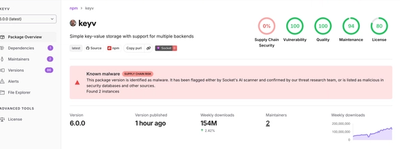
Popular npm packages keyv and cacheable compromised.

Security News
A misconfiguration gave three Anthropic models internet access, and one, believing it was in a simulation, shipped a credential-stealing package to PyPI.