


Product
PHP and Composer Support Is Now in Beta
Socket’s PHP and Composer support is now in Beta for all customers, with PHP reachability analysis generally available.
By Trevor Norris, Benjamin Barslev - Aug 21, 2026
@mindjack/mcp
Advanced tools
Solana memecoin rug check and token risk for trading agents, as MCP tools. pump.fun launches and migrations, calibrated rug probability with a published hit rate, sniper / insider / bundle and fresh-wallet detection, holder clusters, KOL trades, wallet hi
Solana memecoin rug check and token risk for trading agents, as MCP tools: pump.fun launches and migrations, calibrated rug probability, sniper / insider / bundle and fresh-wallet detection, holder clusters, KOL trades, wallet history across every launch indexed, and a live sellability check before you buy. Built for the trenches.
Add to your MCP client config — Claude Desktop, Cursor, Codex, or anything else that speaks MCP:
{
"mcpServers": {
"mindjack": {
"command": "npx",
"args": ["-y", "@mindjack/mcp"]
}
}
}
That is the whole setup. No signup, no card: the server mints a key on first
use, saves it to ~/.config/mindjack/key, and reuses it from then on. A new
key starts empty — fund it with a USDC deposit when you are ready; the free
tools below work before you fund anything, and get_sample answers one real
token in full so you can see every paid tier before spending a cent.
Set MINDJACK_API_KEY to use a specific key instead, or MINDJACK_CONFIG_DIR
to keep it somewhere else.
Prefer to skip keys entirely? The API also speaks x402 — pay per call in USDC on Solana, no account at all.
| Tool | Price | Answers |
|---|---|---|
get_sample | free | One fixed token, answered in full — no key, no payment |
get_coverage | free | What we hold, how fresh, and a mint that works |
get_scorecard | free | Our measured hit rate per risk band |
get_balance | free | What is left on your key |
check_token | $0.001 | Is this one dangerous, and how fast do these collapse |
find_tokens | $0.005 | Which tokens are worth looking at, verdicts attached |
search_tokens | $0.005 /page | Find any token we ever analysed, by symbol, name or mint |
search | $0.005 /page | The same search, shaped for research clients: {id, title, url} rows to cite or pass to fetch |
inspect_token | $0.005 | Who is holding it, and what kind of wallets |
token_wallets | $0.005 | The named wallets behind it: insiders, snipers, fresh, wash, KOLs — with funders and clusters |
token_price_path | $0.005 | What it did after we called it |
can_i_exit | $0.005 | Can it be sold right now — a live Jupiter round trip at $100 and $1000 |
check_wallet | $0.006 | Who is this wallet, across every token we indexed |
kol_leaderboard | $0.02 /page | Every tracked KOL ranked: realized SOL, win rate, recent window |
kol_record | $0.02 | One KOL's full record: per-token history and latest trades |
token_identity | $0.025 | Who is behind it, and how their earlier tokens ended |
token_report | $0.025 | Everything on one token in one call; depth: "full" is $0.07 |
fetch | $0.025 | The same report as one document, keyed by the id a search result gave you |
token_changes | $0.025 | Who sold since we analysed it (reads the chain now) |
test_hypothesis | $0.025 | What happened to tokens shaped like this |
find_serial_insiders | $0.025 / 25 | Who keeps turning up as an insider, across the whole index |
compare_tokens | $0.025 | Were these 2-4 tokens run by the same people |
wallet_network | $0.025 | Who a wallet moves with: counterparts, direction, second hop |
funder_networks | $0.025 /page | Funders seeding fresh wallets index-wide, exchanges named |
token_graph | $0.04 | How the holders are connected: edges, clusters, wash wallets |
token_web | $0.04 | Launches tied to this one through shared wallets, with outcomes and peaks |
search and fetch are aliases, not extra products: same endpoints, same
prices, same billing as search_tokens and token_report. They exist under
those exact names because ChatGPT's deep research and company knowledge modes
look for them by name and connect to nothing without them.
Live feeds (new launches, watched wallets, KOL trades) are server-sent event streams and do not map to MCP tools — the endpoint guide below covers them.
Four read-only documents, all free, attached once rather than called per task. A client can cache them; the model does not have to decide to fetch them.
| URI | What it is |
|---|---|
mindjack://coverage | The window we hold, what is in it, and a live mint guaranteed to have data |
mindjack://scorecard | Every calibrated band with the collapse rate measured for it and its sample size |
mindjack://prices | Every priced route with its price, asset, network and receiving address |
mindjack://sample | One real token answered in full, free, so you can read the shape before buying it |
Three workflows, written down. Each is the order of calls that answers a real question, with what to read out of each step and when the next one is worth its price.
| Prompt | Arguments | Answers |
|---|---|---|
vet_before_buying | mint | Should I take a position in this token? |
find_candidates | hours, min_mcap (optional) | What launched recently that is worth a closer look? |
vet_counterparty | address | Who is this wallet and what has it done before? |
MCP passes prompt arguments as strings, so send "6" rather than 6.
Every tool declares an outputSchema and returns structuredContent beside
the text, so a client can validate the answer and plan the next call from the
field names without paying to discover the shape.
A first run, in the order the server itself recommends:
get_coverage                      -> free; the window, and a mint that works
find_tokens  hours=24 max_rug_pct=45   -> candidates, each with a measured verdict
check_token  mint=<from above>    -> $0.001; structure and collapse speed
token_identity mint=<survivor>    -> $0.025; who is holding it and how their
                                     other tokens ended
max_rug_pct is worth one warning: it is a measured collapse frequency for
a calibrated band, not a score that starts at zero. The safest band we publish
still rugged about 35% of the time, so a threshold under that matches nothing
at any window length. The universe base rate is 45%.
We keep outcomes. Most APIs describe a token as it looks right now. We also
know what happened to every launch we have indexed since March 2026 — tens of
thousands of them — which is why check_token can tell you that tokens scoring
like this one collapsed 78% of the time rather than just handing you a number.
We publish our hit rate. get_scorecard returns the measured accuracy of
every band, refreshed weekly. Nobody who does not keep labelled outcomes can
produce that, and you should not trust a risk score from anyone who won't.
Collapse speed, not just collapse probability. In this market almost everything eventually dies, so "will it" separates weakly. "How fast" separates about tenfold — the worst band's median collapse is 19 seconds from peak, the cleanest is 11 minutes. That is the number that decides whether a position is exitable at all.
Wallets have a past. Millions of recorded wallet appearances. When the same wallets
show up in a new launch, token_identity tells you where else they have been
and how those ended.
_meta.coverage and _meta.billing so you can see exactly
what you got and what it cost.FAQs
Solana memecoin rug check and token risk for trading agents, as MCP tools. pump.fun launches and migrations, calibrated rug probability with a published hit rate, sniper / insider / bundle and fresh-wallet detection, holder clusters, KOL trades, wallet hi
The npm package @mindjack/mcp receives a total of 193 weekly downloads. As such, @mindjack/mcp popularity was classified as not popular.
We found that @mindjack/mcp demonstrated a healthy version release cadence and project activity because the last version was released less than a year ago. It has 1 open source maintainer collaborating on the project.
Product
Socket’s PHP and Composer support is now in Beta for all customers, with PHP reachability analysis generally available.
Product
Socket is bringing experimental protection to Firefox, scanning 97,000+ extensions in Mozilla's official directory for malware and risky updates.
Research
/Security News
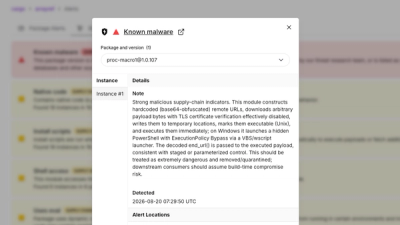
Three compromised Rust crates pulled in a malicious dependency that downloaded and executed cross-platform malware during Cargo builds.