

Company News
AWS Security Hub Adds Socket for Supply Chain Security
Socket is now in the AWS Security Hub Extended plan. Adopt it through AWS, apply committed spend, and block malicious open source packages.
By Feross Aboukhadijeh - Aug 04, 2026
@mlawsonking/code-guard-mcp
Advanced tools
MCP server: security scanner for AI-generated code: the agent scans its own code/diff before committing. Detects injection, SSRF, hardcoded secrets, weak crypto, unsafe deserialization, TLS-off, XSS. Deterministic, free, no LLM.
An MCP server that scans code for security bugs. A coding agent calls it on the code or diff it just produced, before committing or running it. Rule-based, no LLM, free.
More than half of new code is AI-assisted now, and a fair amount of it ships with the usual problems: injection, hardcoded secrets, disabled TLS checks, unsafe deserialization. This catches the common cases in one call. Treat it as a fast first pass, not a substitute for a real security review.
Add it to your MCP client config (Claude Desktop, Cursor, Claude Code, and so on):
{ "mcpServers": { "code-guard": { "command": "npx", "args": ["-y", "@mlawsonking/code-guard-mcp"] } } }
scan_code: scan a snippet. Returns a verdict (pass, review, or block) and a list of findings, each with the rule, category, severity, line number, and a suggested fix. Covers command, code, and SQL injection, SSRF, hardcoded secrets and API keys, weak crypto, unsafe deserialization (pickle, yaml), disabled TLS verification, XSS or template injection, and personal data left in source (email, US SSN, card number).scan_diff: the same scan, but only on the added lines of a unified diff, with correct new-file line numbers. Useful inside a commit loop. It only reads added lines, so a pattern spanning an added line and an untouched one is not seen.list_rules: the full rule catalog, so you can see what it checks and what it doesn't. 32 entries: the 31 code rules, plus one grouped hardcoded-* entry covering 22 credential patterns and 3 personal-data patterns.JS/TS and Python. That is the whole list. 11 rules are JS/TS, 14 are Python, 6 are language-agnostic. There is no Go, Ruby, PHP, Java or Rust ruleset. A language value it doesn't recognise is ignored and the language is sniffed from the source instead, which returns one of three answers: js, py or unknown. Which one depends on what the file happens to contain. import java.util.List; reads as Python, a Go file with a const line reads as JavaScript, a Go file with only func and import "fmt" lands on unknown. Unknown runs all 31 rules against every line, which catches more and flags more things that are not bugs.
The 31 code rules are regexes matched one line at a time. No parser, no data flow, no taint tracking, so it isn't static analysis in the sense a SAST tool means it. It reads text. db.query("SELECT ... " + id) is caught on one line and missed the moment you split it across two. The word DES on a line trips weak-cipher, comment or variable name included. The hardcoded-* patterns are the exception: those run over the whole source, so a multi-line private-key block is still caught. A pass means none of the rules matched, not that the code is safe.
About once a day this server asks the rules feed whether there is a newer ruleset, and applies it if
there is. The request carries two things: which surface asked, which here is facade, and the rules
version already installed. No machine id, no user id, no file names, nothing you scanned.
Bundles are signed with Ed25519 and verified against a public key compiled into this package, so it
does not matter which mirror served one. A bundle that fails its signature, its schema, or its ReDoS
check is discarded and the rules you already had stay in place. --offline turns updates off, as
does AGENT_GUARDS_NO_FEED=1 or {"feed": false} in ~/.agent-guards/config.json. The bundle
format and how to verify one yourself: https://github.com/mlawsonking/MCP/blob/main/rules/README.md
Same input always gives the same output. It calls the API at https://code-guard-api.vercel.app (set CODE_GUARD_API to point at your own copy). One of six agent guards in this repo: package-guard, agent-firewall, payment-guard, email-guard, code-guard, and web-tools. MIT.
FAQs
MCP server: security scanner for AI-generated code: the agent scans its own code/diff before committing. Detects injection, SSRF, hardcoded secrets, weak crypto, unsafe deserialization, TLS-off, XSS. Deterministic, free, no LLM.
We found that @mlawsonking/code-guard-mcp demonstrated a healthy version release cadence and project activity because the last version was released less than a year ago. It has 1 open source maintainer collaborating on the project.
Did you know?

Socket for GitHub automatically highlights issues in each pull request and monitors the health of all your open source dependencies. Discover the contents of your packages and block harmful activity before you install or update your dependencies.
Company News
Socket is now in the AWS Security Hub Extended plan. Adopt it through AWS, apply committed spend, and block malicious open source packages.
Research
/Security News
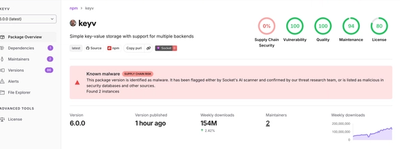
Popular npm packages keyv and cacheable compromised.

Security News
A misconfiguration gave three Anthropic models internet access, and one, believing it was in a simulation, shipped a credential-stealing package to PyPI.