

Company News
AWS Security Hub Adds Socket for Supply Chain Security
Socket is now in the AWS Security Hub Extended plan. Adopt it through AWS, apply committed spend, and block malicious open source packages.
By Feross Aboukhadijeh - Aug 04, 2026
@numeratica/mcp
Advanced tools
Thin stdio MCP bridge to the Numeratica financial-planning API — add retirement, tax, and planning tools to any MCP client with npx.
A thin MCP bridge that connects any MCP client (Claude Desktop, Cursor, …) to the Numeratica financial-planning API — retirement Monte Carlo, taxes, RMDs, Social Security, Roth conversions, and more.
Get a free key at https://docs.numeratica.com.
This package is a transport bridge, nothing more. It reads JSON-RPC from stdin and forwards each message to the hosted POST /mcp endpoint with your API key as a bearer token, then writes the response back to stdout. The tool list and all results come straight from the API — so the bridge always stays in sync and ships no calculation logic of its own. Your key is sent only in the Authorization header and is never logged.
fetch + node:readline).No install needed — your MCP client runs it on demand with npx. (You can also npm i -g @numeratica/mcp to get the numeratica-mcp command.)
Start here. This config needs no signup and no key:
{
  "mcpServers": {
    "numeratica": {
      "command": "npx",
      "args": ["-y", "@numeratica/mcp"]
    }
  }
}
Put it in claude_desktop_config.json (Claude Desktop: Settings → Developer → Edit
Config) or ~/.cursor/mcp.json (Cursor, or a project .cursor/mcp.json), then
restart the client. All 76 tools appear, and you can ask what's available — "What
Numeratica tools do you have?"
Without a key the bridge runs in discovery-only mode: browsing the catalogue works, running a calculation returns a message telling you to add a key. That's the intended state, not a failure.
Get a free key at docs.numeratica.com/get-key, then add one line:
{
  "mcpServers": {
    "numeratica": {
      "command": "npx",
      "args": ["-y", "@numeratica/mcp"],
      "env": { "NUMERATICA_API_KEY": "nmr_sk_your_key_here" }
    }
  }
}
Restart, and the tools are live. Try: "Run a retirement Monte Carlo for a 40-year-old retiring at 65."
| Variable | Required | Default | Notes |
|---|---|---|---|
NUMERATICA_API_KEY | to run calculations | — | Your key. Get one free at docs.numeratica.com/get-key. Never logged. Omit it to browse the catalogue in discovery-only mode. |
NUMERATICA_BASE_URL | no | https://api.numeratica.com | Override the API base (e.g. for testing). |
You can also pass the key with --key <value> or --key=<value> instead of the env
var, but prefer NUMERATICA_API_KEY: a key on the command line is visible to
ps for every user on the machine, lands in shell history, and is stored verbatim
in MCP client config files that people routinely paste into issue reports. For a
non-env option that avoids all three, use --key-file <path>.
MIT © Numeratica / Francis Townsend-Merino
FAQs
Thin stdio MCP bridge to the Numeratica financial-planning API — add retirement, tax, and planning tools to any MCP client with npx.
We found that @numeratica/mcp demonstrated a healthy version release cadence and project activity because the last version was released less than a year ago. It has 1 open source maintainer collaborating on the project.
Did you know?

Socket for GitHub automatically highlights issues in each pull request and monitors the health of all your open source dependencies. Discover the contents of your packages and block harmful activity before you install or update your dependencies.
Company News
Socket is now in the AWS Security Hub Extended plan. Adopt it through AWS, apply committed spend, and block malicious open source packages.
Research
/Security News
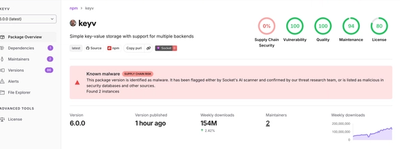
Popular npm packages keyv and cacheable compromised.

Security News
A misconfiguration gave three Anthropic models internet access, and one, believing it was in a simulation, shipped a credential-stealing package to PyPI.