

Security News
/Company News
Securing the Financial Frontier: How Capital One Uses Socket for Open Source Security
Capital One is partnering with Socket to proactively secure its open source supply chain.
By Sarah Gooding - Oct 01, 2026
@omarei/hush
Advanced tools
Envelope-encrypted team secrets your AI agent can use but never read. Zero dependencies, zero servers — your git repo is the backend.

Envelope-encrypted team secrets your AI agent can use but never read.





You keep your API keys in a .env file. It is plaintext, every process you
launch can read it, and the day you pointed an AI coding agent at the repo it
went into the agent's context window — and from there, wherever transcripts go.
hush fixes that without a server, an account, or a shared password. Your
secrets live encrypted inside the repo itself. hush npm run dev puts them
in that one process and nowhere else. Your coding agent gets tools that can
use a key but never read one. A teammate gets access with one command, and
removing them re-encrypts everything. Zero dependencies; one npm install.
hush init acme                  # a vault in .hush/vault.json — commit it
hush add .env --as "Dev"        # your existing secrets, now encrypted, as a set called dev
hush npm run dev                # injected into the process, never onto disk
hush team add sam hush_pk_1xM…  # commit; sam can decrypt. no invite email.
hush team rm sam                # re-keys the vault, re-seals every value
![A .env file goes into a hush vault; what is committed is ciphertext; hush run gives the program the key and prints [redacted:FAL_KEY]](https://github.com/omarei-omoto/hush/raw/HEAD/assets/demo.gif)
[!IMPORTANT] Status: early. This works and is heavily tested, but it is pre-1.0, it has one author, and it has not had an external security review. The crypto is a standard construction (age's, rebuilt on
node:crypto) rather than anything invented here, and there is a differential test suite against an independent reimplementation — but that is not the same as someone qualified having looked at it. docs/REVIEW-SCOPE.md is the brief for the review it needs.Development happens on macOS; Linux is covered by CI. Windows is in beta: your key is kept with DPAPI, approvals are a native Windows dialog,
hush run npm …works throughnpm.cmd, secret files get owner-only ACLs, and there is a PowerShell hook — a Windows CI job checks those paths, but it has not had much real use yet. Fingerprint approval (Windows Hello) is not there yet. Tell me what broke if you try it somewhere unusual.Found a way to read a vault you should not? Please report it privately rather than opening an issue.
One file, no Node needed — macOS, Linux (glibc and musl), and Windows (beta):
curl -fsSL https://raw.githubusercontent.com/omarei-omoto/hush/main/scripts/install.sh | sh
brew install omarei-omoto/tap/hush
irm https://raw.githubusercontent.com/omarei-omoto/hush/main/scripts/install.ps1 | iex
scoop install https://github.com/omarei-omoto/hush/releases/latest/download/hush.json
The installer refuses a binary whose sha256 is not the one in the release's
SHA256SUMS, checks its build-provenance attestation too when the GitHub CLI is
signed in, and installs to ~/.local/bin without sudo. To check a download by
hand: gh attestation verify hush-darwin-arm64 --repo omarei-omoto/hush.
Or from npm, with Node ≥ 22.6:
npm install -g @omarei/hush
From a clone there is no build step — Node ≥ 22.18 runs the TypeScript directly
(on 22.6–22.17, run npm run build first):
git clone https://github.com/omarei-omoto/hush.git
cd hush && node src/cli.ts --help
Node will not strip TypeScript types for anything under node_modules, so an
installed copy cannot run src/. The tarball ships JavaScript in dist/ (built
by npm run build, run automatically by prepack). The hush command decides
by where it lives, not by what exists: under node_modules it runs dist/; in
a checkout (including one npm linked) it runs src/, so a stale build can
never shadow your edits. Still zero runtime dependencies.
cd your-project
hush start
That is the whole thing. It looks for your keys, gets them in, asks whether an AI assistant will be near them, and offers to run your project. A few questions, nothing you have to know already.
Prefer to see every step yourself? The same thing, by hand:
hush init                    # creates your key + a vault, safe to commit
hush add .env --as "Dev"     # what you already have, encrypted, as a set called dev
rm .env                      # you don't need it any more
git add .hush && git commit -m "encrypted secrets"
From now on, put hush in front of whatever you run:
hush npm run dev             # anything after hush runs with the secrets injected
hush dev                     # or: find package.json and run its dev script
Secrets exist in that process's environment and nowhere else. Not on disk, not in your shell, not in your scrollback.
.env files have quietly become the worst artifact in your repo. They are
plaintext, they are readable by every process you launch, and they are now
routinely slurped into an LLM's context — researchers caught a coding agent
uploading whole repos with .env credentials verbatim and
unredacted.
The existing tools each cover part of this:
| What it gets right | What it costs you | |
|---|---|---|
| SOPS / age | per-recipient crypto, real revocation | no idea agents exist; YAML and key juggling |
| secretctl | the agent story | explicitly single-user |
| dotenvx / nevr-env | encrypted file in git | one key for the whole team, so no real revocation |
| 1Password CLI + MCP | real vault, real hardware, real audit, agent access | an account and a subscription for everyone on the team |
| Doppler / Infisical + MCP | proper secrets management, agent access | a server to run or seats to buy |
hush is the local, free, no-account option, not a replacement for the last two. If your team already pays for 1Password or Doppler, their MCP servers do what hush does with better hardware and a real audit trail — use them. hush is for the solo developer and the small team who want age's security model and an agent that cannot read a value, with nothing to sign up for and nothing to deploy: the git repo is the backend.
Where the line is: the moment you need dynamic credentials, leasing, expiry, or an audit log someone else cannot edit, you have outgrown a file in git. hush will not get you there and does not pretend to. Full comparison in RESEARCH.md.
Everything else is in the guide — on GitHub under docs/guide, or as a site at omarei-omoto.github.io/hush.
Very welcome, especially: running it somewhere I cannot (Linux, Windows, a YubiKey I do not own), finding a way to get a value out that should not come out, or telling me where it confused you.
Security problems do not go in issues. Open a private advisory instead.
MIT — see LICENSE.
FAQs
Envelope-encrypted team secrets your AI agent can use but never read. Zero dependencies, zero servers — your git repo is the backend.
The npm package @omarei/hush receives a total of 195 weekly downloads. As such, @omarei/hush popularity was classified as not popular.
We found that @omarei/hush demonstrated a healthy version release cadence and project activity because the last version was released less than a year ago. It has 1 open source maintainer collaborating on the project.
Security News
/Company News
Capital One is partnering with Socket to proactively secure its open source supply chain.
Security News
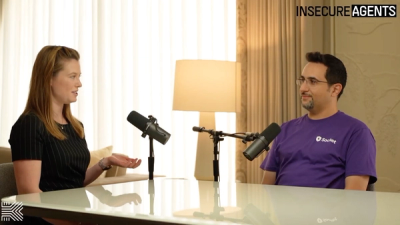
Socket CTO Ahmad Nassri discusses how to keep AI agents from bypassing package blocks, limit credential access, and monitor their actions.

Security News
GPT-6 Astra tried to plant malicious code in simulated open source projects using fake GitHub accounts and deceptive PRs during an assigned CTF challenge.