
Research
/Security News
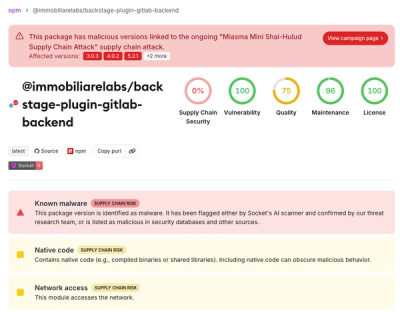
Miasma Mini Shai-Hulud Hits ImmobiliareLabs npm Packages
Miasma Mini Shai-Hulud hits @immobiliarelabs Backstage plugins, targeting GitLab and LDAP auth packages on npm.
By Socket Research Team - Jun 26, 2026
@opvious/stl-settings
Advanced tools
import {
intSetting,
invalidSource,
settingsProvider,
stringSetting,
} from '@opvious/stl-settings';
const settings = settingsProvider((env) => ({
port: intSetting(env.PORT ?? 8080), // Integer value
auth: { // Hierarchical settings
clientID: stringSetting(env.CLIENT_ID ?? 'my-client'), // String value
clientSecret: stringSetting({
source: env.CLIENT_SECRET ?? invalidSource, // Required string value
sensitive: true, // Redact field from parsed sources
}),
},
tag: stringSetting(env.TAG), // Optional string value
}));
const val = settings(); // Parsed values
Importantly, val's type will automatically be inferred as:
{
  readonly port: number;
  readonly auth: {
    readonly clientID: string;
    readonly clientSecret: string;
  }
  readonly tag: string | undefined;
}
If CLIENT_SECRET isn't defined in the environment, the config provider will
throw an informative exception. To test different setting values without needing
mocks, pass in a custom environment when calling the config provider.
const val = settings({
  CLIENT_ID: 'test-id',
  CLIENT_SECRET: 'test-secret',
});
We provide a convenience factory builder for types which do not need any non-standard creation arguments.
import {simpleSettingFactory} from '@opvious/stl-settings';

// A setting which will have values inferred as `Date`s.
const dateSetting = simpleSettingFactory((s): Date => new Date(s));
If additional arguments are desired, it's always possible--just more verbose--to use the underlying setting factory directly. For example, here's one way to implement an enum setting:
import {
  newSetting,
  Setting,
  SettingParams,
  SettingSource
} from '@opvious/stl-settings';

/** Enum setting creation parameters. */
export interface EnumSettingParams<E extends string, S>
  extends SettingParams<S> {
  /** Allowed enum values. */
  readonly symbols: ReadonlyArray<E>;
}

/** Creates a new enum setting. */
export function enumSetting<E extends string, S extends SettingSource>(
  params: EnumSettingParams<E, S>
): Setting<S, E> {
  return newSetting(params, (s): any => {
    if (!~params.symbols.indexOf(s as any)) {
      throw new Error('Invalid enum value');
    }
    return s;
  });
}
In production code, we recommend using modular configuration types. Performing
post-processing on setting values is easy with a settingsManager:
// src/config.ts
import {settingsManager} from '@opvious/stl-settings';

// First the (private) underlying settings resource manager.
const withSettings = settingsManager((env) => ({/* ... */}));

// Then the (public) configuration types. These can be different from the raw
// settings for example discriminated unions are often handy. These are meant
// to be used everywhere in the application. Smaller, more specific, types will
// make testing easier and increase modularity.
export interface ModuleAConfig {/* ... */}
export interface ModuleBConfig {/* ... */}
export interface Config {
  readonly moduleA: ModuleAConfig;
  readonly moduleB: ModuleBConfig;
  // ...
}

// Now the (public, though not meant for use everywhere - see below)
// configuration factory. This function should only be imported in the
// application's entry point and this module's unit-tests. Other modules should
// accept already instantiated configuration types, making testing much easier
// and dependencies explicit.
export const config = withSettings((val) => {
  // Transform the setting values into the public configuration types...
  return {/* ... */};
});
// test/config.test.ts
import * as sut from '../src/config.js';

// Within a test...
const env = {/* ... */}; // Test environment.
expect(config(env)).toEqual(/* ... */); // Expected config for the environment.
FAQs
Standard settings library
We found that @opvious/stl-settings demonstrated a not healthy version release cadence and project activity because the last version was released a year ago. It has 1 open source maintainer collaborating on the project.
Did you know?

Socket for GitHub automatically highlights issues in each pull request and monitors the health of all your open source dependencies. Discover the contents of your packages and block harmful activity before you install or update your dependencies.
Research
/Security News
Miasma Mini Shai-Hulud hits @immobiliarelabs Backstage plugins, targeting GitLab and LDAP auth packages on npm.

Security News
Rolldown paused Rust React Compiler integration after a 5MB binary size increase raised concerns about shipping React-specific code to all Vite users.

Security News
/Research
Mini Shai-Hulud expands into the Go ecosystem after hitting LeoPlatform npm packages and targeting GitHub Actions workflows.