
Product
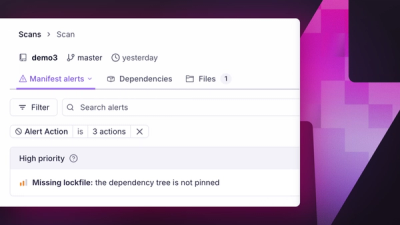
Introducing Manifest Alerts
Socket now detects supply chain risks in project manifests, starting with missing lockfiles that can make dependency installs non-reproducible.
By André Staltz, Trevor Norris - Jun 16, 2026
@orangecheck/relay-filter
Advanced tools
Sybil filter for Nostr relays — reject events from pubkeys without an OrangeCheck proof meeting configurable thresholds.
@orangecheck/relay-filterSybil filter for Nostr relays. Reject events from pubkeys whose OrangeCheck attestation doesn't meet your thresholds. Honest users pay nothing; attackers pay real Bitcoin opportunity cost at scale.
This is the reference implementation for VISION.md pathway 3 — "sybil-filtered infra." Run it on your own relay; license it for commercial deployments; or adapt the primitive into whatever pipeline fits your stack.
yarn add @orangecheck/relay-filter
import { filterEvent } from '@orangecheck/relay-filter';

// On your relay's EVENT write path:
const decision = await filterEvent(event, {
    minSats: 100_000, // at least 100k sats bonded
    minDays: 30, // unspent for at least 30 days
    allowKinds: [0, 3, 10002], // profile meta, contacts, relay list
    allowPubkeys: [operatorHexPubkey], // your own key, always
});

if (decision.action === 'reject') {
    // Nostr OK message: ['OK', event.id, false, msg]
    socket.send(JSON.stringify(['OK', event.id, false, decision.message]));
    return;
}
// accept — store the event
On each call, the filter:
(pubkey, thresholds).@orangecheck/sdk's check() with identity: nostr:<hex pubkey> — discovers the attestation via Nostr relays, verifies the Bitcoin signature, recomputes sats + days from live chain state.{ action: 'accept' | 'reject' | 'shadowReject', reason, message?, check? }.No state beyond the cache. No secrets. No OrangeCheck server in the relay's data path — the SDK talks directly to public Bitcoin explorers and Nostr discovery relays.
Strfry is the most widely-deployed relay implementation. It accepts external policy plugins via a simple stdin/stdout JSON protocol. We ship a ready-made plugin as oc-strfry:
# strfry.conf
writePolicy = {
  plugin = "/usr/local/bin/oc-strfry"
}
Configure via environment variables in the Strfry unit file (or wherever Strfry starts):
| Env var | Default | Meaning |
|---|---|---|
OC_MIN_SATS | 0 | Minimum sats bonded |
OC_MIN_DAYS | 0 | Minimum days unspent |
OC_ALLOW_KINDS | 0,3,10002 | Event kinds that bypass the filter |
OC_ALLOW_PUBKEYS | (none) | Comma-separated hex pubkeys that bypass |
OC_RELAYS | SDK default | Discovery relays for lookups |
OC_FAIL_OPEN | false | Allow events through on lookup failure |
OC_CACHE_TTL_MS | 60000 | Cache TTL |
OC_LOG | true | Emit one log line per decision on stderr |
yarn global add @orangecheck/relay-filter
# makes `oc-strfry` available on PATH
# strfry.conf
writePolicy = {
  plugin = "npx -y @orangecheck/relay-filter"
}
The plugin reads one JSON event per line on stdin:
{ "type": "new", "event": { "id": "...", "pubkey": "...", "kind": 1, ... } }
And writes one decision per line on stdout:
{ "id": "<event_id>", "action": "accept" }
{ "id": "<event_id>", "action": "reject",  "msg": "orangecheck: below threshold" }
{ "id": "<event_id>", "action": "shadowReject" }
Strfry forwards msg to the client as the OK message on reject.
nostr-tools relayIf you're building a relay in JS with nostr-tools, wire filterEvent into the event handler directly:
import { filterEvent } from '@orangecheck/relay-filter';
import { Event, verifyEvent } from 'nostr-tools';

async function handleIncomingEvent(socket: WebSocket, event: Event) {
    if (!verifyEvent(event)) {
        socket.send(JSON.stringify(['OK', event.id, false, 'invalid signature']));
        return;
    }

    const decision = await filterEvent(event, {
        minSats: 100_000,
        minDays: 30,
    });

    if (decision.action === 'reject') {
        socket.send(JSON.stringify(['OK', event.id, false, decision.message]));
        return;
    }

    if (decision.action === 'shadowReject') {
        socket.send(JSON.stringify(['OK', event.id, true, ''])); // lie to client
        return; // do not store
    }

    await store.put(event);
    socket.send(JSON.stringify(['OK', event.id, true, '']));
}
allowKinds on purpose. Kind 0 (profile metadata), kind 3 (contacts), and kind 10002 (relay list) are bootstrap data — users need to publish those before they can create an OC proof. Gating them creates a chicken-and-egg problem. Ephemeral / bootstrap kinds are the only things that bypass by default; everything else (posts, DMs, reactions, zaps) is gated.allowPubkeys. The operator's own key should never be filtered.failOpen: true opts into degraded-mode — useful for non-critical relays.check() already caches lookups for 60 seconds via the hosted API. This package adds a second in-process LRU so a busy relay doesn't even hit the network for hot pubkeys. Decisions stay fresh enough for sybil-gating; bond state changes at Bitcoin's block cadence.nostr-tools' verifyEvent() before calling filterEvent(). We only care about the author's OC proof, not the event integrity.AUTH implementation. Combine with NIP-42 if you also want AUTH-gated reads.nostr: identity. Users bind their npub when they create the attestation; we just look it up.MIT. The OrangeCheck protocol is CC-BY-4.0.
FAQs
Sybil filter for Nostr relays — reject events from pubkeys without an OrangeCheck proof meeting configurable thresholds.
We found that @orangecheck/relay-filter demonstrated a healthy version release cadence and project activity because the last version was released less than a year ago. It has 1 open source maintainer collaborating on the project.
Did you know?

Socket for GitHub automatically highlights issues in each pull request and monitors the health of all your open source dependencies. Discover the contents of your packages and block harmful activity before you install or update your dependencies.
Product
Socket now detects supply chain risks in project manifests, starting with missing lockfiles that can make dependency installs non-reproducible.

Research
/Security News
The trojanized extensions use TinyGo-compiled WebAssembly and Solana transaction memos to resolve command-and-control infrastructure.

Security News
Anthropic says the directive cited national security concerns over a narrow jailbreak, but offered no specific technical details.