
Security News
The Code You Didn't Write Is Still Yours to Defend
AI agents are pulling packages into environments no scanner is watching, creating exposure before security teams can see it.
By Brad Arkin - Jun 23, 2026
@osovv/grace-cli
Advanced tools
GRACE CLI for linting, status snapshots, module health, verification queries, semantic markup, and querying GRACE artifacts with a Bun-powered grace binary.
GRACE means Graph-RAG Anchored Code Engineering: a contract-first AI engineering methodology built around semantic markup, shared XML artifacts, verification planning, and knowledge-graph navigation.
This repository ships the GRACE skills plus the optional grace CLI. It is a packaging and distribution repository, not an end-user application.
Current packaged version: 3.11.0
skills/grace/*plugins/grace/skills/grace/*.claude-plugin/marketplace.jsonplugins/grace/.claude-plugin/plugin.jsonopenpackage.yml@osovv/grace-cliThe published CLI currently gives you:
grace lint for integrity checksgrace lint --profile autonomous for autonomy-readiness checksgrace status for project health, autonomy gate, and next-action guidancegrace module find for module resolution across shared docs and file-local markupgrace module show for shared/public module contextgrace file show for file-local/private implementation contextGRACE is designed for AI-assisted engineering where agents need stable navigation, explicit contracts, and reusable verification evidence.
Core ideas:
GRACE is process-first, not prompt-first:
This makes it easier to:
GRACE was designed by Vladimir Ivanov (@turboplanner).
Install skills first.
Skills and CLI are complementary, but they are distributed differently.
opkg install gh@osovv/grace-marketplace
opkg install gh@osovv/grace-marketplace -g
opkg install gh@osovv/grace-marketplace --platforms claude-code
/plugin marketplace add osovv/grace-marketplace
/plugin install grace@grace-marketplace
git clone https://github.com/osovv/grace-marketplace
cp -r grace-marketplace/skills/grace/grace-* /path/to/your/agent/skills/
The CLI is a companion to the GRACE skills, not a replacement for them.
Requires bun on PATH.
bun add -g @osovv/grace-cli
grace lint --path /path/to/grace-project
For a new GRACE project:
$grace-initdocs/requirements.xml and docs/technology.xml together with your agent$grace-plan$grace-verificationgrace lint --profile autonomous --path /path/to/projectgrace status --path /path/to/project$grace-execute or $grace-multiagent-executeFor an existing GRACE project, the CLI is often the fastest way to orient yourself:
# Integrity gate
grace lint --path /path/to/project
grace lint --profile autonomous --path /path/to/project

# Health + next action
grace status --path /path/to/project

# Resolve the relevant module
grace module find auth --path /path/to/project
grace module find src/provider/config-repo.ts --path /path/to/project --json

# Read shared/public context
grace module show M-AUTH --path /path/to/project
grace module show M-AUTH --path /path/to/project --with verification

# Read file-local/private context
grace file show src/auth/index.ts --path /path/to/project
grace file show src/auth/index.ts --path /path/to/project --contracts --blocks
| Skill | Purpose |
|---|---|
grace-init | Bootstrap the GRACE docs, templates, and agent guidance |
grace-plan | Design modules, phases, flows, dependencies, and contracts |
grace-verification | Build and maintain verification-plan.xml, tests, traces, and log evidence |
grace-execute | Execute the plan sequentially with scoped review and commits |
grace-multiagent-execute | Execute parallel-safe waves with controller-managed synchronization |
grace-refactor | Rename, move, split, merge, and extract modules without shared-artifact drift |
grace-fix | Debug issues from graph, contracts, tests, traces, and semantic blocks |
grace-refresh | Refresh graph and verification artifacts against the real codebase |
grace-reviewer | Review semantic integrity, graph consistency, and verification quality |
grace-status | Report overall project health and suggest the next safe action |
grace-ask | Answer architecture and implementation questions from project artifacts |
grace-cli | Use the optional grace binary as a fast lint and artifact-query layer for GRACE projects |
grace-explainer | Explain the GRACE methodology itself |
grace-setup-subagents | Scaffold shell-specific GRACE worker and reviewer presets |
| Command | What It Does |
|---|---|
grace lint --path <root> | Validate current GRACE artifacts, semantic markup, unique XML tags, and export/map drift |
grace lint --profile autonomous --path <root> | Enforce autonomy readiness for execution packets, verification coverage, observable evidence, and operational-packet presence |
grace status --path <root> | Report artifact health, codebase metrics, integrity snapshot, autonomy gate, recent changes, and the next safe action |
grace module find <query> --path <root> | Search by module ID, name, path, purpose, annotations, dependency IDs, verification IDs, and LINKS |
grace module show <id-or-path> --path <root> | Show the shared/public module record from plan, graph, steps, and linked files |
grace module show <id> --with verification --path <root> | Include verification excerpt when a V-M-* entry exists |
grace file show <path> --path <root> | Show file-local MODULE_CONTRACT, MODULE_MAP, and CHANGE_SUMMARY |
grace file show <path> --contracts --blocks --path <root> | Include scoped contracts and semantic block navigation |
Current output modes:
grace lint: text, jsongrace status: text, jsongrace module find: table, jsongrace module show: text, jsongrace file show: text, jsonGRACE 3.8 pushes more of the autonomous-execution discipline into the product surface:
grace lint --profile autonomous acts as a cheap readiness gate before long runsgrace status surfaces whether the project is healthy enough for execution or needs planning, verification, or refresh work firsttechnology.xml should name preferred stacks, test tools, and observability surfaces so workers stay on approved, high-reliability pathsoperational-packets.xml should define assumptions, stop conditions, retry budgets, and checkpoint fields so workers can stop or replan without hidden reasoningGRACE works best when shared docs stay public and stable, while private detail stays close to code.
Use shared XML artifacts for:
Use file-local markup for:
MODULE_CONTRACTMODULE_MAPCHANGE_SUMMARYRule of thumb:
grace module show is the shared/public truthgrace file show is the file-local/private truthGRACE is designed to be easy to navigate through exact-text search.
Prefer this order when narrowing scope:
docs/knowledge-graph.xml, docs/development-plan.xml, docs/verification-plan.xmlMODULE_CONTRACT, MODULE_MAP, START_CONTRACT:, START_BLOCK_, START_CHANGE_SUMMARY, LINKS:Common anchors:
M- for module IDsV-M- for verification IDsCrossLink for graph edgesSTART_MODULE_CONTRACTSTART_MODULE_MAPSTART_CONTRACT:START_BLOCK_START_CHANGE_SUMMARYLINKS:Copy-paste grep recipes:
# find module records in shared docs
grep -R -n -E '\bM-[A-Z0-9]+(-[A-Z0-9]+)*\b' docs/development-plan.xml docs/knowledge-graph.xml

# find verification entries in shared docs
grep -R -n -E '\bV-M-[A-Z0-9]+(-[A-Z0-9]+)*\b' docs/verification-plan.xml docs/knowledge-graph.xml

# find graph links from file-local markup into shared docs
grep -R -n 'LINKS:' src tests

# find file-level GRACE contracts
grep -R -n 'START_MODULE_CONTRACT\|START_MODULE_MAP\|START_CHANGE_SUMMARY' src tests

# find function/type contracts and logic blocks
grep -R -n 'START_CONTRACT:\|START_BLOCK_' src tests

# find all mentions of one module ID everywhere
grep -R -n 'M-XXX' docs src tests

# find all verification references for one module everywhere
grep -R -n 'V-M-XXX\|M-XXX' docs src tests
Normalization rules behind these patterns:
M- prefix onlyV-M- prefix only| Artifact | Role |
|---|---|
docs/requirements.xml | Product intent, scope, use cases, and requirements |
docs/technology.xml | Stack, tooling, constraints, runtime, and testing choices |
docs/development-plan.xml | Modules, contracts, implementation order, phases, and flows |
docs/verification-plan.xml | Verification entries, test commands, scenarios, and required markers |
docs/knowledge-graph.xml | Module map, dependencies, public annotations, and navigation graph |
docs/operational-packets.xml | Canonical execution packet, delta, and failure handoff templates |
src/**/* and tests/**/* with GRACE markup | File-local module context, contracts, and semantic block boundaries |
$grace-init
design requirements.xml and technology.xml together with your agent
$grace-plan
$grace-verification
$grace-execute or $grace-multiagent-execute
grep "M-" docs/development-plan.xml docs/knowledge-graph.xml
grace module find <name-or-path>
grace module show M-XXX --with verification
grep "LINKS:" src tests
grace file show <governed-file> --contracts --blocks
grace lint --path <project-root>
grace status --path <project-root>
$grace-reviewer
$grace-refresh
grep "V-M-" docs/verification-plan.xml docs/knowledge-graph.xml
grace module find <error-or-path>
grace module show M-XXX --with verification
grep "START_BLOCK_" src tests
grace file show <governed-file> --contracts --blocks
$grace-fix
| Path | Purpose |
|---|---|
skills/grace/* | Canonical skill sources |
plugins/grace/skills/grace/* | Packaged mirror used for marketplace distribution |
.claude-plugin/marketplace.json | Marketplace entry and published skill set |
plugins/grace/.claude-plugin/plugin.json | Packaged plugin manifest |
src/grace.ts | CLI entrypoint |
src/grace-lint.ts | grace lint command |
src/grace-module.ts | grace module find/show commands |
src/grace-verification.ts | grace verification find/show commands |
src/grace-file.ts | grace file show command |
src/query/* | Artifact loader, index, and render layer for CLI queries |
scripts/validate-marketplace.ts | Packaging and release validation |
scripts/release-checklist.ts | Release hygiene checklist for the current version and workflow coverage |
.github/workflows/validate.yml | CI workflow for tests, CLI validation, and marketplace checks |
examples/cli/* | Sample CLI flows and packet examples |
RELEASING.md | Manual release checklist and validation commands |
skills/grace/* as the source of truth unless the task is explicitly about packaged output.plugins/grace/skills/grace/* synchronized with the canonical skill files.README.md, package.json, openpackage.yml, .claude-plugin/marketplace.json, and plugins/grace/.claude-plugin/plugin.json.bun run ./scripts/validate-marketplace.ts.bun run validate:ci.skills/grace/ is published; the actual shipped set is declared in .claude-plugin/marketplace.json.Install dependencies:
bun install
Run the test suite:
bun test
Run the CLI against the repository itself:
bun run validate:cli
Run marketplace and packaging validation:
bun run validate:marketplace
Run the full CI-compatible validation stack:
bun run validate:ci
bun run release:checklist
Smoke test the query layer against a real GRACE project:
bun run ./src/grace.ts module show M-AUTH --path /path/to/grace-project --with verification
bun run ./src/grace.ts file show src/auth/index.ts --path /path/to/grace-project --contracts --blocks
MIT
FAQs
GRACE CLI for linting, status snapshots, module health, verification queries, semantic markup, and querying GRACE artifacts with a Bun-powered grace binary.
The npm package @osovv/grace-cli receives a total of 216 weekly downloads. As such, @osovv/grace-cli popularity was classified as not popular.
We found that @osovv/grace-cli demonstrated a healthy version release cadence and project activity because the last version was released less than a year ago. It has 1 open source maintainer collaborating on the project.
Did you know?

Socket for GitHub automatically highlights issues in each pull request and monitors the health of all your open source dependencies. Discover the contents of your packages and block harmful activity before you install or update your dependencies.
Security News
AI agents are pulling packages into environments no scanner is watching, creating exposure before security teams can see it.

Security News
GitHub Actions checkout now blocks risky pull_request_target checkouts by default to help prevent pwn request supply chain attacks.
Product
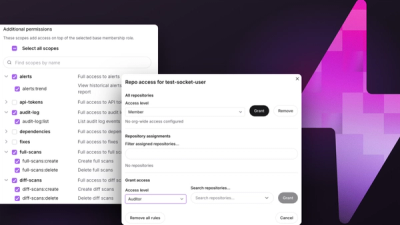
Socket now supports Custom Roles and Repository Access Permissions so organizations can control who can access specific repositories and actions.