

Company News
AWS Security Hub Adds Socket for Supply Chain Security
Socket is now in the AWS Security Hub Extended plan. Adopt it through AWS, apply committed spend, and block malicious open source packages.
By Feross Aboukhadijeh - Aug 04, 2026
@patrizzos/stylespeak
Advanced tools
MCP server and CLI that makes CSS legible to AI agents — resolves cascade, traces properties, explains what applies and why.
A companion MCP server and CLI to stylesafe that makes CSS legible to AI agents — resolving cascade, tracing properties, predicting change impact, and explaining what applies and why before an agent touches a single line of styles.
AI coding agents write CSS without being able to see its effect. They modify a rule, assume it worked, and move on — unaware that a higher-specificity rule elsewhere already overrides it, a combinator rule in another file is silently winning, or a CSS variable resolves to something entirely different than expected. stylespeak gives agents a structured knowledge layer to consult before making changes.
resolve_styles — answers "what CSS actually applies to this selector?"
Given a selector and a set of files, returns every CSS property the selector would receive, which rule wins for each, and which rules were overridden — with confidence levels since no real DOM is available. CSS custom properties (var()) are resolved to their actual values, including chained variables, fallbacks, and media-context overrides.
trace_property — answers "everywhere this property is set, who wins?"
Given a property name and a set of files, returns every rule that sets it, groups competing rules that target overlapping selectors, and shows the full cascade chain for each group — with resolved variable values included.
impact_preview — answers "if I change this, what else breaks?"
Given a selector, property, and optional new value, predicts the full blast radius of the change before it's made — showing which selectors will see a different value, which are shielded by higher specificity, which cascade relationships are uncertain, and which downstream rules are affected through CSS variable chains or property inheritance. Works without a browser.
style_manifest — answers "what does this entire project's CSS look like at a glance?"
Builds a compressed, structured summary of a project's entire CSS knowledge — selectors, properties, variables, competition groups, and risk hotspots — that an agent can load once at the start of a session and keep in context instead of repeatedly querying individual files.
live_resolve — answers "what does the browser actually compute for this selector?"
Queries a running Chromium browser via CDP and returns exact computed styles and matched rules. No heuristics, no confidence levels — the browser resolved it. Requires Chrome running with --remote-debugging-port=9222.
npm install -g @patrizzos/stylespeak
stylespeak resolve ".btn.primary" src/styles/main.css
stylespeak trace "color" --projectRoot src/styles
stylespeak impact ".btn" "background-color" src/styles/main.css --newValue "#ff0000"
stylespeak manifest --projectRoot src/styles
Add to your MCP client config (Cursor: .cursor/mcp.json, VS Code: .vscode/mcp.json):
{
  "mcpServers": {
    "stylespeak": {
      "command": "node",
      "args": ["/absolute/path/to/stylespeak/src/server.js"]
    }
  }
}
Once connected, agents can call:
resolve_styles({ selector, files, projectRoot, componentFiles? })trace_property({ property, files, projectRoot })impact_preview({ selector, property, newValue?, files, projectRoot })style_manifest({ files?, projectRoot?, maxSelectors? })live_resolve({ selector, port?, tabUrl? })stylespeak impact ".btn" "background-color" src/styles/buttons.css --newValue "#ff0000"
{
  "change": {
    "selector": ".btn",
    "property": "background-color",
    "currentValue": "var(--color-primary)",
    "newValue": "#ff0000"
  },
  "blastRadius": {
    "total": 3,
    "valueChanges": 1,
    "shielded": 1,
    "risks": 0,
    "variableDownstream": 0,
    "inheritanceDownstream": 1
  },
  "riskLevel": "low",
  "safeToChange": true,
  "impacts": [
    {
      "type": "value-change",
      "affectedSelector": ".btn",
      "currentValue": "var(--color-primary)",
      "newValue": "#ff0000",
      "confidence": "certain"
    },
    {
      "type": "shielded",
      "affectedSelector": ".btn.primary",
      "shieldingValue": "darkblue",
      "confidence": "certain",
      "reason": ".btn.primary has higher specificity — elements with both classes won't be affected"
    }
  ],
  "summary": "1 selector will see a different value, 1 selector is shielded by higher specificity.",
  "agentNote": "Change appears safe to make. Shielded selectors are safe — higher-specificity rules protect those elements."
}
stylespeak resolve ".btn" src/styles/buttons.css
{
  "properties": {
    "background-color": {
      "winner": {
        "value": "var(--color-primary)",
        "resolvedValue": "#2563eb",
        "variableChain": ["--color-primary → #2563eb"],
        "selector": ".btn",
        "specificity": "(0,0,1,0)"
      },
      "confidence": "certain"
    }
  },
  "variables": { "--color-primary": { "value": "#2563eb", "selector": ":root" } }
}
| Level | Meaning |
|---|---|
certain | Exact selector match — rule definitively applies |
likely | Rule tokens are a subset of the queried selector — applies in most cases |
possible | Combinator rule — depends on DOM ancestry, unknown without rendering |
exact | Returned by live_resolve only — browser-resolved, no heuristics |
As of v0.2, stylespeak fully resolves CSS custom properties (var()) in all output:
value — the raw value as written (var(--color-primary))resolvedValue — the actual resolved value (#2563eb)variableChain — the full resolution path, including chained variablesconditionalValues — media-context overrides where the variable resolves differentlySupported: simple, fallback, nested fallback, chained, scoped, media-context, circular reference protection.
stylesafe catches problems in your CSS — conflicts, dead rules, Tailwind clashes — before they ship.
stylespeak explains your CSS — resolving cascade, tracing properties, predicting impact, resolving variables — so agents understand before they act.
Use stylesafe as a post-edit check. Use stylespeak as a pre-edit consultation. Together they give AI coding agents a complete feedback loop on styles.
live_resolve requires a Chromium browser running with remote debugging enabled:
# Windows
chrome.exe --remote-debugging-port=9222

# macOS
/Applications/Google\ Chrome.app/Contents/MacOS/Google\ Chrome --remote-debugging-port=9222

# Linux
google-chrome --remote-debugging-port=9222
Security note: Never run
--remote-debugging-porton a machine exposed to untrusted networks or in production. This flag opens a local API that any process on the machine can connect to.
| Format | Support level |
|---|---|
.css | Full |
.scss | Full — nesting, & references, @media passthrough |
.module.css / .module.scss | Full — locally scoped classes detected and tagged |
| vanilla-extract / Linaria / StyleX | Supported via compiled CSS output |
| styled-components / Emotion | Not supported — dynamic runtime styles |
| CSS-in-JS object syntax | Not supported (post v1.0 roadmap) |
src/
  cssParser.js            — CSS tokenizer with SCSS nesting support
  specificity.js          — standard (id, class, type) specificity calculator
  cssomBuilder.js         — in-memory cascade model builder
  selectorMatcher.js      — heuristic selector matching with confidence levels
  variableResolver.js     — CSS custom property resolution
  cssModulesAnalyzer.js   — CSS Modules local scope detection
  scssNestingExpander.js  — SCSS nesting pre-processor
  astComponentGraph.js    — AST component graph for graph-aware matching
  resolveStyles.js        — resolve_styles tool
  traceProperty.js        — trace_property tool
  impactPreview.js        — impact_preview tool
  styleManifest.js        — style_manifest project-wide knowledge builder
  cdpBridge.js            — Chrome DevTools Protocol WebSocket client
  liveResolve.js          — live_resolve tool
  server.js               — MCP server (stdio JSON-RPC) + CLI entry point
Zero external dependencies. Requires Node.js 21+.
FAQs
MCP server and CLI that makes CSS legible to AI agents — resolves cascade, traces properties, explains what applies and why.
We found that @patrizzos/stylespeak demonstrated a healthy version release cadence and project activity because the last version was released less than a year ago. It has 1 open source maintainer collaborating on the project.
Did you know?

Socket for GitHub automatically highlights issues in each pull request and monitors the health of all your open source dependencies. Discover the contents of your packages and block harmful activity before you install or update your dependencies.
Company News
Socket is now in the AWS Security Hub Extended plan. Adopt it through AWS, apply committed spend, and block malicious open source packages.
Research
/Security News
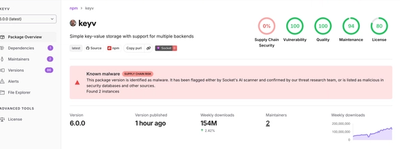
Popular npm packages keyv and cacheable compromised.

Security News
A misconfiguration gave three Anthropic models internet access, and one, believing it was in a simulation, shipped a credential-stealing package to PyPI.