

Company News
AWS Security Hub Adds Socket for Supply Chain Security
Socket is now in the AWS Security Hub Extended plan. Adopt it through AWS, apply committed spend, and block malicious open source packages.
By Feross Aboukhadijeh - Aug 04, 2026
@peekdev/mcp
Advanced tools
local-first browser-session forensics + repro for AI coding agents. peek's native messaging host + stdio MCP server — owns ~/.peek/sessions.db (better-sqlite3) and bridges the browser extension, CLI, and AI tools to one local source of truth.

Let your AI coding agent debug what already happened in your real browser — peek reads your locally-recorded sessions (DOM history, console & network errors, the action right before a failure) over MCP and turns them into a runnable Playwright repro. Local-first: peek uploads nothing — what your MCP client does with the data is up to you.







Docs: https://peek.cubenest.in
@peekdev/mcp is two things in one binary:
~/.peek/sessions.db.The same binary handles both roles — chosen by argv. You don't install this package directly in normal use; the @peekdev/cli peek init wizard wires it into your AI client's MCP config and into Chrome's NativeMessagingHosts/.
Requires Node.js ≥ 22. The native
better-sqlite3dependency only ships prebuilt binaries for Node 22+ — on Node 20 (notably Windows, which has no C/C++ toolchain by default) the install falls back to compiling from source and fails. Use Node 22 or newer.
@peekdev/cli insteadnpm install -g @peekdev/cli
peek init
Read on if you're configuring the MCP server manually, building tooling against it, or want the protocol/tool reference.
execute_action, request_authorization) are gated by the per-origin permission model (off by default) + the destructive blocklist + the audit-log writer. The cross-process IPC that delivers them to the browser native host (LocalSocketHostBridge ↔ HostSocketServer over ~/.peek/host.sock) is now wired: at Level 3 every action prompts the side-panel confirm banner before it runs. The real-browser MAIN-world dispatch + banner UX are covered by the Playwright E2E (e2e/smoke.spec.ts); the bridge, relay, dispatcher, and confirm logic are unit-tested.chrome.debugger access from the MCP server.
Click the button (or paste the link into Cursor) and Cursor prompts to add peek to ~/.cursor/mcp.json — no terminal needed. This wires the MCP server only; to capture sessions you still run peek init once (registers the native messaging host) and install the Chrome extension.
If you use Claude Code, install peek as a plugin in one step:
/plugin marketplace add Cubenest/rrweb-stack
/plugin install peekdev@peek
That wires up this MCP server (18 tools) plus the peek skill. You still need the
recorder — run npx @peekdev/cli init once and install the peek Chrome
extension — before there are sessions to read. Local-first: peek uploads nothing
— what your MCP client does with the data is up to you.
If peek init doesn't recognize your client, paste this into your client's MCP server registry:
{
  "mcpServers": {
    "peek": {
      "command": "npx",
      "args": ["-y", "@peekdev/mcp@latest"]
    }
  }
}
The @latest tag is required while peek is in alpha: every published version is a
prerelease (0.1.0-alpha.*), and a bare npx -y @peekdev/mcp resolves the
implicit * range, which doesn't match prereleases (ETARGET: No matching version found for @peekdev/mcp@*). Pinning @latest forces the newest published
build.
PEEK_HOME defaults to ~/.peek; set it via env only if you want a non-default capture directory.
The per-user config paths peek init writes to (canonical, see packages/peek-cli/src/lib/init-config.ts):
| Client | Path |
|---|---|
| Claude Code | ~/.claude.json (or claude mcp add) |
| Cursor | ~/.cursor/mcp.json |
| VS Code (MCP) | ~/.vscode/mcp.json |
| Windsurf | ~/.codeium/windsurf/mcp_config.json |
| Cline | ~/cline_mcp_settings.json |
| Tool | Action | Authorization |
|---|---|---|
list_recent_sessions | List recently recorded sessions, newest first (id, origin, ts, event count) | none |
search_sessions | Find sessions by text in title/URL/origin plus facets (origin, date range, status, console/network errors). Read-only; returns the same rows as list_recent_sessions. | none |
get_session_summary | LLM-readable narrative summary of a session | none |
get_session_console_errors | List console errors recorded in a session | none |
get_session_network_errors | List failed/notable network requests in a session | none |
get_user_action_before_error | Pre-assembled causal chain for a console error: time-ordered timeline (user action → DOM mutation → network/console error), grouped actions/domMutations/networkErrors, the seed error, a deterministic narrative, and windowMs bounding the correlated window. Backward-compatible: errorId/errorTs/actions are still present. | none |
generate_playwright_repro | Generate a runnable Playwright test from a session. Emits semantic locators (getByTestId/getByRole/getByPlaceholder/getByText, uniqueness-checked, CSS fallback). Accepts an optional errorId that seeds a console-error-absence assertion so the repro fails while the bug is present and passes once fixed. | none |
get_dom_snapshot | Reconstruct the DOM of a recorded session at a given timestamp (forensic) | none |
query_dom_history | Two modes: selector mode — timeline of attribute/text changes for one node (as before); window mode (ts + optional windowMs, no selector) — all DOM changes in a time window with target hints. | none |
get_page_view | Live, masked, ref-tagged list of interactive elements — target a ref in write actions instead of a CSS selector (cheaper + deterministic than get_dom_snapshot) | per-origin Level 1+ |
get_element_detail | Full masked detail for one ref from get_page_view (role, name, all aria-*, state, value, href, position, nearby heading, direct interactive children with their refs) — drill in only on the element you need to disambiguate or act on | per-origin Level 1+ |
request_authorization | Side-panel consent for write actions (Level 3) | per-action user prompt |
execute_action | Dispatch a UI action (gated by permission level + destructive blocklist). Pass observe: true on a mutating action (click/type/scroll/enter/dblclick/navigate/…) to also get back a details.viewDelta of what changed (added/removed/changed refs) in one round-trip — instead of re-calling get_page_view | permission level + destructive blocklist |
suggest_element | Highlight an element via a non-destructive overlay | per-origin Level 2+ |
clear_highlight | Remove the highlight overlay | per-origin Level 2+ |
set_intent | Set the control-shield status banner | per-origin Level 4 |
request_user_input | Pause and hand a field back to the user, then resume | per-origin Level 4 |
verify_audit_log | Verify peek's local action audit log (~/.peek/audit.log) is an intact, tamper-evident hash chain. Returns status (intact / broken / truncated / tail-tampered / prefix-tampered / gaps / incomplete-final / head-missing) + entry count and a short message. Read-only. | none |
The full tool list is exposed via the MCP tools/list request (spec 2025-11-25 + back-compat for 2025-03-26). Tool docs ship with the binary via tools/list response description fields.
Per-origin, 5 levels (0–4). Default is Level 1 — Read-only. Higher levels are opt-in per origin.
| Level | Name | What it allows | Default |
|---|---|---|---|
| 0 | Off | Recording suppressed, tool surface disabled for the origin | |
| 1 | Read-only | Read recorded sessions; no action execution | enabled |
| 2 | Suggest-only | Read + highlight DOM via overlay; no DOM mutation | |
| 3 | Act-with-confirm | Read + execute actions, each prompting Allow once / Always for this site / Deny | |
| 4 | YOLO this session | Read + execute non-destructive actions with no prompt (auto-expires on tab close or 60 min) |
At Level 3 every execute_action call prompts the user via the side-panel banner (unless a one-shot confirmToken from a prior request_authorization is passed). At Level 4 (YOLO) non-destructive actions are auto-allowed with no prompt. Levels 0–2 deny execute_action.
Destructive-action blocklist (cross-level override) — independent of the level, any action whose resolved target text/label matches a destructive term (delete, remove, transfer, send, pay, withdraw, etc. — full base list in permissions/destructive.ts, extensible via ~/.peek/policy.json) always prompts for confirmation. This overrides all levels, including Level 4 YOLO — it is not a separate "Level 5".
Every execute_action and request_authorization call is appended to ~/.peek/audit.log (JSONL, mode 0600 — peek audit log --json prints it), including denied ones. Each entry carries a seq counter and a prevHash field (SHA-256 of the previous line); a sidecar audit.head.json records the tail hash for truncation detection. Run peek audit verify to recompute the chain and confirm it is intact. The log is tamper-evident, not tamper-proof — it detects corruption, truncation, and reordering, but not a determined attacker who recomputes the chain. No keys, no external anchor, no egress.
The write-path is wired end to end: the five-level model, the destructive blocklist, and the audit-log writer are enforced inside peek-mcp (observable via ~/.peek/audit.log), and the cross-process IPC that lets execute_action fire a click in the browser now lands — a LocalSocketHostBridge (MCP process) ↔ HostSocketServer (native host) over ~/.peek/host.sock, a MAIN-world action dispatcher (click/type/navigate/scroll), and a side-panel confirm banner. Both write levels are implemented: Level 3 (act-with-confirm — every action prompts the banner) and Level 4 (YOLO — non-destructive actions auto-allow, destructive ones still prompt via the blocklist override). Both are opt-in per origin; the default stays Level 1 (read-only). Level 2 highlight (suggest_element / clear_highlight) and the Level-4 control tools (set_intent, request_user_input) are also implemented. The real-browser dispatch + banner are covered by the Playwright E2E (e2e/smoke.spec.ts).
~/.peek/sessions.db — SQLite (better-sqlite3, WAL mode). Schema in src/db/migrations/. The CLI opens this DB read-mostly; the native host writes it during extension capture; the MCP server reads it for tool calls.
The native host is the only writer. The CLI and MCP server only read (except for the audit log, which is append-only JSONL on disk, not in the DB).
For consumers building tooling on top of peek:
import { generatePlaywrightRepro } from '@peekdev/mcp/mcp/playwright-repro';
import { loadSessionEvents } from '@peekdev/mcp/mcp/event-blobs';
import { openDb, peekHomeDir } from '@peekdev/mcp/db';
import { buildManifest, installManifests } from '@peekdev/mcp/native-host';
These are the subpath exports the @peekdev/cli package uses. API surface is small but stable.
Semantic Versioning. Currently 0.1.0-alpha.x — pre-release; tool schemas are stable in spirit but new tools may land in patch releases. See SUPPORTED.md for the compatibility matrix (MCP protocol versions, Chrome stable channels, Node versions).
Per-release changes are recorded in the CHANGELOG.
Local-only. No network destinations. No telemetry. The MCP transport is stdio over a child-process pipe — your AI client launches peek-mcp, talks to it over stdin/stdout, and kills it when done. The binary holds no persistent state outside ~/.peek/.
Full data-handling policy: docs/peek/PRIVACY_POLICY.md. Threat model: docs/peek/THREATMODEL.md.
This section is for the maintainer's submission workflow at Phase 5 launch. If you're a user, you don't need any of this — just
npx @peekdev/cli init.
peek is listed (or queued for listing) on the discovery surfaces below. Each linked file is a submission scaffold with pre-filled metadata audited against the registry's current schema as of 2026-05-30 — not a user-facing install guide.
server.json for registry.modelcontextprotocol.io via mcp-publisher CLI. Downstream registries (PulseMCP, others) ingest from here.smithery mcp publish.peek init.Launch order is documented in docs/peek/distribution/README.md (CWS first, then the MCP-registry fan-out). The Chrome Web Store listing is submitted + live: chromewebstore.google.com/detail/peek/dmgpmkeneheenpdnfmpjjahnkknkaejb.
@peekdev/cli — the peek init wizard that wires this MCP server into your AI client and installs the native messaging host. Start here.@peekdev/extension — the Chrome MV3 extension that records masked browser sessions and writes them to ~/.peek/sessions.db. Available on the Chrome Web Store; contributors can also load it unpacked from packages/peek-extension/chrome-mv3/ for local builds. The npm package stays private (not published to npm).Apache 2.0. The bundled rrweb engine remains MIT-licensed; see NOTICE.
Contributions are accepted under the Developer Certificate of Origin (DCO) — sign your commits with git commit -s. See CONTRIBUTING.md + SECURITY.md.
FAQs
local-first browser-session forensics + repro for AI coding agents. peek's native messaging host + stdio MCP server — owns ~/.peek/sessions.db (better-sqlite3) and bridges the browser extension, CLI, and AI tools to one local source of truth.
The npm package @peekdev/mcp receives a total of 141 weekly downloads. As such, @peekdev/mcp popularity was classified as not popular.
We found that @peekdev/mcp demonstrated a healthy version release cadence and project activity because the last version was released less than a year ago. It has 1 open source maintainer collaborating on the project.
Did you know?

Socket for GitHub automatically highlights issues in each pull request and monitors the health of all your open source dependencies. Discover the contents of your packages and block harmful activity before you install or update your dependencies.
Company News
Socket is now in the AWS Security Hub Extended plan. Adopt it through AWS, apply committed spend, and block malicious open source packages.
Research
/Security News
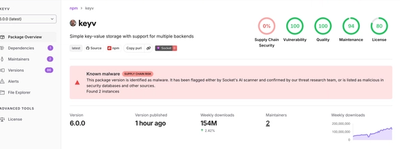
Popular npm packages keyv and cacheable compromised.

Security News
A misconfiguration gave three Anthropic models internet access, and one, believing it was in a simulation, shipped a credential-stealing package to PyPI.