

Security News
Federal Audit Finds NIST Wasted Funds With No Plan to Clear NVD Backlog
Federal audit finds NIST lacked a plan to clear the NVD backlog, wasted funds on duplicate work, and delayed use of CISA data.
By Sarah Gooding - Jun 03, 2026
@php-wasm/compile-extension
Advanced tools
Builds a PHP extension source directory into PHP.wasm JSPI side modules for a PHP version matrix.
npx @php-wasm/compile-extension \
--source ./ext-src \
--name wp_mysql_parser \
--php-versions 8.4 \
--out ./dist
The command writes one JSPI .so per PHP version and a manifest.json that
can be consumed by PHP.wasm extension-loading helpers. The manifest matches
the PHPExtensionManifest shape from @php-wasm/universal:
{
	"name": "wp_mysql_parser",
	"version": "0.1.0",
	"artifacts": [
		{
			"phpVersion": "8.4",
			"sourcePath": "wp_mysql_parser-php8.4-jspi.so"
		}
	]
}
To stage sidecar files (data directories, web UI assets, ICU data, etc.) under
an absolute VFS prefix, pass --extra-files <hostDir>:<vfsRoot>. The host
directory is copied next to the manifest and recorded under extraFiles.nodes:
npx @php-wasm/compile-extension \
	--source ./spx-src \
	--name spx \
	--php-versions 8.2 \
	--extra-files ./web-ui:/internal/shared/spx \
	--out ./dist
Empty directories are recorded as type: "directory" nodes so the loader
creates them before PHP starts.
If an extension needs startup settings, add them to the manifest:
{
	"name": "spx",
	"version": "0.1.0",
	"artifacts": [
		{
			"phpVersion": "8.4",
			"sourcePath": "spx-php8.4-jspi.so"
		}
	],
	"iniEntries": {
		"spx.http_enabled": "1"
	},
	"env": {
		"SPX_DATA_DIR": "/internal/shared/spx/data"
	}
}
The supported --php-versions are 7.4 and 8.0 through 8.5.
Docker is required. The CLI lazily fetches the small PHP.wasm Docker asset set
needed to prepare the Emscripten base image and all compile/php/php*.patch
files, then runs phpize, emconfigure, and emmake inside the container.
The package only needs Docker and Node. It does not require a checkout of
WordPress/wordpress-playground. A typical GitHub Actions job:
- uses: actions/checkout@v4

- uses: actions/setup-node@v4
  with:
      node-version: '24'

- run: |
      npx --yes @php-wasm/compile-extension \
        --source ./my-extension \
        --name my_extension \
        --php-versions 8.0,8.1,8.2,8.3,8.4,8.5 \
        --out ./dist/my-extension
In a matrix workflow, set strategy.max-parallel: 1 on the WASM job —
parallel Docker builds on hosted runners often hit apt-mirror flakes during
the base image build.
On first use, a published @php-wasm/compile-extension package fetches Docker
assets from the matching WordPress/wordpress-playground tag, such as
v3.1.27 for package version 3.1.27. When running from a Playground
workspace, it uses local workspace assets when available and otherwise fetches
from trunk. Fetched assets are cached under
~/.cache/php-wasm/compile-extension/docker-assets, or under
PHP_WASM_COMPILE_EXTENSION_CACHE_DIR when that environment variable is set.
Advanced workflows may need to run another build step inside the same
Emscripten/PHP image before compiling the final phpize extension. For example,
a Rust extension can build a wasm32-unknown-emscripten staticlib first and
then pass that archive through --extra-ldflags.
Use --prepare-image to build the package-owned Docker image and exit without
compiling an extension source directory:
npx @php-wasm/compile-extension \
	--prepare-image \
	--php-versions 8.4 \
	--jobs 1
For PHP 8.4, the prepared image tag is
playground-php-wasm:compile-extension-php8-4-jspi.
Host the entire output directory somewhere static and pass the manifest URL to
the runtime through the startup-time extensions option:
import { loadNodeRuntime } from '@php-wasm/node';
import { PHP } from '@php-wasm/universal';

const php = new PHP(
	await loadNodeRuntime('8.4', {
		extensions: [
			{
				source: {
					format: 'manifest',
					manifestUrl: 'https://example.com/wp_mysql_parser/manifest.json',
				},
			},
		],
	})
);
The loader chooses the artifact whose phpVersion matches the running
PHP.wasm runtime, downloads it, stages the .so, writes a startup .ini
file, copies any extraFiles declared in the manifest, and registers the
extension scan directory before PHP starts.
In Node.js, manifestUrl may also be a local path:
const php = new PHP(
	await loadNodeRuntime('8.4', {
		extensions: [
			{
				source: {
					format: 'manifest',
					manifestUrl: './dist/wp_mysql_parser/manifest.json',
				},
			},
		],
	})
);
Pass a direct .so URL when the caller chooses the artifact instead of a
manifest:
const php = new PHP(
	await loadNodeRuntime('8.4', {
		extensions: [
			{
				name: 'wp_mysql_parser',
				source: {
					format: 'url',
					url: 'https://example.com/extensions/wp_mysql_parser-php8.4-jspi.so',
				},
			},
		],
	})
);
Use loadWithIniDirective: 'zend_extension' for Zend extensions such as
Xdebug. Use extraFiles and env for sidecar files needed by the extension.
The helper can only link WebAssembly objects built with the same Emscripten
toolchain and JSPI ABI as the PHP runtime. Native host libraries from
/usr/lib, Homebrew, apt, or npm packages cannot be linked into the .so.
The lazy-fetched asset set includes only the Docker files required for the PHP
extension build itself. It does not include prebuilt Playground dependency
archives such as libz, libxml2, or libpng.
For dependencies:
config.m4, using paths under /build after the helper copies /src..a archive under the extension source directory, and
pass /build/... paths through --extra-cflags and --extra-ldflags.--extra-cflags,
--extra-ldflags, and --config-args.For example, if an extension vendors an external library that is not provided by
Playground and stores its Emscripten build output under
vendor/string-score/install, pass the copied /build paths:
npx @php-wasm/compile-extension \
	--source ./external-lib-probe \
	--name external_lib_probe \
	--php-versions 8.4 \
	--extra-cflags "-I/build/vendor/string-score/install/include" \
	--extra-ldflags "/build/vendor/string-score/install/lib/libstring_score.a"
Prebuilt static archives, including Rust staticlib archives, should also be
passed through --extra-ldflags. The helper detects .a entries and
force-links them into the final side module with --whole-archive:
npx @php-wasm/compile-extension \
	--source ./my-rust-extension \
	--name my_rust_extension \
	--php-versions 8.4 \
	--extra-ldflags "/build/target/wasm32-unknown-emscripten/release/libmy_rust_extension.a"
Do not use PHP_ADD_LIBRARY_WITH_PATH for sibling .a archives in
config.m4. PHP's libtool setup can look for a matching .so, fail to link
the archive into the side module, and still leave a build artifact behind. Use
--extra-ldflags for static archives instead.
If the dependency uses CMake, build it as a static archive with Emscripten and store the install tree under the extension source directory:
# Run this inside the same Emscripten toolchain used for the target PHP.wasm
# version and JSPI ABI.
source /root/emsdk/emsdk_env.sh

emcmake cmake \
	-S vendor/libfoo \
	-B vendor/libfoo/build \
	-DCMAKE_BUILD_TYPE=Release \
	-DCMAKE_INSTALL_PREFIX="$PWD/vendor/libfoo/install" \
	-DBUILD_SHARED_LIBS=OFF

emmake cmake --build vendor/libfoo/build --target install

npx @php-wasm/compile-extension \
	--source . \
	--name my_extension \
	--php-versions 8.4 \
	--extra-cflags "-I/build/vendor/libfoo/install/include" \
	--extra-ldflags "/build/vendor/libfoo/install/lib/libfoo.a"
For plain Makefile dependencies, force the Makefile to use Emscripten tools and link the resulting archive the same way:
source /root/emsdk/emsdk_env.sh

emmake make -C vendor/libfoo \
	CC=emcc \
	CXX=em++ \
	AR=emar \
	RANLIB=emranlib \
	PREFIX="$PWD/vendor/libfoo/install" \
	install

npx @php-wasm/compile-extension \
	--source . \
	--name my_extension \
	--php-versions 8.4 \
	--extra-cflags "-I/build/vendor/libfoo/install/include" \
	--extra-ldflags "/build/vendor/libfoo/install/lib/libfoo.a"
The final PHP extension still needs to be a phpize extension with config.m4.
If an extension is CMake-only or Makefile-only and produces the final .so
without phpize, add a thin config.m4 wrapper that builds the PHP extension
and treats the CMake/Make output as dependency code. A fully custom final build
script is outside v1.
Rust extensions should wrap the Rust crate with a small config.m4 and C shim
that defines the PHP module entry and calls exported Rust functions over C ABI.
The helper image includes a host php CLI for build scripts such as
ext-php-rs, exports BINDGEN_EXTRA_CLANG_ARGS for the PHP.wasm target and
sysroot, and sets CFLAGS_wasm32_unknown_emscripten=-fPIC for cc-rs build
scripts. Rust staticlib archives must still be built with panic=abort and a
nightly rebuilt standard library:
RUSTFLAGS="-C panic=abort" cargo +nightly build \
	--release \
	--target wasm32-unknown-emscripten \
	-Zbuild-std=std,panic_abort
Keep dependencies aligned with the custom extension target. Custom extensions
are JSPI-only, so link jspi dependency archives.
ext-php-rs 0.15 depends on PHP 8 Zend APIs and does not compile against
PHP 7.4 headers, so Rust extensions built on top of ext-php-rs 0.15
should restrict --php-versions to 8.0 through 8.5. The helper itself
still supports PHP 7.4 for non-Rust extensions and for Rust extensions that
bind Zend directly through bindgen.
--extra-cflags is visible during ./configure. --extra-ldflags is applied
to the final side-module link so dependency archives do not break Autoconf's
compiler smoke tests. If an extension's config.m4 insists on link-probing a
dependency, pass explicit --config-args to select the known dependency path or
patch the extension's build recipe to use the WebAssembly archive directly.
Static .a archives passed via --extra-ldflags are force-linked with
--whole-archive so the side module contains the dependency code it needs.
When developing inside the WordPress Playground monorepo, the CLI still prefers
the workspace Docker assets. In that monorepo-only workflow, dependency archives
built under packages/php-wasm/compile are mounted at /php-wasm-compile.
Package consumers should not need that path in CI.
Could not detect the extension name
Pass --name explicitly, or make sure config.m4 contains PHP_ARG_ENABLE,
PHP_ARG_WITH, or PHP_NEW_EXTENSION for the extension.
configure: error: ... not found
The dependency headers or libraries are not visible inside the container. Use
paths under /build for files copied from --source. The
/php-wasm-compile/<dependency>/<mode>/dist/root/lib paths are only available
when running inside a WordPress Playground monorepo checkout with those
dependency archives already built.
undefined symbol when loading the extension
The extension references a function that is not exported by the PHP main module
or was not linked from a WebAssembly dependency archive. Add the dependency
archive to --extra-ldflags, or rebuild the main PHP.wasm runtime if the symbol
must come from PHP core.
WebAssembly.LinkError or startup crashes
Check that the extension loads in a JSPI runtime. The custom extension helper does not build Asyncify artifacts.
wasm-ld: unknown file type or file not recognized
One of the linked libraries is a native host library. Rebuild that dependency
with Emscripten and link the resulting .a file.
R_WASM_MEMORY_ADDR_SLEB cannot be used against symbol
A C or C++ object in a static archive was not compiled as position-independent
code. Rebuild it with -fPIC, or make sure Rust cc-rs sees
CFLAGS_wasm32_unknown_emscripten=-fPIC.
__cpp_exception is undefined when loading a Rust extension
The Rust archive was built against an unwinding std. Rebuild it with
RUSTFLAGS="-C panic=abort" and
cargo +nightly build -Zbuild-std=std,panic_abort.
bad export type for 'stdin' or another C runtime global
The side module pulled in a dependency object that expects a mutable C runtime global the main PHP.wasm module does not export. Rebuild the dependency with the unused feature disabled, link a smaller archive that excludes that object, or move the dependency into the main PHP.wasm build so the global is provided by the runtime.
phpize cannot find headers
The helper image builds and installs a minimal matching PHP source tree before
running phpize. If an extension includes headers from optional PHP extensions,
copy or generate those headers in the Docker layer or include them in the
extension source.
FAQs
Build PHP.wasm extension side modules across PHP versions
We found that @php-wasm/compile-extension demonstrated a healthy version release cadence and project activity because the last version was released less than a year ago. It has 8 open source maintainers collaborating on the project.
Did you know?

Socket for GitHub automatically highlights issues in each pull request and monitors the health of all your open source dependencies. Discover the contents of your packages and block harmful activity before you install or update your dependencies.
Security News
Federal audit finds NIST lacked a plan to clear the NVD backlog, wasted funds on duplicate work, and delayed use of CISA data.
Research
/Security News
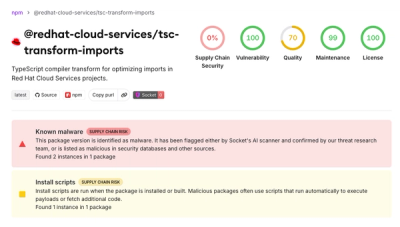
A mini Shai-Hulud campaign compromised Red Hat Cloud Services npm packages to steal developer and CI/CD secrets during installation.

Research
/Security News
The North Korean malware loader hides in a Packagist-listed package and its GitHub branch to fetch and execute remote code in a likely Contagious Interview-style lure.