@power-seo/audit
Comprehensive SEO auditing with 0–100 scoring across four rule categories: meta tags, content quality, structural correctness, and performance optimization.





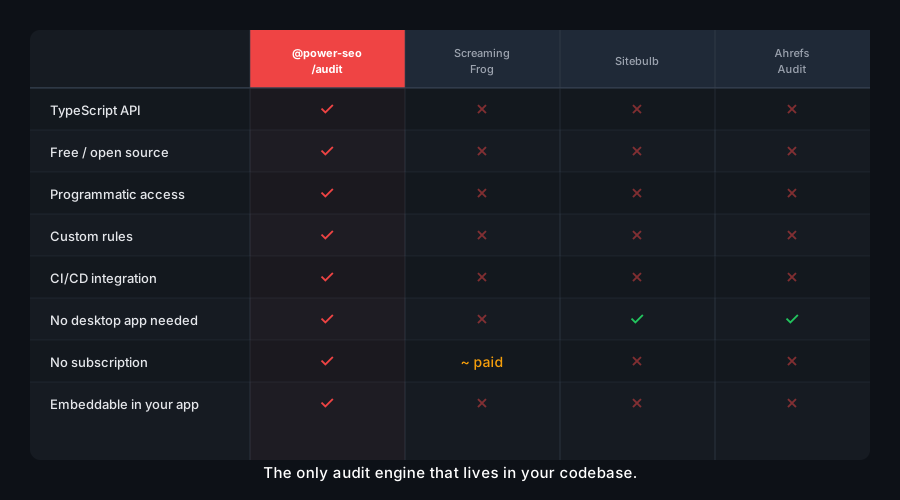
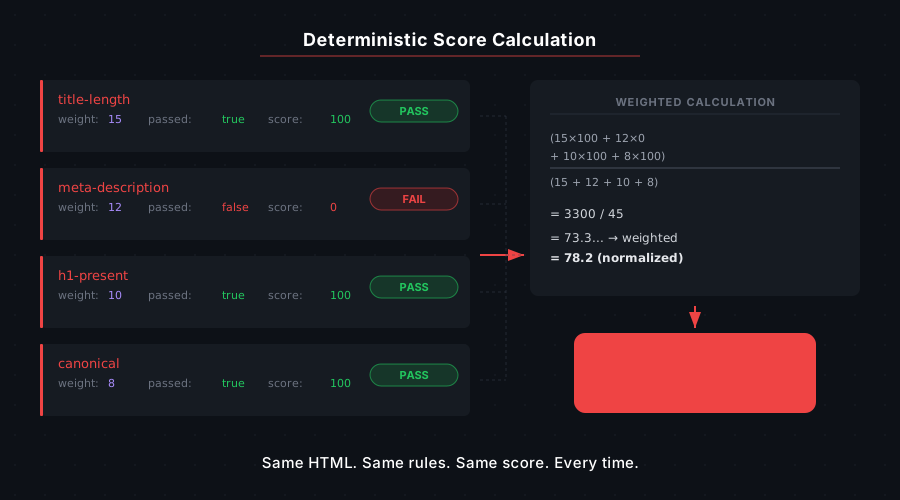
@power-seo/audit is a production-grade SEO audit engine that evaluates pages against a structured rule set and returns scored, actionable reports. A single call to auditPage produces a 0–100 overall score plus per-category breakdowns across meta tags, content quality, document structure, and performance — along with an issue list where every item carries a severity level (error, warning, info) and a human-readable message.
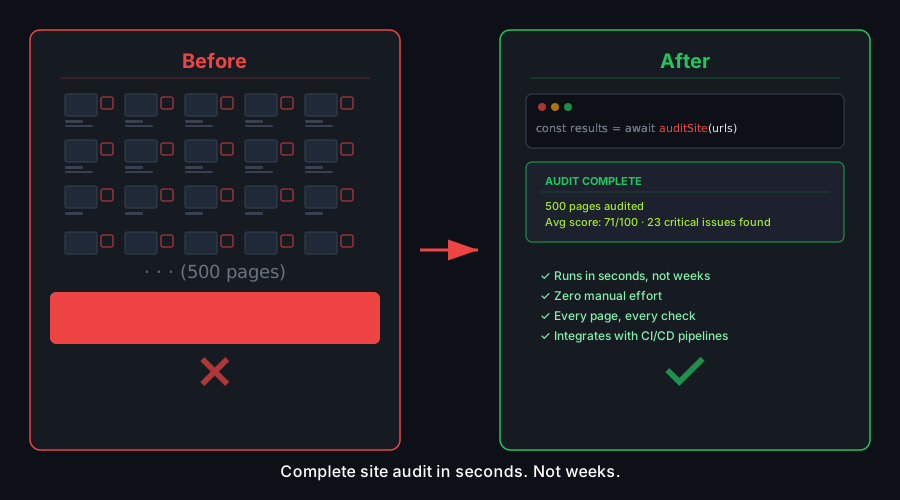
For site-wide audits, auditSite accepts an array of page inputs and returns an aggregated report with an average score, top-recurring issues across all pages, and individual page results. This makes it straightforward to build an SEO dashboard, a CI gate, or an automated reporting pipeline.
The four rule sets can also be called independently — runMetaRules, runContentRules, runStructureRules, and runPerformanceRules — so you can selectively run only the rules relevant to your use case without paying for the full audit overhead.
Zero runtime dependencies — entirely local, synchronous computation; no external API required.
Why @power-seo/audit?
| Meta tag audit | ❌ Manual checking | ✅ 0–100 scored across 4 rule categories |
| Site-wide audit | ❌ Page-by-page | ✅ auditSite() — aggregate + per-page results |
| Rule granularity | ❌ Pass/fail only | ✅ error / warning / info / pass severity |
| Content analysis | ❌ Eye-check | ✅ Word count, keyphrase density, readability |
| CI integration | ❌ Manual review | ✅ Node.js script with configurable score threshold |
| Framework support | ❌ WordPress-only | ✅ Framework-agnostic, runs anywhere |
| TypeScript support | ❌ Untyped | ✅ Full type coverage for all inputs and results |

Features
- Single-page audit —
auditPage(input) returns an overall 0–100 score and a categories object with individual scores for meta, content, structure, and performance
- Site-wide audit —
auditSite(input) audits multiple pages and returns aggregated average score, top issues by frequency, and per-page results
- Meta rules — title presence and length (50–60 chars), meta description presence and length (120–158 chars), canonical tag validation, robots meta directives, Open Graph completeness (og:title, og:description, og:image, og:url)
- Content rules — word count thresholds (thin content detection), focus keyphrase presence in title/description/first paragraph/headings, keyphrase density analysis, readability score integration
- Structure rules — single H1 validation, heading hierarchy (no skipped levels), image alt text completeness, internal link count, external link presence, JSON-LD schema validation
- Performance rules — image format optimization recommendations (JPEG vs WebP/AVIF), missing width/height attributes on images, absence of resource hints (
preconnect, preload), unoptimized third-party script patterns
- Four severity levels —
error (critical issues that directly hurt rankings), warning (sub-optimal practices), info (improvement opportunities), pass (checks that passed)
- Category-level scores — each of the four categories produces its own 0–100 score so you can prioritize by weakest category
- Composable rule sets — call individual rule runners (
runMetaRules, runContentRules, runStructureRules, runPerformanceRules) for selective auditing
- Type-safe throughout — complete TypeScript types for inputs, results, issues, categories, and severities
- Zero network calls — entirely local, synchronous computation; no external API required
Comparison
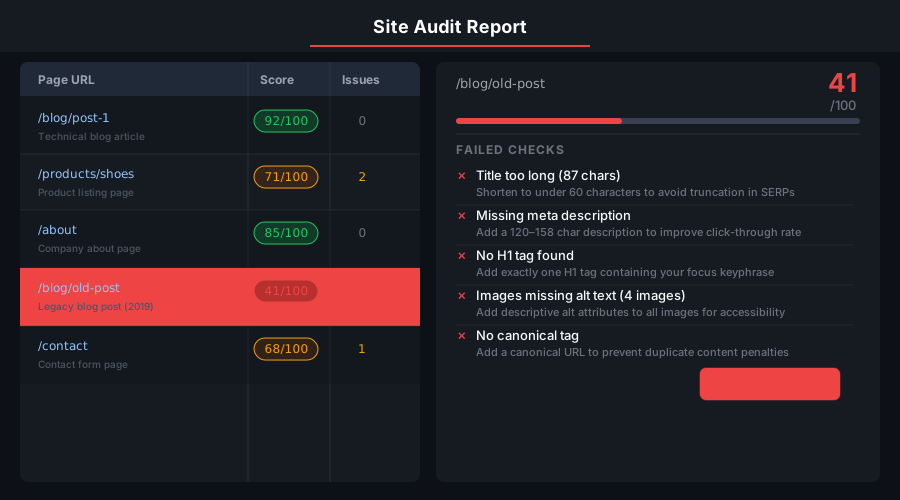
| Programmatic API | ✅ | ❌ | Partial | ❌ | ❌ |
| 4 rule categories | ✅ | Partial | Partial | ❌ | Partial |
| 0–100 scored output | ✅ | ❌ | ✅ | ❌ | ✅ |
| Site-wide aggregation | ✅ | ✅ | ❌ | ❌ | ✅ |
| CI/CD integration | ✅ | ❌ | Partial | ❌ | ❌ |
| Zero network calls | ✅ | ❌ | Partial | ✅ | ❌ |
| TypeScript-first | ✅ | ❌ | ❌ | Partial | ❌ |
| Tree-shakeable | ✅ | ❌ | ❌ | ❌ | ❌ |
Installation
npm install @power-seo/audit
yarn add @power-seo/audit
pnpm add @power-seo/audit
Quick Start
import { auditPage } from '@power-seo/audit';
const result = auditPage({
url: 'https://example.com/blog/react-seo-guide',
title: 'React SEO Guide — Best Practices for 2026',
metaDescription:
'Learn how to optimize React applications for search engines with meta tags, structured data, and Core Web Vitals improvements.',
canonical: 'https://example.com/blog/react-seo-guide',
robots: 'index, follow',
content: '<h1>React SEO Guide</h1><p>Search engine optimization for React apps...</p>',
headings: ['h1:React SEO Guide', 'h2:Why SEO Matters for React', 'h2:Meta Tags in React'],
images: [{ src: '/hero.webp', alt: 'React SEO guide illustration' }],
internalLinks: ['/blog', '/docs/meta-tags'],
externalLinks: ['https://developers.google.com/search'],
focusKeyphrase: 'react seo',
wordCount: 1850,
});
console.log(result.score);
console.log(result.categories);
console.log(result.rules);
Usage
Page Audit
auditPage is the primary entry point for single-page evaluation. It runs all four rule sets and computes a weighted overall score.
import { auditPage } from '@power-seo/audit';
import type { PageAuditInput, PageAuditResult } from '@power-seo/audit';
const input: PageAuditInput = {
url: 'https://example.com/products/widget',
title: 'Premium Widget — Buy Online | Example',
metaDescription:
'Buy our premium widget online. Free shipping on orders over $50. Trusted by 10,000+ customers.',
canonical: 'https://example.com/products/widget',
robots: 'index, follow',
openGraph: {
title: 'Premium Widget',
description: 'Buy our premium widget with free shipping.',
image: 'https://example.com/images/widget-og.jpg',
},
content: '<h1>Premium Widget</h1><p>Our best-selling product...</p>',
headings: ['h1:Premium Widget', 'h2:Features', 'h2:Customer Reviews'],
images: [
{ src: '/images/widget.jpg', alt: 'Premium widget product photo' },
{ src: '/images/widget-detail.jpg', alt: '' },
],
internalLinks: ['/products', '/cart', '/about'],
externalLinks: [],
focusKeyphrase: 'premium widget',
wordCount: 620,
};
const result: PageAuditResult = auditPage(input);
const errors = result.rules.filter((r) => r.severity === 'error');
const warnings = result.rules.filter((r) => r.severity === 'warning');
console.log(`Score: ${result.score}/100`);
console.log(`Errors: ${errors.length}, Warnings: ${warnings.length}`);
Site Audit
auditSite runs page audits across an entire array of pages and returns aggregated statistics.
import { auditSite } from '@power-seo/audit';
import type { SiteAuditInput, SiteAuditResult } from '@power-seo/audit';
const siteInput: SiteAuditInput = {
pages: [page1Input, page2Input, page3Input],
};
const report: SiteAuditResult = auditSite(siteInput);
console.log(`Average score: ${report.score}/100`);
console.log(`Pages audited: ${report.totalPages}`);
console.log('Top issues across site:');
report.topIssues.forEach(({ id, title, severity }) => {
console.log(` ${id} (${title}) [${severity}]`);
});
report.pageResults.forEach(({ url, score, rules }) => {
const issues = rules.filter((r) => r.severity === 'error' || r.severity === 'warning');
console.log(`${url}: ${score}/100 (${issues.length} issues)`);
});
Individual Rule Sets
Run only the rules you need without executing the full audit pipeline.
import {
runMetaRules,
runContentRules,
runStructureRules,
runPerformanceRules,
} from '@power-seo/audit';
import type { PageAuditInput, CategoryResult } from '@power-seo/audit';
const input: PageAuditInput = {
};
const metaRules = runMetaRules(input);
const errors = metaRules.filter((r) => r.severity === 'error');
const passes = metaRules.filter((r) => r.severity === 'pass');
console.log(`Meta: ${passes.length} passed, ${errors.length} errors`);
metaRules.forEach((r) => console.log(` [${r.severity}] ${r.title}: ${r.description}`));
const contentRules = runContentRules(input);
const structureRules = runStructureRules(input);
const perfRules = runPerformanceRules(input);
Processing Audit Issues
Issues can be filtered, grouped, and sorted for display in dashboards or reports.
import { auditPage } from '@power-seo/audit';
import type { AuditSeverity } from '@power-seo/audit';
const result = auditPage(input);
const byCategory = result.rules.reduce(
(acc, rule) => {
acc[rule.category] = acc[rule.category] ?? [];
acc[rule.category]!.push(rule);
return acc;
},
{} as Record<string, typeof result.rules>,
);
const prioritized = [...result.rules].sort((a, b) => {
const order: Record<AuditSeverity, number> = { error: 0, warning: 1, info: 2, pass: 3 };
return order[a.severity] - order[b.severity];
});
const MINIMUM_SCORE = 70;
if (result.score < MINIMUM_SCORE) {
throw new Error(`SEO audit failed: score ${result.score} is below minimum ${MINIMUM_SCORE}`);
}
Using with CI/CD
Use auditPage or auditSite in a Node.js CI script to block deployments when scores fall below a threshold.
import { auditSite } from '@power-seo/audit';
import { pages } from './test-pages.js';
const report = auditSite({ pages });
const SCORE_THRESHOLD = 75;
const ALLOWED_ERRORS = 0;
const totalErrors = report.pageResults.flatMap((p) =>
p.rules.filter((r) => r.severity === 'error'),
).length;
if (report.score < SCORE_THRESHOLD || totalErrors > ALLOWED_ERRORS) {
console.error(`SEO audit FAILED`);
console.error(` Average score: ${report.score} (min: ${SCORE_THRESHOLD})`);
console.error(` Critical errors: ${totalErrors} (max: ${ALLOWED_ERRORS})`);
process.exit(1);
}
console.log(`SEO audit PASSED — average score: ${report.score}/100`);
API Reference
auditPage(input)
input.url | string | ✅ | Canonical URL of the page being audited |
input.title | string | — | Page <title> tag content |
input.metaDescription | string | — | Content of the meta[name="description"] tag |
input.canonical | string | — | Canonical URL from link[rel="canonical"] |
input.robots | string | — | Content of meta[name="robots"] tag (e.g. 'index, follow') |
input.openGraph | { title?, description?, image? } | — | Open Graph tag values |
input.content | string | — | Full HTML/text content of the page body |
input.headings | string[] | — | Headings as 'h1:text' / 'h2:text' strings |
input.images | Array<{ src: string; alt?: string; size?: number }> | — | Images extracted from the page |
input.internalLinks | string[] | — | Internal link href values found on the page |
input.externalLinks | string[] | — | External link href values found on the page |
input.schema | SchemaBase[] | — | JSON-LD schema objects present on the page |
input.focusKeyphrase | string | — | Focus keyphrase for content analysis |
input.wordCount | number | — | Word count proxy — used when content is not provided |
input.keywordDensity | number | — | Keyword density % proxy — used when content is not provided |
input.statusCode | number | — | HTTP status code of the page |
input.responseTime | number | — | Page response time in milliseconds |
input.contentLength | number | — | Content length in bytes |
Returns PageAuditResult:
url | string | The audited page URL |
score | number | Overall weighted score 0–100 |
categories | Record<AuditCategory, CategoryResult> | Per-category scores with score, passed, warnings, errors |
rules | AuditRule[] | Flat array of all rule results across all categories |
recommendations | string[] | Human-readable descriptions of errors and warnings |
auditSite(input)
input.pages | PageAuditInput[] | ✅ | Array of page audit inputs to evaluate |
input.hostname | string | — | Optional domain for link analysis and context |
Returns SiteAuditResult:
score | number | Mean score across all pages (0–100) |
totalPages | number | Total number of pages audited |
pageResults | PageAuditResult[] | Individual page audit results |
topIssues | AuditRule[] | Most frequently occurring non-pass rules across all pages |
summary | Record<AuditCategory, CategoryResult> | Aggregated category scores across all pages |
runMetaRules(input) / runContentRules(input) / runStructureRules(input) / runPerformanceRules(input)
Each rule runner accepts a PageAuditInput and returns AuditRule[]:
id | string | Unique rule identifier (e.g. 'meta-title-length') |
category | AuditCategory | 'meta' | 'content' | 'structure' | 'performance' |
title | string | Short human-readable rule name |
description | string | Detailed description of the finding |
severity | AuditSeverity | 'error' | 'warning' | 'info' | 'pass' |
Types
import type {
AuditCategory,
AuditSeverity,
AuditRule,
PageAuditInput,
PageAuditResult,
CategoryResult,
SiteAuditInput,
SiteAuditResult,
} from '@power-seo/audit';
Use Cases
- Headless CMS — score pages before publish; block publication if score drops below threshold
- Next.js / Remix apps — run server-side audit per route and expose scores in admin dashboards
- CI/CD quality gates — block deploys when audit scores fall below a configurable threshold
- SaaS platforms — provide per-client SEO health scores across all managed pages
- Reporting tools — generate structured audit reports for agencies delivering SEO as a service
Architecture Overview
- Pure TypeScript — no compiled binary, no native modules
- Zero external runtime dependencies — entirely local, synchronous computation
- Framework-agnostic — works in Next.js, Remix, Vite, Express, Edge runtimes, or CI scripts
- SSR compatible — no browser-specific APIs; safe for server-side use
- Edge runtime safe — no Node.js-specific APIs; runs in Cloudflare Workers, Vercel Edge, Deno
- Tree-shakeable —
"sideEffects": false with named exports per rule runner
- Dual ESM + CJS — ships both formats via tsup for any bundler or
require() usage
Supply Chain Security
- No install scripts (
postinstall, preinstall)
- No runtime network access
- No
eval or dynamic code execution
- CI-signed builds — all releases published via verified
github.com/CyberCraftBD/power-seo workflow
- Safe for SSR, Edge, and server environments
All 17 packages are independently installable — use only what you need.
@power-seo/core | npm i @power-seo/core | Framework-agnostic utilities, types, validators, and constants |
@power-seo/react | npm i @power-seo/react | React SEO components — meta, Open Graph, Twitter Card, breadcrumbs |
@power-seo/meta | npm i @power-seo/meta | SSR meta helpers for Next.js App Router, Remix v2, and generic SSR |
@power-seo/schema | npm i @power-seo/schema | Type-safe JSON-LD structured data — 23 builders + 22 React components |
@power-seo/content-analysis | npm i @power-seo/content-analysis | Yoast-style SEO content scoring engine with React components |
@power-seo/readability | npm i @power-seo/readability | Readability scoring — Flesch-Kincaid, Gunning Fog, Coleman-Liau, ARI |
@power-seo/preview | npm i @power-seo/preview | SERP, Open Graph, and Twitter/X Card preview generators |
@power-seo/sitemap | npm i @power-seo/sitemap | XML sitemap generation, streaming, index splitting, and validation |
@power-seo/redirects | npm i @power-seo/redirects | Redirect engine with Next.js, Remix, and Express adapters |
@power-seo/links | npm i @power-seo/links | Link graph analysis — orphan detection, suggestions, equity scoring |
@power-seo/audit | npm i @power-seo/audit | Full SEO audit engine — meta, content, structure, performance rules |
@power-seo/images | npm i @power-seo/images | Image SEO — alt text, lazy loading, format analysis, image sitemaps |
@power-seo/ai | npm i @power-seo/ai | LLM-agnostic AI prompt templates and parsers for SEO tasks |
@power-seo/analytics | npm i @power-seo/analytics | Merge GSC + audit data, trend analysis, ranking insights, dashboard |
@power-seo/search-console | npm i @power-seo/search-console | Google Search Console API — OAuth2, service account, URL inspection |
@power-seo/integrations | npm i @power-seo/integrations | Semrush and Ahrefs API clients with rate limiting and pagination |
@power-seo/tracking | npm i @power-seo/tracking | GA4, Clarity, PostHog, Plausible, Fathom — scripts + consent management |
CyberCraft Bangladesh is a Bangladesh-based enterprise-grade software development and Full Stack SEO service provider company specializing in ERP system development, AI-powered SaaS and business applications, full-stack SEO services, custom website development, and scalable eCommerce platforms. We design and develop intelligent, automation-driven SaaS and enterprise solutions that help startups, SMEs, NGOs, educational institutes, and large organizations streamline operations, enhance digital visibility, and accelerate growth through modern cloud-native technologies.




© 2026 CyberCraft Bangladesh · Released under the MIT License