




Research
/Security News
Fake imToken Chrome Extension Steals Seed Phrases via Phishing Redirects
Mixed-script homoglyphs and a lookalike domain mimic imToken’s import flow to capture mnemonics and private keys.
By Kirill Boychenko - Mar 05, 2026
@power-seo/audit
Advanced tools
SEO site health auditing with meta, content, structure, and performance rules
Comprehensive SEO auditing with 0–100 scoring across four rule categories: meta tags, content quality, structural correctness, and performance optimization.




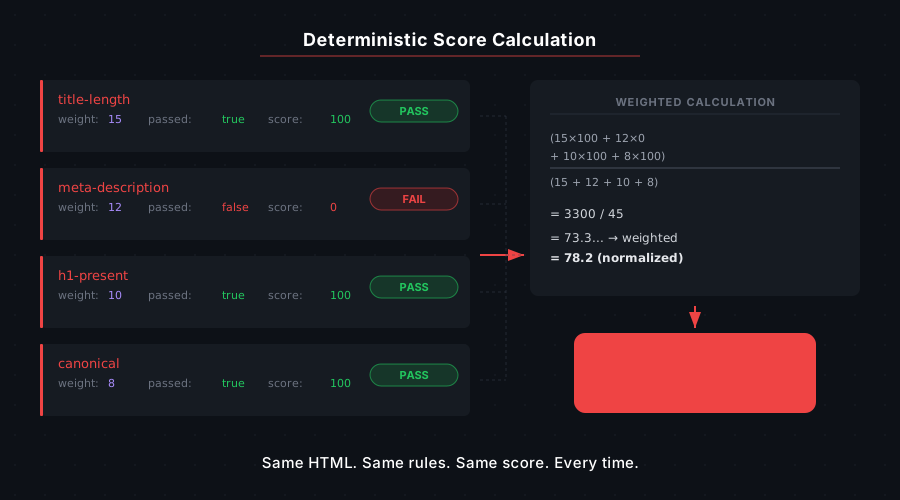
@power-seo/audit is a production-grade SEO audit engine that evaluates pages against a structured rule set and returns scored, actionable reports. A single call to auditPage produces a 0–100 overall score plus per-category breakdowns across meta tags, content quality, document structure, and performance — along with an issue list where every item carries a severity level (error, warning, info) and a human-readable message.
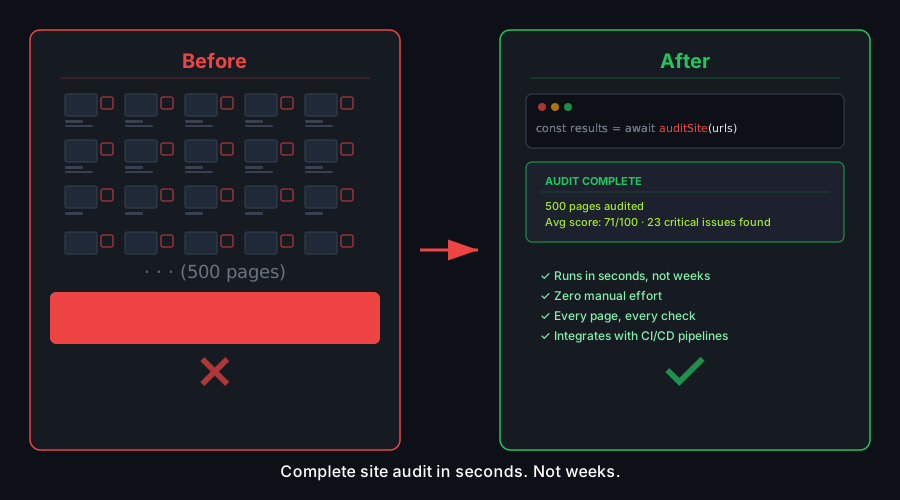
For site-wide audits, auditSite accepts an array of page inputs and returns an aggregated report with an average score, top-recurring issues across all pages, and individual page results. This makes it straightforward to build an SEO dashboard, a CI gate, or an automated reporting pipeline.
The four rule sets can also be called independently — runMetaRules, runContentRules, runStructureRules, and runPerformanceRules — so you can selectively run only the rules relevant to your use case without paying for the full audit overhead.
Zero runtime dependencies — entirely local, synchronous computation; no external API required.
| Without | With | |
|---|---|---|
| Meta tag audit | ❌ Manual checking | ✅ 0–100 scored across 4 rule categories |
| Site-wide audit | ❌ Page-by-page | ✅ auditSite() — aggregate + per-page results |
| Rule granularity | ❌ Pass/fail only | ✅ error / warning / info / pass severity |
| Content analysis | ❌ Eye-check | ✅ Word count, keyphrase density, readability |
| CI integration | ❌ Manual review | ✅ Node.js script with configurable score threshold |
| Framework support | ❌ WordPress-only | ✅ Framework-agnostic, runs anywhere |
| TypeScript support | ❌ Untyped | ✅ Full type coverage for all inputs and results |
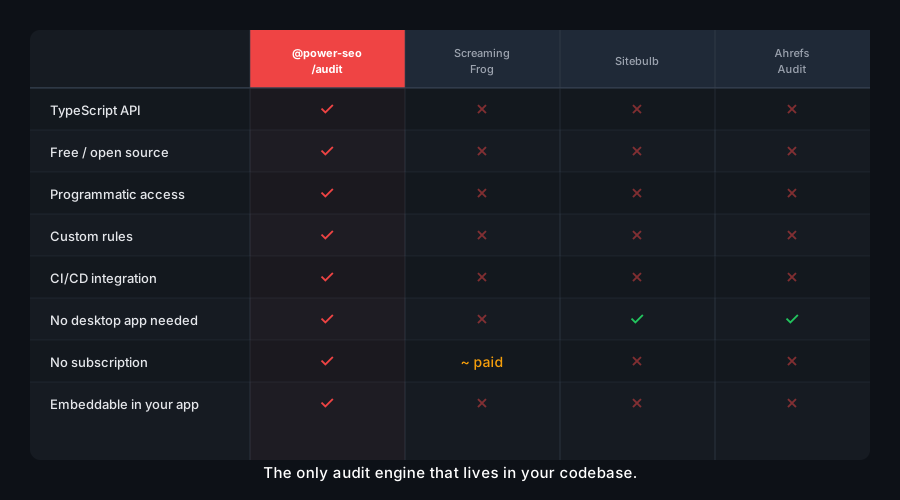

auditPage(input) returns an overall 0–100 score and a categories object with individual scores for meta, content, structure, and performanceauditSite(input) audits multiple pages and returns aggregated average score, top issues by frequency, and per-page resultspreconnect, preload), unoptimized third-party script patternserror (critical issues that directly hurt rankings), warning (sub-optimal practices), info (improvement opportunities), pass (checks that passed)runMetaRules, runContentRules, runStructureRules, runPerformanceRules) for selective auditing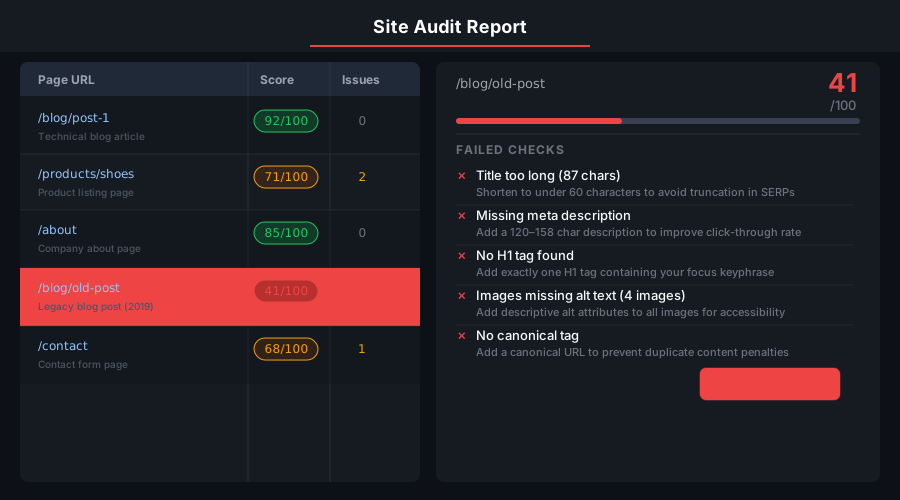
| Feature | @power-seo/audit | Screaming Frog | Lighthouse | next-seo | ahrefs site audit |
|---|---|---|---|---|---|
| Programmatic API | ✅ | ❌ | Partial | ❌ | ❌ |
| 4 rule categories | ✅ | Partial | Partial | ❌ | Partial |
| 0–100 scored output | ✅ | ❌ | ✅ | ❌ | ✅ |
| Site-wide aggregation | ✅ | ✅ | ❌ | ❌ | ✅ |
| CI/CD integration | ✅ | ❌ | Partial | ❌ | ❌ |
| Zero network calls | ✅ | ❌ | Partial | ✅ | ❌ |
| TypeScript-first | ✅ | ❌ | ❌ | Partial | ❌ |
| Tree-shakeable | ✅ | ❌ | ❌ | ❌ | ❌ |
npm install @power-seo/audit
yarn add @power-seo/audit
pnpm add @power-seo/audit
import { auditPage } from '@power-seo/audit';

const result = auditPage({
  url: 'https://example.com/blog/react-seo-guide',
  title: 'React SEO Guide — Best Practices for 2026',
  metaDescription:
    'Learn how to optimize React applications for search engines with meta tags, structured data, and Core Web Vitals improvements.',
  canonical: 'https://example.com/blog/react-seo-guide',
  robots: 'index, follow',
  content: '<h1>React SEO Guide</h1><p>Search engine optimization for React apps...</p>',
  headings: ['h1:React SEO Guide', 'h2:Why SEO Matters for React', 'h2:Meta Tags in React'],
  images: [{ src: '/hero.webp', alt: 'React SEO guide illustration' }],
  internalLinks: ['/blog', '/docs/meta-tags'],
  externalLinks: ['https://developers.google.com/search'],
  focusKeyphrase: 'react seo',
  wordCount: 1850,
});

console.log(result.score); // e.g. 84
console.log(result.categories);
// { meta: { score: 90, passed: 9, warnings: 1, errors: 0 }, content: { score: 82, ... }, ... }
console.log(result.rules);
// [
//   { id: 'meta-description-length', category: 'meta', severity: 'warning', title: '...', description: '...' },
//   { id: 'content-word-count', category: 'content', severity: 'pass', ... },
// ]
auditPage is the primary entry point for single-page evaluation. It runs all four rule sets and computes a weighted overall score.
import { auditPage } from '@power-seo/audit';
import type { PageAuditInput, PageAuditResult } from '@power-seo/audit';

const input: PageAuditInput = {
  url: 'https://example.com/products/widget',
  title: 'Premium Widget — Buy Online | Example',
  metaDescription:
    'Buy our premium widget online. Free shipping on orders over $50. Trusted by 10,000+ customers.',
  canonical: 'https://example.com/products/widget',
  robots: 'index, follow',
  openGraph: {
    title: 'Premium Widget',
    description: 'Buy our premium widget with free shipping.',
    image: 'https://example.com/images/widget-og.jpg',
  },
  content: '<h1>Premium Widget</h1><p>Our best-selling product...</p>',
  headings: ['h1:Premium Widget', 'h2:Features', 'h2:Customer Reviews'],
  images: [
    { src: '/images/widget.jpg', alt: 'Premium widget product photo' },
    { src: '/images/widget-detail.jpg', alt: '' },
  ],
  internalLinks: ['/products', '/cart', '/about'],
  externalLinks: [],
  focusKeyphrase: 'premium widget',
  wordCount: 620,
};

const result: PageAuditResult = auditPage(input);

// Filter rules by severity
const errors = result.rules.filter((r) => r.severity === 'error');
const warnings = result.rules.filter((r) => r.severity === 'warning');

console.log(`Score: ${result.score}/100`);
console.log(`Errors: ${errors.length}, Warnings: ${warnings.length}`);
auditSite runs page audits across an entire array of pages and returns aggregated statistics.
import { auditSite } from '@power-seo/audit';
import type { SiteAuditInput, SiteAuditResult } from '@power-seo/audit';

const siteInput: SiteAuditInput = {
  pages: [page1Input, page2Input, page3Input],
};

const report: SiteAuditResult = auditSite(siteInput);

console.log(`Average score: ${report.score}/100`);
console.log(`Pages audited: ${report.totalPages}`);
console.log('Top issues across site:');
report.topIssues.forEach(({ id, title, severity }) => {
  console.log(`  ${id} (${title}) [${severity}]`);
});

// Access individual page results
report.pageResults.forEach(({ url, score, rules }) => {
  const issues = rules.filter((r) => r.severity === 'error' || r.severity === 'warning');
  console.log(`${url}: ${score}/100 (${issues.length} issues)`);
});
Run only the rules you need without executing the full audit pipeline.
import {
  runMetaRules,
  runContentRules,
  runStructureRules,
  runPerformanceRules,
} from '@power-seo/audit';
import type { PageAuditInput, CategoryResult } from '@power-seo/audit';

const input: PageAuditInput = {
  /* ... */
};

// Run only meta checks — title, description, canonical, robots, OG
const metaRules = runMetaRules(input);
const errors = metaRules.filter((r) => r.severity === 'error');
const passes = metaRules.filter((r) => r.severity === 'pass');
console.log(`Meta: ${passes.length} passed, ${errors.length} errors`);
metaRules.forEach((r) => console.log(`  [${r.severity}] ${r.title}: ${r.description}`));

// Run only content checks — word count, keyphrase, readability
const contentRules = runContentRules(input);

// Run only structure checks — headings, images, links, schema
const structureRules = runStructureRules(input);

// Run only performance checks — image formats, resource hints
const perfRules = runPerformanceRules(input);
Issues can be filtered, grouped, and sorted for display in dashboards or reports.
import { auditPage } from '@power-seo/audit';
import type { AuditSeverity } from '@power-seo/audit';

const result = auditPage(input);

// Group rules by category
const byCategory = result.rules.reduce(
  (acc, rule) => {
    acc[rule.category] = acc[rule.category] ?? [];
    acc[rule.category]!.push(rule);
    return acc;
  },
  {} as Record<string, typeof result.rules>,
);

// Priority order: errors first, then warnings, then info, then pass
const prioritized = [...result.rules].sort((a, b) => {
  const order: Record<AuditSeverity, number> = { error: 0, warning: 1, info: 2, pass: 3 };
  return order[a.severity] - order[b.severity];
});

// Check if page passes a minimum score threshold
const MINIMUM_SCORE = 70;
if (result.score < MINIMUM_SCORE) {
  throw new Error(`SEO audit failed: score ${result.score} is below minimum ${MINIMUM_SCORE}`);
}
Use auditPage or auditSite in a Node.js CI script to block deployments when scores fall below a threshold.
// scripts/seo-audit.ts
import { auditSite } from '@power-seo/audit';
import { pages } from './test-pages.js';

const report = auditSite({ pages });

const SCORE_THRESHOLD = 75;
const ALLOWED_ERRORS = 0;

const totalErrors = report.pageResults.flatMap((p) =>
  p.rules.filter((r) => r.severity === 'error'),
).length;

if (report.score < SCORE_THRESHOLD || totalErrors > ALLOWED_ERRORS) {
  console.error(`SEO audit FAILED`);
  console.error(`  Average score: ${report.score} (min: ${SCORE_THRESHOLD})`);
  console.error(`  Critical errors: ${totalErrors} (max: ${ALLOWED_ERRORS})`);
  process.exit(1);
}

console.log(`SEO audit PASSED — average score: ${report.score}/100`);
auditPage(input)| Parameter | Type | Required | Description |
|---|---|---|---|
input.url | string | ✅ | Canonical URL of the page being audited |
input.title | string | — | Page <title> tag content |
input.metaDescription | string | — | Content of the meta[name="description"] tag |
input.canonical | string | — | Canonical URL from link[rel="canonical"] |
input.robots | string | — | Content of meta[name="robots"] tag (e.g. 'index, follow') |
input.openGraph | { title?, description?, image? } | — | Open Graph tag values |
input.content | string | — | Full HTML/text content of the page body |
input.headings | string[] | — | Headings as 'h1:text' / 'h2:text' strings |
input.images | Array<{ src: string; alt?: string; size?: number }> | — | Images extracted from the page |
input.internalLinks | string[] | — | Internal link href values found on the page |
input.externalLinks | string[] | — | External link href values found on the page |
input.schema | SchemaBase[] | — | JSON-LD schema objects present on the page |
input.focusKeyphrase | string | — | Focus keyphrase for content analysis |
input.wordCount | number | — | Word count proxy — used when content is not provided |
input.keywordDensity | number | — | Keyword density % proxy — used when content is not provided |
input.statusCode | number | — | HTTP status code of the page |
input.responseTime | number | — | Page response time in milliseconds |
input.contentLength | number | — | Content length in bytes |
Returns PageAuditResult:
| Property | Type | Description |
|---|---|---|
url | string | The audited page URL |
score | number | Overall weighted score 0–100 |
categories | Record<AuditCategory, CategoryResult> | Per-category scores with score, passed, warnings, errors |
rules | AuditRule[] | Flat array of all rule results across all categories |
recommendations | string[] | Human-readable descriptions of errors and warnings |
auditSite(input)| Parameter | Type | Required | Description |
|---|---|---|---|
input.pages | PageAuditInput[] | ✅ | Array of page audit inputs to evaluate |
input.hostname | string | — | Optional domain for link analysis and context |
Returns SiteAuditResult:
| Property | Type | Description |
|---|---|---|
score | number | Mean score across all pages (0–100) |
totalPages | number | Total number of pages audited |
pageResults | PageAuditResult[] | Individual page audit results |
topIssues | AuditRule[] | Most frequently occurring non-pass rules across all pages |
summary | Record<AuditCategory, CategoryResult> | Aggregated category scores across all pages |
runMetaRules(input) / runContentRules(input) / runStructureRules(input) / runPerformanceRules(input)Each rule runner accepts a PageAuditInput and returns AuditRule[]:
| Property | Type | Description |
|---|---|---|
id | string | Unique rule identifier (e.g. 'meta-title-length') |
category | AuditCategory | 'meta' | 'content' | 'structure' | 'performance' |
title | string | Short human-readable rule name |
description | string | Detailed description of the finding |
severity | AuditSeverity | 'error' | 'warning' | 'info' | 'pass' |
import type {
  AuditCategory, // 'meta' | 'content' | 'structure' | 'performance'
  AuditSeverity, // 'error' | 'warning' | 'info' | 'pass'
  AuditRule, // { id, category, title, description, severity }
  PageAuditInput, // Full page input object (see auditPage parameters above)
  PageAuditResult, // { url, score, categories, rules, recommendations }
  CategoryResult, // { score: number; passed: number; warnings: number; errors: number }
  SiteAuditInput, // { pages: PageAuditInput[] }
  SiteAuditResult, // { score, totalPages, pageResults, topIssues, summary }
} from '@power-seo/audit';
"sideEffects": false with named exports per rule runnerrequire() usagepostinstall, preinstall)eval or dynamic code executiongithub.com/CyberCraftBD/power-seo workflowAll 17 packages are independently installable — use only what you need.
| Package | Install | Description |
|---|---|---|
@power-seo/core | npm i @power-seo/core | Framework-agnostic utilities, types, validators, and constants |
@power-seo/react | npm i @power-seo/react | React SEO components — meta, Open Graph, Twitter Card, breadcrumbs |
@power-seo/meta | npm i @power-seo/meta | SSR meta helpers for Next.js App Router, Remix v2, and generic SSR |
@power-seo/schema | npm i @power-seo/schema | Type-safe JSON-LD structured data — 23 builders + 22 React components |
@power-seo/content-analysis | npm i @power-seo/content-analysis | Yoast-style SEO content scoring engine with React components |
@power-seo/readability | npm i @power-seo/readability | Readability scoring — Flesch-Kincaid, Gunning Fog, Coleman-Liau, ARI |
@power-seo/preview | npm i @power-seo/preview | SERP, Open Graph, and Twitter/X Card preview generators |
@power-seo/sitemap | npm i @power-seo/sitemap | XML sitemap generation, streaming, index splitting, and validation |
@power-seo/redirects | npm i @power-seo/redirects | Redirect engine with Next.js, Remix, and Express adapters |
@power-seo/links | npm i @power-seo/links | Link graph analysis — orphan detection, suggestions, equity scoring |
@power-seo/audit | npm i @power-seo/audit | Full SEO audit engine — meta, content, structure, performance rules |
@power-seo/images | npm i @power-seo/images | Image SEO — alt text, lazy loading, format analysis, image sitemaps |
@power-seo/ai | npm i @power-seo/ai | LLM-agnostic AI prompt templates and parsers for SEO tasks |
@power-seo/analytics | npm i @power-seo/analytics | Merge GSC + audit data, trend analysis, ranking insights, dashboard |
@power-seo/search-console | npm i @power-seo/search-console | Google Search Console API — OAuth2, service account, URL inspection |
@power-seo/integrations | npm i @power-seo/integrations | Semrush and Ahrefs API clients with rate limiting and pagination |
@power-seo/tracking | npm i @power-seo/tracking | GA4, Clarity, PostHog, Plausible, Fathom — scripts + consent management |
CyberCraft Bangladesh is a Bangladesh-based enterprise-grade software development and Full Stack SEO service provider company specializing in ERP system development, AI-powered SaaS and business applications, full-stack SEO services, custom website development, and scalable eCommerce platforms. We design and develop intelligent, automation-driven SaaS and enterprise solutions that help startups, SMEs, NGOs, educational institutes, and large organizations streamline operations, enhance digital visibility, and accelerate growth through modern cloud-native technologies.



© 2026 CyberCraft Bangladesh · Released under the MIT License
FAQs
SEO site health auditing with meta, content, structure, and performance rules
The npm package @power-seo/audit receives a total of 322 weekly downloads. As such, @power-seo/audit popularity was classified as not popular.
We found that @power-seo/audit demonstrated a healthy version release cadence and project activity because the last version was released less than a year ago. It has 1 open source maintainer collaborating on the project.
Did you know?

Socket for GitHub automatically highlights issues in each pull request and monitors the health of all your open source dependencies. Discover the contents of your packages and block harmful activity before you install or update your dependencies.
Research
/Security News
Mixed-script homoglyphs and a lookalike domain mimic imToken’s import flow to capture mnemonics and private keys.

Security News
Latio’s 2026 report recognizes Socket as a Supply Chain Innovator and highlights our work in 0-day malware detection, SCA, and auto-patching.

Company News
Join Socket for live demos, rooftop happy hours, and one-on-one meetings during BSidesSF and RSA 2026 in San Francisco.