

Company News
AWS Security Hub Adds Socket for Supply Chain Security
Socket is now in the AWS Security Hub Extended plan. Adopt it through AWS, apply committed spend, and block malicious open source packages.
By Feross Aboukhadijeh - Aug 04, 2026
@sapiom/sandbox
Advanced tools
🕗 Deprecated for new projects.
@sapiom/toolsnow ships sandbox support built in — use itssapiom.sandboxes.*surface instead. This standalone package remains published and supported for existing production use, but new projects should not adopt it.
Sandbox environment management for the Sapiom SDK. Create isolated execution environments, manage files, run commands, and stream output in real time.
npm install @sapiom/sandbox
# or
pnpm add @sapiom/sandbox
import { SapiomSandbox } from "@sapiom/sandbox";

// Create a sandbox (uses SAPIOM_API_KEY env var by default)
const sandbox = await SapiomSandbox.create({ name: "my-sandbox" });

// Write a file
await sandbox.writeFile("hello.py", 'print("Hello from the sandbox!")');

// Execute a command and wait for completion
const result = await sandbox.exec("python hello.py");
console.log(result.stdout); // "Hello from the sandbox!"

// Stream output from a long-running process
const proc = await sandbox.execStream("node runner.js");
for await (const line of proc.output) {
  console.log(`[${line.stream}] ${line.data}`);
}
console.log("exit code:", proc.exitCode);

// Clean up
await sandbox.destroy();
SapiomSandbox.create(opts)Creates a new sandbox and returns a handle for interacting with it.
const sandbox = await SapiomSandbox.create({
  name: "my-sandbox",
  tier: "m",
  ttl: "1h",
  image: "python:3.12",
  envs: { NODE_ENV: "production" },
});
Options:
| Option | Type | Required | Description |
|---|---|---|---|
name | string | Yes | Sandbox name (lowercase alphanumeric + hyphens, 2-63 chars) |
apiKey | string | No | Sapiom API key. Falls back to SAPIOM_API_KEY env var |
baseUrl | string | No | Override the sandbox service URL |
fetch | typeof fetch | No | Pre-configured fetch function (overrides apiKey) |
tier | SandboxTier | No | Memory tier: 'xs', 's', 'm', 'l', 'xl' (default 's') |
ttl | string | No | Time-to-live (e.g. '1h', '24h', '7d') |
envs | Record<string, string> | No | Environment variables |
port | number | No | Single port to expose (mutually exclusive with ports) |
ports | PortSpec[] | No | Array of port specs to expose (mutually exclusive with port) |
image | string | No | Pre-built Docker image for instant creation |
sandbox.writeFile(path, content)Writes a file relative to the sandbox's workspace root.
await sandbox.writeFile("src/index.ts", 'console.log("hi")');
sandbox.uploadFile(path, content, opts?)Uploads a file using multipart upload. Handles the full initiate → upload parts → complete lifecycle, with parallel part uploads and automatic abort on any failure. Prefer this over writeFile for binary content or files over a few MB.
import { openAsBlob } from "node:fs";

// From a buffer / Uint8Array
await sandbox.uploadFile("data/snapshot.bin", new Uint8Array(bytes));

// From a file on disk without slurping it into memory (Node 20+)
const blob = await openAsBlob("./huge.parquet");
await sandbox.uploadFile("datasets/huge.parquet", blob, {
  partSize: 5 * 1024 * 1024,
  concurrency: 4,
  onPartUploaded: (part, progress) => {
    const pct = ((progress.bytesUploaded / progress.totalBytes) * 100).toFixed(1);
    console.log(`part ${part.partNumber} ok — ${pct}%`);
  },
});

// Cancel a running upload — the server-side multipart session is auto-aborted
const ctrl = new AbortController();
setTimeout(() => ctrl.abort(), 10_000);
await sandbox.uploadFile("big.bin", blob, { signal: ctrl.signal });
Options:
| Option | Type | Default | Description |
|---|---|---|---|
partSize | number | 5 * 1024 * 1024 | Part size in bytes. The Sapiom ingress rejects uploads over ~8 MiB, so keep this ≤ 7 MiB. |
concurrency | number | 4 | Number of parallel part uploads. Blaxel recommends 3–5. |
permissions | string | "0644" | Unix file permissions. |
maxRetries | number | 3 | Retries per failed part on 408/425/429/5xx and network errors. 0 disables. |
retryBaseDelayMs | number | 50 | Initial backoff in ms. Doubles per attempt with jitter; honors Retry-After. |
signal | AbortSignal | — | Cancel the upload. Triggers an auto-abort of the server-side session. |
onPartUploaded | (part, progress) => void | — | Fired after each part finishes (completion order — not partNumber order). |
The server accepts at most 10,000 parts per upload. If content.size / partSize > 10_000, uploadFile throws before making any request and suggests a larger partSize.
For resumable uploads or custom retry logic, drive the multipart lifecycle directly:
const { uploadId } = await sandbox.initiateMultipartUpload("large.bin");

try {
  // ...upload parts as bytes become available
  const part1 = await sandbox.uploadPart(uploadId, 1, chunk1);
  const part2 = await sandbox.uploadPart(uploadId, 2, chunk2);

  // Inspect server-side state (useful after a crash/reconnect)
  const uploaded = await sandbox.listMultipartParts(uploadId);

  await sandbox.completeMultipartUpload(uploadId, [
    { partNumber: part1.partNumber, etag: part1.etag },
    { partNumber: part2.partNumber, etag: part2.etag },
  ]);
} catch (err) {
  await sandbox.abortMultipartUpload(uploadId);
  throw err;
}
| Method | Description |
|---|---|
initiateMultipartUpload(path, opts?) | Start a session. Returns { uploadId, path }. |
uploadPart(uploadId, partNumber, bytes, opts?) | Upload one part (1-indexed, 1–10000). |
listMultipartParts(uploadId, opts?) | List parts already uploaded. |
completeMultipartUpload(uploadId, parts, opts?) | Commit the upload. |
abortMultipartUpload(uploadId, opts?) | Discard the session and clean up parts. |
sandbox.readFile(path)Reads a file relative to the sandbox's workspace root and returns its content as a string.
const content = await sandbox.readFile("src/index.ts");
sandbox.exec(command, opts?)Executes a shell command inside the sandbox. By default waits for the process to finish.
// Wait for completion (default)
const result = await sandbox.exec("npm install");
console.log(result.exitCode); // 0
console.log(result.stdout);
console.log(result.stderr);

// Fire-and-forget
const bg = await sandbox.exec("npm start", { waitForCompletion: false });
console.log(bg.pid);

// Check on it later
const status = await sandbox.getProcess(bg.pid);
console.log(status.completed, status.exitCode);

// Or wait for it to finish
const final = await sandbox.waitForProcess(bg.pid);
console.log(final.exitCode);
Options:
| Option | Type | Default | Description |
|---|---|---|---|
cwd | string | — | Working directory (resolved relative to workspaceRoot) |
env | Record<string, string> | — | Environment variables for the process |
waitForCompletion | boolean | true | Wait for the process to finish |
pollInterval | number | 1000 | Polling interval in ms |
timeout | number | 60000 | Timeout in ms when waiting |
signal | AbortSignal | — | Signal to cancel the operation |
sandbox.execStream(command, opts?)Executes a command and streams output in real time via an async iterable. Ideal for long-running processes like AI agent runs.
const proc = await sandbox.execStream("node agent.js");
for await (const line of proc.output) {
  // line.stream is 'stdout' or 'stderr'
  process.stdout.write(line.data);
}
console.log("exit code:", proc.exitCode);
Supports cancellation via AbortSignal:
const controller = new AbortController();
const proc = await sandbox.execStream("long-task", {
  signal: controller.signal,
});

setTimeout(() => controller.abort(), 30_000);

for await (const line of proc.output) {
  console.log(line.data);
}
Options:
| Option | Type | Default | Description |
|---|---|---|---|
cwd | string | — | Working directory (resolved relative to workspaceRoot) |
env | Record<string, string> | — | Environment variables for the process |
signal | AbortSignal | — | Signal to cancel the operation |
sandbox.getProcess(pid)Gets the current status of a process by PID.
const status = await sandbox.getProcess(pid);
console.log(status.completed, status.exitCode);
sandbox.waitForProcess(pid, opts?)Waits for a process to complete by polling its status. Returns the same ExecResult as exec().
const result = await sandbox.waitForProcess(pid, { timeout: 120_000 });
console.log(result.exitCode, result.stdout);
sandbox.destroy()Destroys the sandbox and releases all associated resources.
await sandbox.destroy();
| Property | Type | Description |
|---|---|---|
sandbox.name | string | Sandbox identifier |
sandbox.workspaceRoot | string | Absolute workspace root path in the sandbox |
MIT
FAQs
Sandbox environment management for Sapiom SDK
We found that @sapiom/sandbox demonstrated a healthy version release cadence and project activity because the last version was released less than a year ago. It has 3 open source maintainers collaborating on the project.
Did you know?

Socket for GitHub automatically highlights issues in each pull request and monitors the health of all your open source dependencies. Discover the contents of your packages and block harmful activity before you install or update your dependencies.
Company News
Socket is now in the AWS Security Hub Extended plan. Adopt it through AWS, apply committed spend, and block malicious open source packages.
Research
/Security News
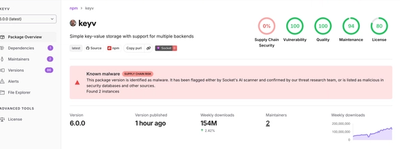
Popular npm packages keyv and cacheable compromised.

Security News
A misconfiguration gave three Anthropic models internet access, and one, believing it was in a simulation, shipped a credential-stealing package to PyPI.