
Research
/Security News
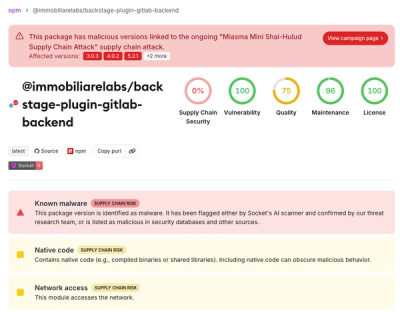
Miasma Mini Shai-Hulud Hits ImmobiliareLabs npm Packages
Miasma Mini Shai-Hulud hits @immobiliarelabs Backstage plugins, targeting GitLab and LDAP auth packages on npm.
By Socket Research Team - Jun 26, 2026
@schris403/expo-analytics
Advanced tools
Google Analytics integration for use with React Native apps built on Expo.

Google Analytics integration for use with React Native apps built on Expo. Most of the other Google Analytics libraries I've found require linking, which is not supported with Expo. This library does not require linking.
Please create issues for any bugs you find or features you would like added.
npm install expo-analytics --save
Selecting this option when creating a google analytics property the tracking ID it is not prefixed with 'UA-' but with G- resulting in views not showing up. For now use the regular GA property pending resolving issue #48
It seems that Expo introduced some breaking changes in SDK 33, so if you are using a version of Expo below 33 please pin your package.json to version 1.0.8 of this package. expo-analytics 1.0.9+ is only compatable with Expo SDK 33+.
Your React Native app's screen resolution, app name, app ID, app version and multiple other parameters will be automatically resolved and sent with each hit or event.
For SDK 44+ support you will need to provide the clientId in the form a UUID as Constants.installationId has been deprecated. You should generate and store this where appropriate for the platform and provide the value as the second argument.
Sending page hits or screen hits is done by constructing a new PageHit or ScreenHit instance and passing it to the hit function of an Analytics instance.
import { Analytics, PageHit } from 'expo-analytics';

const analytics = new Analytics('UA-XXXXXX-Y', 'UUID');
analytics.hit(new PageHit('Home'))
  .then(() => console.log("success"))
  .catch(e => console.log(e.message));
You can also send custom events by constructing a new Event instance and passing it to the event function. Events have four parameters.
These parameters are passed to the Event constructor in that order.
import { Analytics, Event } from 'expo-analytics';

const analytics = new Analytics('UA-XXXXXX-Y', 'UUID');
analytics.event(new Event('Video', 'Play', 'The Big Lebowski', 123))
  .then(() => console.log("success"))
  .catch(e => console.log(e.message));
Learn more about custom events.
Custom Dimensions are also supported. Any custom dimensions set will be sent with each request.
import { Analytics, Event } from 'expo-analytics';

const analytics = new Analytics('UA-XXXXXX-Y', 'UUID');
analytics.addCustomDimension(1, 'TrialAccount');
analytics.addCustomDimension(2, 'Comedy');
analytics.event(new Event('Video', 'Play', 'The Big Lebowski', 123))
  .then(() => console.log("success"))
  .catch(e => console.log(e.message));
You can remove custom dimensions as needed.
analytics.removeCustomDimension(1);
Custom Metrics work the same way with just a slightly different call.
import { Analytics, Event } from 'expo-analytics';

const analytics = new Analytics('UA-XXXXXX-Y', 'UUID');
analytics.addCustomMetric(1, 15);
analytics.removeCustomMetric(1);
You can also optionally include any additional supported parameters you would like.
import { Analytics } from 'expo-analytics';

// pass in the user ID (uid), referrer (dr) and campaign name (cn)
const analytics = new Analytics('UA-XXXXXX-Y', 'UUID', { uid: '999', dr: 'github.com', cn: 'get_more_views' });
You can also send purchase by constructing a new Transaction instance and passing it to the transaction function. Transaction have five parameters.
These parameters are passed to the Transaction constructor in that order.
import { Analytics, Transaction } from 'expo-analytics';

const analytics = new Analytics('UA-XXXXXX-Y', 'UUID');

 analytics.hit(new Transaction('1235', 'Store', 38.43, 1.29, 5))
  .then(() => console.log("success"))
  .catch(e => console.log(e.message));
You can also send along the purchase the products that were purchased in the transaction, constructing a new AddItem instance and passing it to the AddItem function. 'AddItem' have six parameters.
These parameters are passed to the AddItem constructor in that order.
import { Analytics, AddItem } from 'expo-analytics';

const analytics = new Analytics('UA-XXXXXX-Y', 'UUID');

 analytics.hit(new AddItem('1235', 'T-SHIRT', 11.99, 1, 'DD44', 'Clothes'))
  .then(() => console.log("success"))
  .catch(e => console.log(e.message));
The Google Analytics API is a bit particular. If you're not seeing Real Time hits in your Analytics console you can turn on debug mode for this package and the exact URL request being sent will be printed to the console.
import { Analytics, PageHit } from 'expo-analytics';

const analytics = new Analytics('UA-XXXXXX-Y', 'UUID', null, { debug: true });
analytics.hit(new PageHit('IsItWorking'))
  .then(() => console.log("success"))
  .catch(e => console.log(e.message));
You might want to use your own static userAgent http header instead of the default WebView header.
const analytics = new Analytics('UA-XXXXXX-Y', null, { userAgent: 'Custom UserAgent' });
1.0.16 Using installationId instead of deviceId. Thanks @AlexKvazos! 👨🏻🎤
1.0.15 Fix for CORS issue in Safari when using with expo-web. Thanks @spencerlevitt and @chunghe!
1.0.14 Fixing a possible race condition. Thanks, @giautm!
1.0.13 User agent caching (thanks, @musemind!) and screenTitle on PageHits (thanks, @YassineElbouchaibi)
1.0.11 Support for e-commerce tracking. Thanks, @lucianfialhobp.
1.0.10 Support for custom metrics.
1.0.9 Support for Expo 0.33. Thanks, @rossb89.
1.0.8 Adding TypeScript definitions.
1.0.7 Promisification. Thanks, @dylancompanjen!
1.0.6 Fix for ScreenHit parameter name (thanks @davisml!). Support for custom dimensions.
1.0.5 Fixing issue with duplicate dependencies causing installation problems.
1.0.4 Automatically pull screen resolution from React Native dimensions. Resolve app name, app ID, app version from Expo manifest. App name is now required. Added debug option.
1.0.3 Added support for app ID and version
1.0.2 Added support for custom events
1.0.1 Initial release
FAQs
Google Analytics integration for use with React Native apps built on Expo.
We found that @schris403/expo-analytics demonstrated a not healthy version release cadence and project activity because the last version was released a year ago. It has 1 open source maintainer collaborating on the project.
Did you know?

Socket for GitHub automatically highlights issues in each pull request and monitors the health of all your open source dependencies. Discover the contents of your packages and block harmful activity before you install or update your dependencies.
Research
/Security News
Miasma Mini Shai-Hulud hits @immobiliarelabs Backstage plugins, targeting GitLab and LDAP auth packages on npm.

Security News
Rolldown paused Rust React Compiler integration after a 5MB binary size increase raised concerns about shipping React-specific code to all Vite users.

Security News
/Research
Mini Shai-Hulud expands into the Go ecosystem after hitting LeoPlatform npm packages and targeting GitHub Actions workflows.