

Company News
AWS Security Hub Adds Socket for Supply Chain Security
Socket is now in the AWS Security Hub Extended plan. Adopt it through AWS, apply committed spend, and block malicious open source packages.
By Feross Aboukhadijeh - Aug 04, 2026
@scorezilla/mcp
Advanced tools
Official MCP server for Scorezilla — add a leaderboard to your game from your AI coding assistant.


Official Model Context Protocol (MCP) server for Scorezilla — the easiest way to add a leaderboard to your game. Connect this server to your AI coding assistant (Claude Code, Cursor, Continue.dev, …) and ship a working leaderboard without leaving your editor.
Eleven tools total — five read-only, and six that write: four that create resources (bootstrap_leaderboard, create_game, create_board, mint_key) plus two that update config (update_board_config — score bounds + retention, e.g. an anti-cheat maxScore; update_game_config — the browser-submit origin allowlist).
Status — v0.3.0. Published on the
@latestdist-tag.0.3.0adds three create-only write tools —create_game,create_board,mint_key— so an agent can provision against an existing game (add boards, mint keys, create more games), not just bootstrap a brand-new one.0.2.0added the integration-axis arguments (identity strategy, OAuth provider, hosting/anti-cheat pattern, server language) tobootstrap_leaderboard+get_sdk_snippet. Destructive ops (edit/delete, key revocation) remain dashboard-only by design.
Sign in at dashboard.scorezilla.dev, open MCP tokens, click Create token. Copy the mcp_live_* value once — it's not shown again.
Claude Code — edit ~/.claude/settings.json:
{
  "mcpServers": {
    "scorezilla": {
      "command": "npx",
      "args": ["-y", "@scorezilla/mcp"],
      "env": {
        "SCOREZILLA_TOKEN": "mcp_live_…"
      }
    }
  }
}
🔒 Keep
~/.claude/settings.jsonprivate. The token is stored in plaintext in that file. Make sure it's not committed to git (it's usually in your.gitignore), not synced to a public dotfiles repo, and not backed up to a shared location. On macOS/Linux:chmod 600 ~/.claude/settings.jsonso only your user can read it. If a token leaks, revoke it at dashboard.scorezilla.dev/account/tokens.
Cursor — open Settings → Features → MCP → Add new MCP server, then use the same command + args + env shape.
Anything else MCP-compatible — point your client at npx -y @scorezilla/mcp with SCOREZILLA_TOKEN set in the environment.
In Claude Code or Cursor: "Add a Scorezilla leaderboard to this game."
| Tool | What it does |
|---|---|
list_games | Lists your games. Use this first to orient. |
list_boards | Lists leaderboards under a game. |
get_keys | Returns the public key (safe to embed) and the secret-key prefix. The full secret never leaves the dashboard. |
get_board_top_n | Returns the top entries on a board. The "is my integration working?" tool. |
get_sdk_snippet | Returns ready-to-paste integration code for a board. Optional axis args tailor it: anonymous/OAuth identity, client-only vs. server-validated anti-cheat, and the server language (TS/Python/Go/C#). |
bootstrap_leaderboard | Creates a new game + first board in one call, then returns the widget embed + SDK snippet + a plain-English recommendation. Same optional axis args (anti-cheat, OAuth, server language). The 90-second-demo path. |
create_game | Creates a new (empty) game. Use when a game already exists (so bootstrap_leaderboard would conflict) or you want another. |
create_board | Adds a leaderboard board to an existing game (by gameId), with full options (sortDir, scoreKind, retention, bounds). |
mint_key | Mints a fresh public/secret key pair for an existing game. The secret is shown once. |
scorezilla-mcp [--read-only] [--base-url=<url>] [--version] [--help]
--read-only — refuse to register the write tools (bootstrap_leaderboard, create_game, create_board, mint_key, update_board_config, update_game_config). Use this on shared/CI configs to guarantee the AI can't create or change resources.--base-url=<url> — override the API origin. Defaults to https://api.scorezilla.dev. Useful for self-hosted or staging environments.SCOREZILLA_TOKEN — required. Bearer token issued at dashboard.scorezilla.dev/account/tokens.SCOREZILLA_BASE_URL — same as --base-url, but via env. CLI flag wins if both are set.SCOREZILLA_BETA_TOKEN — pre-public closed-beta only. When set, sent as the X-MCP-Beta header on every API call to unlock the MCP namespace before the public switch is flipped. You'll only need this if a Scorezilla team member gave you a beta token; ignore otherwise.env blocks, password managers, or secret stores.https://api.scorezilla.devReleases are CI-driven and require an approval click in the npm-publish GitHub Environment. The full flow:
pnpm changeset — describes what changed and the bump type. Commit the file under .changeset/..github/workflows/release.yml runs and opens a "chore(release): version @scorezilla/mcp" PR that bumps package.json, syncs server.json (the MCP Registry manifest) via scripts/sync-server-json-version.mjs, and updates CHANGELOG.md.--provenance (verifiable build attestation via GH OIDC + sigstore)mcp-publisher login github-oidc → mcp-publisher publishnode dist/index.js --version), and release:check (asserts package.json and server.json versions agree).Manual publishes from a developer terminal still work (bash scripts/publish.sh) but aren't the path CI takes — they skip provenance and approval gates. Use only for one-off recovery.
MIT.
FAQs
Official MCP server for Scorezilla — add a leaderboard to your game from your AI coding assistant.
We found that @scorezilla/mcp demonstrated a healthy version release cadence and project activity because the last version was released less than a year ago. It has 1 open source maintainer collaborating on the project.
Did you know?

Socket for GitHub automatically highlights issues in each pull request and monitors the health of all your open source dependencies. Discover the contents of your packages and block harmful activity before you install or update your dependencies.
Company News
Socket is now in the AWS Security Hub Extended plan. Adopt it through AWS, apply committed spend, and block malicious open source packages.
Research
/Security News
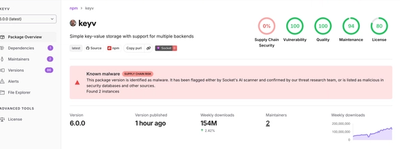
Popular npm packages keyv and cacheable compromised.

Security News
A misconfiguration gave three Anthropic models internet access, and one, believing it was in a simulation, shipped a credential-stealing package to PyPI.