

Company News
AWS Security Hub Adds Socket for Supply Chain Security
Socket is now in the AWS Security Hub Extended plan. Adopt it through AWS, apply committed spend, and block malicious open source packages.
By Feross Aboukhadijeh - Aug 04, 2026
@seedbase/client
Advanced tools
Node.js client + MCP server for Seedbase — generate realistic, relationship-preserving, privacy-safe test data and pull it into your database.

Generate realistic, relationship-preserving, privacy-safe test data for your databases — and pull it straight into your local or CI database.
Seedbase lives on seedbase.dev: you model (or import) a schema there, generate datasets, and use this package to pull them into Postgres, MySQL, SQLite and more. Schema-aware, foreign-key-correct, reproducible by seed.
This is the Node.js client, a counterpart to the Python SDK.
npm install @seedbase/client
Zero runtime dependencies — pure ESM, built on the native fetch of Node 18+.
import { SeedbaseClient } from "@seedbase/client";

// Token from the argument, $SEEDBASE_TOKEN, or ~/.seedbase/config.json
const client = new SeedbaseClient({ token: "dr_sk_..." });

// Trigger a generation and wait for it to finish
const gen = await client.generate(projectId, { seed: 42, wait: true });

// Download the result (Uint8Array)
const bytes = await client.download(gen.id, { format: "sql" });
import { writeFile } from "node:fs/promises";
await writeFile("dump.sql", bytes);
This package ships seedbase-mcp — a zero-dependency Model Context Protocol
server that lets AI assistants generate test data for you. Describe what you
need ("fill my Shop project with MySQL test data") and the assistant drives
SeedBase end-to-end through five tools:
| Tool | What it does |
|---|---|
list_projects | List your SeedBase projects (id, name, database type) |
create_project | Create a new, empty project |
import_schema | Import a schema from SQL DDL (raw pg_dump --schema-only works), CSV/JSON or ORM model code |
get_ddl | Get a project's schema as CREATE TABLE statements, per dialect |
generate_test_data | Generate a fresh FK-consistent dataset and return it as SQL (large results are written to a local file, never truncated) |
Hosted (zero install) — point any Streamable-HTTP MCP client at
https://seedbase.dev/mcp with an Authorization: Bearer dr_sk_... header:
claude mcp add-json seedbase '{"type":"http","url":"https://seedbase.dev/mcp","headers":{"Authorization":"Bearer dr_sk_..."}}'
Local via Claude Code (stdio):
claude mcp add-json seedbase '{"type":"stdio","command":"npx","args":["-y","-p","@seedbase/client","seedbase-mcp"],"env":{"SEEDBASE_API_KEY":"dr_sk_..."}}'
Claude Desktop (claude_desktop_config.json):
{
  "mcpServers": {
    "seedbase": {
      "command": "npx",
      "args": ["-y", "-p", "@seedbase/client", "seedbase-mcp"],
      "env": { "SEEDBASE_API_KEY": "dr_sk_..." }
    }
  }
}
Create a free account at seedbase.dev/register (no
credit card), then create an API key under Settings → API keys. The free tier is
enough to generate full, foreign-key-consistent datasets. The server is stdio-only,
talks exclusively to https://seedbase.dev, and stores nothing locally.
The token is resolved in this order:
token option passed to the constructor.SEEDBASE_TOKEN environment variable.token field in ~/.seedbase/config.json (written by seedbase login).API keys with the dr_sk_ prefix are sent as Authorization: Bearer ..., other
tokens as Authorization: Token .... Get a key at
seedbase.dev/settings?tab=api-keys.
new SeedbaseClient({
  token,            // optional, see resolution order above
  apiUrl,           // default "https://seedbase.dev/api/v1" (https enforced, http only for localhost)
  configPath,       // override ~/.seedbase/config.json
  requestTimeout,   // per-request timeout in ms, default 30000
  fetch,            // inject a custom fetch (e.g. for tests)
});
| Method | Description |
|---|---|
listProjects() | All datasets/projects (paginated, followed automatically). |
getProject(projectId) | A single project. |
listGenerations(projectId) | Generations for a project (paginated). |
getGeneration(generationId) | A single generation. |
generate(projectId, opts) | Trigger a generation. opts: { seed, rows, format, rebaseTo, wait, timeout, pollInterval }. With wait: true it polls until the generation reaches completed/failed/cancelled. |
download(generationId, { format }) | Download the generated artifact as a Uint8Array. format defaults to "sql". |
seededRows(projectId, { seed, rows }) | Generate and return the rows as { tableName: [row, ...] }, in foreign-key-safe order. |
exportConfig(projectId) | The project's engine config as an object. |
importConfig(projectId, config) | Replace the project's engine config. |
All methods are async and return Promises. Failures throw a SeedbaseError
(with .statusCode for HTTP errors), carrying a readable message that includes
the server's detail or field errors.
import { SeedbaseError } from "@seedbase/client";

try {
  await client.getProject("missing");
} catch (err) {
  if (err instanceof SeedbaseError) {
    console.error(err.statusCode, err.message);
  }
}
Fill a Prisma-managed database with realistic, foreign-key-consistent data, in
one call. Your schema must already exist (your prisma migrate owns it);
SeedBase only fills it. Free tier.
// prisma/seed.ts
import { PrismaClient } from "@prisma/client";
import { SeedbaseClient } from "@seedbase/client";
import { seedPrisma } from "@seedbase/client/prisma";

const prisma = new PrismaClient();
const client = new SeedbaseClient({ token: process.env.SEEDBASE_TOKEN });

await seedPrisma(prisma, client, { project: process.env.SEEDBASE_PROJECT, seed: 42 });
Then run prisma db seed. A runnable demo (offline, no account) is in
examples/prisma-seed-demo.mjs.
MIT licensed.
FAQs
Node.js client + MCP server for Seedbase — generate realistic, relationship-preserving, privacy-safe test data and pull it into your database.
We found that @seedbase/client demonstrated a healthy version release cadence and project activity because the last version was released less than a year ago. It has 1 open source maintainer collaborating on the project.
Did you know?

Socket for GitHub automatically highlights issues in each pull request and monitors the health of all your open source dependencies. Discover the contents of your packages and block harmful activity before you install or update your dependencies.
Company News
Socket is now in the AWS Security Hub Extended plan. Adopt it through AWS, apply committed spend, and block malicious open source packages.
Research
/Security News
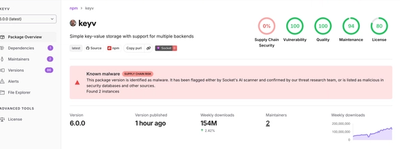
Popular npm packages keyv and cacheable compromised.

Security News
A misconfiguration gave three Anthropic models internet access, and one, believing it was in a simulation, shipped a credential-stealing package to PyPI.