
Product
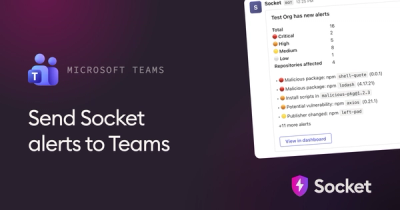
Microsoft Teams Notifications Are Now Available in Socket
Socket can now send alerts and supply chain attack notifications to Microsoft Teams, with filters that route the right updates to each channel.
By Jeppe Hasseriis - Sep 01, 2026
@seemseam/llmgateway
Advanced tools
llmgateway is a small async Python library for routing LLM calls through one
or more providers. It provides shared runtime configuration, provider failover,
concurrency limits, retry helpers, JSON parsing helpers, and task-to-model
routing.
It is designed for applications that want one internal API while switching between OpenAI-compatible Responses APIs, Anthropic Messages, or LiteLLM-style backends.
After first PyPI publication is complete and verified, install the Python package with:
python3 -m pip install llmgateway
After first npm publication is complete and verified, install the companion npm package with:
npm install @seemseam/llmgateway
The npm package is a lightweight companion for JavaScript tooling that needs package metadata or the same default config paths. It does not implement LLM transport and does not install the Python package automatically.
For local development from a checkout:
python3 -m pip install -e ".[dev]"
npm test
Python 3.10 or newer is required.
Create a config file such as llmgateway.yaml, or use the default user config
path ~/.llmgateway/config.yaml. The environment variables
LLMGATEWAY_CONFIG, LLMGATEWAY_USER_CONFIG_DIR, and
LLMGATEWAY_PROVIDER_STATE can override config and provider-state locations.
See llmgateway.example.yaml for a larger template. A minimal single-provider config looks like this:
version: 1
providers:
  - provider_type: openai
    api_style: responses
    base_url: ${LLM_API_BASE_URL:-https://api.openai.com/v1}
    api_key: ${LLM_API_KEY}
    headers: {}
    model_map: {}

settings:
  strong_model: gpt-5.4
  weak_model: gpt-5.4-mini
  strong_reasoning_effort: high
  weak_reasoning_effort: low
  max_concurrent: 8
  retry_max: 2
  transport_retries: 2
  timeout: 30

tasks:
  analysis:
    tier: weak
    max_tokens: 4000
  planning:
    tier: strong
    max_tokens: 8000
Values written as ${ENV_NAME} or ${ENV_NAME:-default} are resolved from the
environment when user config is loaded. Providers are tried in order. When a
provider succeeds, llmgateway records that provider in provider-state.json
under the user config directory and can prefer it on later requests without
rewriting config.yaml.
Legacy single-provider config under provider: is still supported, but new
configs should prefer providers:.
import asyncio
from pathlib import Path

from llmgateway import Gateway, load_runtime_spec


async def main() -> None:
    runtime = load_runtime_spec(Path("llmgateway.yaml"))
    gateway = Gateway(runtime)

    text = await gateway.run_task(
        "analysis",
        [{"role": "user", "content": "Summarize this in one sentence."}],
    )
    print(text)


asyncio.run(main())
For JSON-oriented tasks:
import asyncio
from pathlib import Path

from llmgateway import Gateway, load_runtime_spec


async def main() -> None:
    runtime = load_runtime_spec(Path("llmgateway.yaml"))
    gateway = Gateway(runtime)

    result = await gateway.run_json_task(
        "analysis",
        [{"role": "user", "content": "Return JSON with a summary field."}],
    )
    print(result.data)


asyncio.run(main())
Run the test suite:
PYTHONPATH=src python3 -m pytest -q
Build source and wheel distributions:
rm -rf build dist *.egg-info src/*.egg-info
python3 -m build
python3 -m twine check dist/*
Smoke-test a built wheel in a clean virtual environment:
python3 -m venv /tmp/llmgateway-smoke
/tmp/llmgateway-smoke/bin/python -m pip install --upgrade pip
/tmp/llmgateway-smoke/bin/python -m pip install dist/llmgateway-*.whl
/tmp/llmgateway-smoke/bin/python - <<'PY'
from llmgateway import Gateway, runtime_spec_from_dict

runtime = runtime_spec_from_dict({
    "providers": [{"provider_type": "openai", "api_style": "responses"}],
    "settings": {"strong_model": "example-model"},
    "tasks": {"analysis": {"tier": "strong"}},
})
gateway = Gateway(runtime)
print(type(gateway).__name__, runtime.task("analysis").tier)
PY
Keep version in pyproject.toml and package.json synchronized before
publishing a new release. Then run the clean build and metadata checks above.
First PyPI publication should be done only after confirming the llmgateway
project is available on PyPI and the release owner has configured a safe
publication path. Publish with a configured API token or Trusted Publisher
environment:
python3 -m twine upload dist/*
After publishing, verify the released package from PyPI:
python3 -m venv /tmp/llmgateway-pypi-smoke
/tmp/llmgateway-pypi-smoke/bin/python -m pip install --upgrade pip
/tmp/llmgateway-pypi-smoke/bin/python -m pip install llmgateway
/tmp/llmgateway-pypi-smoke/bin/python - <<'PY'
import llmgateway
from llmgateway import Gateway

print(llmgateway.__name__, Gateway.__name__)
PY
This repository now has npm package metadata, but first npm publication still
requires release-owner action. Before first npm publication, verify that the
@seemseam/llmgateway package name is still available and that the publishing
account has access to the @seemseam npm scope. Inspect the tarball contents
and publish only from a committed release state:
npm test
npm pack --dry-run
First npm publication can then be done by the release owner from a clean, committed checkout:
npm publish --access public
The npm package is intentionally a companion package, not a full JavaScript or TypeScript SDK. A real JS/TS LLM gateway API should be designed before expanding the npm runtime surface.
FAQs
Companion npm package for llmgateway configuration metadata.
We found that @seemseam/llmgateway demonstrated a healthy version release cadence and project activity because the last version was released less than a year ago. It has 1 open source maintainer collaborating on the project.
Product
Socket can now send alerts and supply chain attack notifications to Microsoft Teams, with filters that route the right updates to each channel.

Security News
pnpm 12 rewrites the package manager in Rust, cutting install times by up to 90% while preserving pnpm 11 workflows and lockfiles.

Security News
Socket CTO Ahmad Nassri joins AppSec leaders at Black Hat to discuss active malware, package manager risks, and software supply chain defense.