
Product
Introducing Manifest Alerts
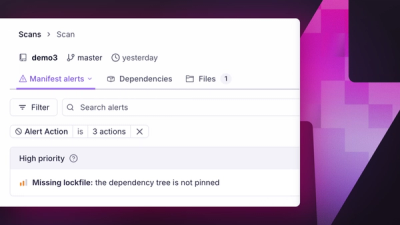
Socket now detects supply chain risks in project manifests, starting with missing lockfiles that can make dependency installs non-reproducible.
By André Staltz, Trevor Norris - Jun 16, 2026
@sentinel-password/breach
Advanced tools
Have I Been Pwned breach checking via k-anonymity for sentinel-password. Zero runtime dependencies; ≤ 10 KB gzipped (CI enforced).
Have I Been Pwned breach checking via k-anonymity, for sentinel-password. Zero runtime dependencies. ≤ 10 KB gzipped (CI enforced).
The password is SHA-1 hashed locally and only the first 5 hex characters of the digest are sent to the Pwned Passwords range API. The password, the full hash, and the matched suffix never leave the process and are never logged.
pnpm add @sentinel-password/breach
Requires a runtime with global fetch and crypto.subtle — Node.js ≥ 20 or a
modern browser. (SHA-1 is mandated by the HIBP protocol; it is not used here as
a security primitive.)
import { checkBreach } from '@sentinel-password/breach'

const result = await checkBreach(password)

if (result.status === 'error') {
  // The check could not complete — see result.reason. It is NEVER silently
  // treated as "safe". You decide: block submission, or allow and log.
} else if (result.breached) {
  console.log(`Seen ${result.breachCount} times in known breaches`)
}
@sentinel-password/coreThis package shares no types or runtime with core. Compose them explicitly:
import { validatePassword } from '@sentinel-password/core'
import { checkBreach } from '@sentinel-password/breach'

async function evaluate(password: string) {
  const rule = validatePassword(password)
  const pwned = await checkBreach(password)

  // Fail-closed example: a degraded breach check blocks the password.
  // Swap to fail-open by treating status === 'error' as acceptable.
  const breachOk = pwned.status === 'ok' && !pwned.breached

  return { accepted: rule.valid && breachOk, rule, pwned }
}
SHA1(password) is computed locally and upper-cased to 40 hex chars.GET https://api.pwnedpasswords.com/range/<prefix>.SUFFIX:COUNT pair sharing that prefix (hundreds of
them). The remaining 35 chars are matched locally.Add-Padding: true is sent by default so the response size
doesn't leak how many suffixes share the prefix.checkBreach(password, options?): Promise<BreachResult>Never throws. Resolves to a discriminated union:
{ status: 'ok', breachCount, breached } — breached is
breachCount >= threshold.{ status: 'error', reason, detail? } — reason is one of network,
timeout, rate-limit, http, unsupported. detail never contains the
password or its hash.An empty password short-circuits to a zero verdict with no hashing or network.
| Option | Default | Description |
|---|---|---|
threshold | 1 | Exposure count at or above which breached is true. |
addPadding | true | Send the HIBP Add-Padding: true header. |
timeoutMs | 5000 | Abort the request after this many milliseconds. |
fetch | global | fetch implementation (inject for proxies/agents or tests). |
cache | — | Optional prefix-keyed response cache (see createBreachCache). |
createBreachCache(maxEntries?): BreachCacheIn-memory, FIFO-bounded cache keyed by the 5-char prefix. One cached prefix serves every password whose hash starts with it. Stores only public range data — never a password or hash.
resolveBreachMessage(code, params, options?) / DEFAULT_BREACH_MESSAGESOptional decoupled i18n, mirroring core's messages / formatMessage
mechanism but owned by this package (core's MessageCode union is untouched).
checkBreach returns structured data; use this only if you want a rendered,
translatable string.
HIBP best practice is to call this from your server, not the browser:
A runnable server example lives in examples/express-backend.
CI fails if dist/index.js exceeds 10 KB gzipped. Check locally:
pnpm --filter @sentinel-password/breach build
gzip -c packages/breach/dist/index.js | wc -c   # must be <= 10240
MIT. See the repository root LICENSE.
FAQs
Have I Been Pwned breach checking via k-anonymity for sentinel-password. Zero runtime dependencies; ≤ 10 KB gzipped (CI enforced).
We found that @sentinel-password/breach demonstrated a healthy version release cadence and project activity because the last version was released less than a year ago. It has 1 open source maintainer collaborating on the project.
Did you know?

Socket for GitHub automatically highlights issues in each pull request and monitors the health of all your open source dependencies. Discover the contents of your packages and block harmful activity before you install or update your dependencies.
Product
Socket now detects supply chain risks in project manifests, starting with missing lockfiles that can make dependency installs non-reproducible.

Research
/Security News
The trojanized extensions use TinyGo-compiled WebAssembly and Solana transaction memos to resolve command-and-control infrastructure.

Security News
Anthropic says the directive cited national security concerns over a narrow jailbreak, but offered no specific technical details.