

Company News
AWS Security Hub Adds Socket for Supply Chain Security
Socket is now in the AWS Security Hub Extended plan. Adopt it through AWS, apply committed spend, and block malicious open source packages.
By Feross Aboukhadijeh - Aug 04, 2026
@synchronex/agent-bridge
Advanced tools
Synchronex local agent bridge — routes AI generation through your local subscription CLIs
Routes AI content generation through local AI CLIs on your machine, so generation can use the provider subscription you already have instead of per-token API billing.
The bridge runs as your local user, launches official provider CLIs, and sends stdout/stderr back to the connected app. It never reads, stores, or proxies provider OAuth tokens.
Most Synchronex users do not need the auto-start daemon. The managed web app is the default path, and foreground run is the reliable local bridge path when you want subscription routing from your machine.
npx @synchronex/agent-bridge@latest setup
Setup checks Node, validates local AI provider CLIs, opens browser pairing when needed, and ends with a clear checklist. If a provider install or login is blocked, setup tells you the exact next command and leaves Synchronex on managed cloud generation instead of dead-ending.
When setup is complete, start the bridge in the foreground:
npx @synchronex/agent-bridge@latest run
For local development:
npx @synchronex/agent-bridge --app http://localhost:3000
For Tractic:
npx @synchronex/agent-bridge --app https://tractic.io
On startup, the bridge validates installed local CLIs before reporting them as session capabilities. Presence and credential files are not enough: each provider must pass a bounded headless request so stale logins or interactive prompts fall back to managed compute cleanly.
cli:claude when Claude Code is installed, signed in, and validatescli:codex when Codex CLI is installed, signed in, and validatescli:gemini when Gemini CLI is installed, signed in, and validatescli:cursor when Cursor CLI is installed, signed in, and validatesNo extra setup is required in the bridge. Install whichever provider CLI matches the subscription you want to use, log in once, and the bridge validates it before connect. Heartbeats reuse a short-lived validation cache to avoid repeatedly spending provider requests.
The canonical setup command is npx @synchronex/agent-bridge@latest setup. Copy-paste setup details for Node, Claude Code, Codex CLI, Gemini CLI, Cursor CLI, and the bridge are in docs/SETUP.md.
Claude Code requires a Pro, Max, Team, Enterprise, or Console account.
| Platform | Install | Login |
|---|---|---|
| macOS / Linux / WSL | curl -fsSL https://claude.ai/install.sh | bash | claude |
| Windows PowerShell | irm https://claude.ai/install.ps1 | iex | claude |
ChatGPT / OpenAI Codex CLI is included with ChatGPT Plus, Pro, Business, Edu, and Enterprise plans.
| Platform | Install | Login |
|---|---|---|
| macOS / Windows / Linux | npm i -g @openai/codex | codex |
Gemini CLI supports Google OAuth sign-in from the CLI.
| Platform | Install | Login |
|---|---|---|
| macOS / Windows / Linux | npm install -g @google/gemini-cli | gemini |
| macOS / Linux with Homebrew | brew install gemini-cli | gemini |
npx @synchronex/agent-bridge                    # auto: connect if needed, then run in the foreground
npx @synchronex/agent-bridge setup              # check Node, vendor CLIs, auth, pairing, and fallback path
npx @synchronex/agent-bridge connect            # only run device authorization
npx @synchronex/agent-bridge add                # pair another account onto this machine (same as connect)
npx @synchronex/agent-bridge run                # start polling for every paired account (fails if none)
npx @synchronex/agent-bridge install            # show the foreground-run path and advanced daemon instructions
npx @synchronex/agent-bridge install --daemon   # advanced: install a per-user background service at login
npx @synchronex/agent-bridge uninstall          # remove the service, revoke tokens, and clear local credentials
npx @synchronex/agent-bridge uninstall --keep-token  # remove only the service; keep paired credentials
npx @synchronex/agent-bridge status             # list every paired account and its device
npx @synchronex/agent-bridge update             # update the installed binary (verifies checksum; npx: use @latest)
npx @synchronex/agent-bridge logout             # revoke + clear ALL accounts
npx @synchronex/agent-bridge logout --account you@example.com  # revoke + remove one account
Run connect first, then run when you want local subscription routing:
npx @synchronex/agent-bridge connect
npx @synchronex/agent-bridge run
Auto-start is optional and advanced. It is useful only if you explicitly want the bridge to run at every login without a terminal open:
npx @synchronex/agent-bridge install --daemon
The daemon installer creates a per-user service only:
~/Library/LaunchAgents/ai.synchronex.agent-bridge.plist%APPDATA%\Microsoft\Windows\Start Menu\Programs\Startup\SynchronexAgentBridge.cmd launching an %APPDATA%\Synchronex\agent-bridge.cmd wrapper~/.config/systemd/user/synchronex-agent-bridge.serviceUse uninstall to unload the service, remove service files, revoke bridge tokens server-side, and clear local credentials. Passing --keep-token removes only the daemon service.
Advanced setup and Windows troubleshooting: docs/agent-bridge-setup.md.
One bridge can serve several Synchronex accounts at once — for example your
primary account for daily work plus a separate test/audit account. Each account
is paired independently (add while signed into that account in the browser),
and the bridge runs one session per account, each authenticated with its own
token. Requests are only ever claimed by the account that owns them, so accounts
stay fully isolated. Re-run npx @synchronex/agent-bridge after add so the
running bridge picks up the newly paired account.
| Variable | Description |
|---|---|
SYNCHRONEX_APP_URL | Override the target app URL (alternative to --app flag) |
SYNCHRONEX_BRIDGE_AUTH_VALIDATION_TIMEOUT_MS | Timeout for provider validation probes. Default: 8000 |
SYNCHRONEX_BRIDGE_AUTH_VALIDATION_CACHE_MS | Cache duration for provider validation results during a bridge session. Default: 600000 |
AGENT_BRIDGE_HEADLESS_TIMEOUT_MS | Timeout for non-interactive provider requests. Default: 240000 |
For each generation request, the bridge creates a temporary output directory and exposes it as BRIDGE_OUTPUT_DIR. Skills should write deliverable files there. After the command exits, the bridge sends those files back to the connected app as attachment events:
bridge-attachments storage bucket with a signed URLIf BRIDGE_OUTPUT_DIR is not set, skills may fall back to ./output/ for local development.
When the app includes a brand kit in the request metadata, the bridge writes it to a temporary JSON file and exposes the path as BRIDGE_BRAND_KIT_PATH. Skills can read that file for colors, logos, fonts, and tagline data.
When the app includes metadata.needsApiKeys, the bridge writes only the requested provider API keys to a temporary JSON file and exposes it as BRIDGE_AI_KEYS_PATH. The file is deleted with the request directory after the command exits.
FAQs
Synchronex local agent bridge — routes AI generation through your local subscription CLIs
We found that @synchronex/agent-bridge demonstrated a healthy version release cadence and project activity because the last version was released less than a year ago. It has 1 open source maintainer collaborating on the project.
Did you know?

Socket for GitHub automatically highlights issues in each pull request and monitors the health of all your open source dependencies. Discover the contents of your packages and block harmful activity before you install or update your dependencies.
Company News
Socket is now in the AWS Security Hub Extended plan. Adopt it through AWS, apply committed spend, and block malicious open source packages.
Research
/Security News
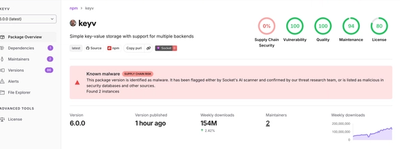
Popular npm packages keyv and cacheable compromised.

Security News
A misconfiguration gave three Anthropic models internet access, and one, believing it was in a simulation, shipped a credential-stealing package to PyPI.