
Security News
The Code You Didn't Write Is Still Yours to Defend
AI agents are pulling packages into environments no scanner is watching, creating exposure before security teams can see it.
By Brad Arkin - Jun 23, 2026
@tabularium/cli
Advanced tools
Author-side CLI for the Tabularium plugin registry — `tabularium validate` checks your `.tabularium` manifest against a running registry's schema.
@tabularium/cliCommand-line tool for Tabularium plugin authors. Thin wrapper around @tabularium/manifest — kept separate so library consumers don't pull commander and friends.
Run on-demand with bunx (no install):
bunx @tabularium/cli validate ./tabularium.yaml
Or install globally:
bun add -g @tabularium/cli
tabularium validate ./tabularium.yaml
validate <file>Validates a manifest against the registry's JSON Schema. Reads the schema from --registry (default the canonical Tabularium instance) so you're always checking against the operator's live extension deltas, not a stale local copy.
bunx @tabularium/cli validate ./tabularium.yaml \
  --kind theme \
  --registry https://registry.example.com
Flags:
--kind <key> — apply per-kind extensions (e.g. fields only required for themes).--registry <url> — base URL to fetch the schema from. Defaults to the public Tabularium registry.Output, per error, one per line:
/screenshots/0/url    minLength    must NOT have fewer than 8 characters
/repository/url       pattern      must match pattern "^https?://"
Exit code:
0 — manifest is valid.1 — validation failed; errors printed to stderr.2 — file or schema couldn't be loaded.Drop into any pipeline that has Bun (or use npx if you prefer the npm route — the binary works identically).
- uses: oven-sh/setup-bun@v2
- run: bunx @tabularium/cli validate ./tabularium.yaml --registry ${{ vars.TABULARIUM_REGISTRY }}
- uses: actions/setup-node@v4
- run: npx -y @tabularium/cli validate ./tabularium.yaml --registry $TABULARIUM_REGISTRY
A reusable Action that wraps this command is tracked as a follow-up — it'll add nice error annotations on the PR. Until then, the CLI's plain output is grep-able.
@tabularium/manifest stays pure (no commander, no picocolors, no node CLI machinery) so:
wasm-bindings or deno.land/x mirrors stay small.--sign) — out of scope for the first release. The registry signs every published release; author-side signatures are a separate trust layer.tabularium publish / tabularium release — not happening. The registry is webhook-driven; releases land via your existing git platform (GitHub / Forgejo / Codeberg). The CLI stays a check-only tool.FAQs
Author-side CLI for the Tabularium plugin registry — `tabularium validate` checks your `.tabularium` manifest against a running registry's schema.
We found that @tabularium/cli demonstrated a healthy version release cadence and project activity because the last version was released less than a year ago. It has 1 open source maintainer collaborating on the project.
Did you know?

Socket for GitHub automatically highlights issues in each pull request and monitors the health of all your open source dependencies. Discover the contents of your packages and block harmful activity before you install or update your dependencies.
Security News
AI agents are pulling packages into environments no scanner is watching, creating exposure before security teams can see it.

Security News
GitHub Actions checkout now blocks risky pull_request_target checkouts by default to help prevent pwn request supply chain attacks.
Product
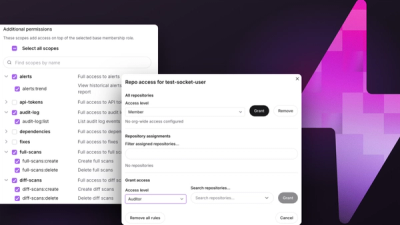
Socket now supports Custom Roles and Repository Access Permissions so organizations can control who can access specific repositories and actions.