

Product
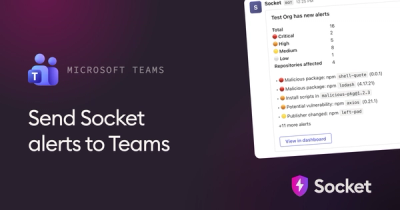
Microsoft Teams Notifications Are Now Available in Socket
Socket can now send alerts and supply chain attack notifications to Microsoft Teams, with filters that route the right updates to each channel.
By Jeppe Hasseriis - Sep 01, 2026
@tenetvault/mcp-server
Advanced tools
Local-first memory and rules layer for AI coding agents — MCP server and CLI.
Local-first memory and rules layer for AI coding agents — via Model Context Protocol.
npx -y @tenetvault/mcp-server@latest setup cursor
This npm package is the developer/advanced fallback. The ordinary-user release format is a verified per-platform standalone archive that includes Node and native production dependencies and installs in the user's own directory without global npm or sudo. This initializes the vault and configures Cursor MCP in one step. Replace cursor with claude, codex, or all.
On macOS this default setup installs and verifies one persistent per-user login service. After login or reboot the daemon starts automatically, but the encrypted Vault intentionally remains locked until you unlock it. --no-service is an advanced opt-out. Windows and Linux currently use a session daemon and require tenetvault start after login/reboot; an equivalent persistent service is not yet claimed.
The repository's current docs/04-operations/PLATFORM_SUPPORT.md is authoritative for distribution, service, manual-unlock, and Quick Unlock support. Historical build notes do not broaden that matrix.
Verify with:
npx -y @tenetvault/mcp-server@latest doctor
mcp_write_enabled (default off) guards all write operationstenetvault setup <ide> # Configure MCP + service + encrypted Vault (cursor|claude|codex|all)
tenetvault doctor [ide] # Diagnose activation issues (--json for CI)
tenetvault init # Initialize an encrypted vault at ~/.tenetvault/
# Non-interactive: tenetvault init --passphrase-file <private-0600-file>
tenetvault capture --title <t> --content <c> # Save a candidate growth memory
pbpaste | tenetvault capture --title <t> --kind lesson
tenetvault review today --approve 1,3 --reject 2 --complete
tenetvault start # Start daemon (Local API + vault runtime) + Web UI
tenetvault open # Start if needed and open the dashboard
tenetvault vault unlock # Unlock interactively in this terminal
tenetvault vault quick-unlock enable # macOS opt-in; stores a device key, never your passphrase
tenetvault vault quick-unlock # User-triggered system authentication after a restart
tenetvault vault quick-unlock status # Inspect non-sensitive configuration state
tenetvault vault quick-unlock forget # Remove this Mac's device slot and Keychain item
tenetvault vault quick-unlock downgrade # Verify both recovery paths, remove device slots, return to v2
tenetvault vault rotate-key --confirm # Rekey SQLCipher and every active key slot
tenetvault version # Show version
tenetvault flags list # List feature flags
tenetvault flags set <key> <on|off> # Toggle a feature flag
The daemon can be healthy while the encrypted Vault is locked. Agents cannot read protected data in that state. Unlock from the local dashboard or a trusted local terminal; agents never receive or submit your passphrase. Quick Unlock is an explicit macOS convenience feature and never runs automatically. It is available only in releases whose app-like Keychain helper is formally signed and provisioned; the current release retains the code but ships it disabled and fail-closed until those Apple release materials are available. Manual passphrase and recovery unlock remain supported.
The MCP initialize response instructs Agents to load relevant memories, active rules, and decisions before non-trivial work. If that context is unavailable or locked, the Agent must stop the entire task, wait for the human to recover through a trusted local interface, and reload context before resuming. The Agent never receives or submits a Vault credential.
Full documentation is included in the source repository. The GitHub link is usable only when that repository is publicly available or the reader has access: github.com/tenetvault/tenetvault.
MIT
FAQs
Local-first memory and rules layer for AI coding agents — MCP server and CLI.
We found that @tenetvault/mcp-server demonstrated a healthy version release cadence and project activity because the last version was released less than a year ago. It has 1 open source maintainer collaborating on the project.
Product
Socket can now send alerts and supply chain attack notifications to Microsoft Teams, with filters that route the right updates to each channel.

Security News
pnpm 12 rewrites the package manager in Rust, cutting install times by up to 90% while preserving pnpm 11 workflows and lockfiles.
Security News
Socket CTO Ahmad Nassri joins AppSec leaders at Black Hat to discuss active malware, package manager risks, and software supply chain defense.