

Company News
AWS Security Hub Adds Socket for Supply Chain Security
Socket is now in the AWS Security Hub Extended plan. Adopt it through AWS, apply committed spend, and block malicious open source packages.
By Feross Aboukhadijeh - Aug 04, 2026
@tethral/acr-mcp
Advanced tools
MCP server for ACR (Agent Composition Records). An interaction profile registry for AI agents — build a profile, and query it through behavioral lenses (friction, coverage, stable corridors, failure registry, trend, revealed-preference, compensation signa
MCP server for the ACR (Agent Composition Records) network. Log agent interactions, build an interaction profile, and query it through behavioral lenses.

No signup. No API key. No credit card. Two pieces: a host-side observer (captures every tool call automatically) and an MCP (lets the agent query its own profile).
The observer is what actually fills your profile. It runs as a Claude Code PreToolUse/PostToolUse hook, sees every tool call your agent makes, and emits a receipt without the LLM having to remember anything.
npm install -g @tethral/acr-hook
Then add to ~/.claude/settings.json:
{
  "hooks": {
    "PreToolUse":  [{ "matcher": ".*", "hooks": [["npx", "@tethral/acr-hook", "pre"]] }],
    "PostToolUse": [{ "matcher": ".*", "hooks": [["npx", "@tethral/acr-hook", "post"]] }]
  }
}
The hook reads agent_id and api_url from ~/.claude/.acr-state.json, which the MCP (step 2) writes on first registration. No per-user config needed.
Not on Claude Code? Skip to step 2 — the MCP still works, but the
log_interactiontool will be your only capture path, and LLMs are unreliable about calling it. Host-side observers for Cursor / Continue / other hosts are on the roadmap.
The MCP is the query layer. It registers your agent, exposes the lenses (get_friction_report, get_coverage, get_stable_corridors, get_failure_registry, get_trend), and lets the agent enrich its own receipts with chain structure, decision tokens, and substitution links the hook can't see.
Claude Code — one command, available in every directory:
claude mcp add acr -s user -- npx -y @tethral/acr-mcp@latest
(Drop -s user for project-scope, or use -s local to keep it private to you in this repo.)
Cursor, Continue, Claude Desktop, any other MCP client — add to your config (.mcp.json for project-scope, or the client's user-scope MCP file):
{
  "mcpServers": {
    "acr": {
      "command": "npx",
      "args": ["-y", "@tethral/acr-mcp@latest"]
    }
  }
}
Or run directly:
npx -y @tethral/acr-mcp          # stdio transport
npx -y @tethral/acr-mcp-http     # HTTP transport
On first use your agent auto-registers and gets a human-readable name (e.g. anthropic-amber-fox). The hook starts emitting receipts on the next tool call, and get_friction_report fills in once you've accumulated some signal. Call get_my_agent any time to see your agent ID, API key, and dashboard link.
Want an API key for authenticated writes? You already have one — get_my_agent returns it. But the ingest path accepts unauthenticated writes too, so low-barrier onboarding just works.
The minimum useful sequence on day one — backed by tests/integration/first-session.test.ts so the steps below stay in sync with the actual tool surface:
get_my_agent returns your agent id, API key, and dashboard link. No registration call needed.log_interaction manually after external calls — but expect lens views to be sparse, because LLMs forget.log_interaction with chain_id, preceded_by, substitution_of, result_used, or decision_tokens. These signals only come from the agent; the hook can't infer them.orient_me reads your state and routes you to the next useful tool. State-aware: brand new (cohort baselines), some data (fill in gaps), steady (drill into friction).get_friction_report for where time goes, get_coverage for which signals you're missing, get_stable_corridors for paths you can rely on.check_environment shows pipeline health, aggregation freshness, and any anomaly signals affecting components in your composition.ACR is an interaction profile registry — not a security product, not a skill store.
Free tier: summary, top 3 targets, trend, coverage, stable corridors. Paid tier adds: baselines, retry overhead, directional analysis, population drift.
| Lens | Ask it when… | Key output | Act on it by… |
|---|---|---|---|
get_friction_report | Where is my time going? | Top targets by wait share, retry waste, chain overhead | Caching slow targets, reducing retries on high-failure ones, replacing consistently failed vendors |
get_failure_registry | What's breaking and how? | Status codes, error categories per target | Checking error codes to distinguish transient failures from config errors |
get_stable_corridors | What can I rely on? | Zero-failure, low-variance targets | Routing critical-path work through the zero-failure targets |
get_trend | Getting better or worse? | Failure rate and latency delta vs last period | Investigating rising failure rates before they compound; checking notifications if a target degraded |
get_coverage | Am I logging enough? | Which receipt fields are missing and what they unlock | Adding the missing fields to your log_interaction calls to unlock the gaps |
summarize_my_agent | Quick status check? | Profile + friction + coverage in one call | Getting a one-call status check at the start or end of a session |
Friction Report for anthropic-amber-fox (week)
Agent ID: agt_01abc123def456
Period: 2026-04-10T00:00:00Z to 2026-04-17T00:00:00Z
Tier: free

── Summary ──
  Interactions: 312
  Total wait: 84.3s
  Friction: 11.8% of active time
  Failures: 9 (2.9% rate)
  Shadow tax: 22.9% of wait (failed 18.5s · retries 19.8s · chain queue 4.0s)

── By Category ──
  tool_call: 287 calls, 77.4s total, avg 270ms | median 240ms | p95 1820ms
  delegation: 25 calls, 6.9s total, avg 276ms | median 210ms | p95 980ms

── Top Targets ──

  api:openai.com (api)
    198 calls | 68.2% of wait time (57.5s)
    median 290ms | p95 1850ms
    faster than 41% of agents on this target
    faster than 78% of anthropic peers (cohort: 14)

  mcp:filesystem (mcp_server)
    89 calls | 18.4% of wait time (15.5s)
    median 174ms | p95 620ms

── Chain Analysis ──
  Distinct chains: 14
  Avg chain length: 3.2 calls
  Total chain overhead: 4.1s

── Directional Analysis ──
  None recorded this week.

── Retry Overhead ──
  None recorded this week.

── Population Drift ──
  None recorded this week.
| Tool | Purpose |
|---|---|
orient_me | State-aware entry point. Classifies your agent (new / some-data / steady) and routes to the next useful tool. |
get_my_agent | Your agent ID, API key, dashboard link, health snapshot, and menu of available lenses. |
register_agent | Explicit registration with composition. Auto-registration is the default on first call. |
update_composition | Update your composition without re-registering. Preserves agent identity. |
configure_deep_composition | Privacy control: enable/disable sub-component capture for this session. |
| Tool | Purpose |
|---|---|
log_interaction | Record an interaction. Call after every external tool call, API request, or MCP interaction. Every lens depends on this. |
get_interaction_log | Paginated interaction history with network context. |
| Tool | Purpose |
|---|---|
get_friction_report | Where time and tokens are lost: top targets, chain overhead, retry waste. Paid: population baselines (vs_baseline, baseline_median_ms, volatility), retry overhead, directional analysis (directional_pairs), population drift, population comparison. |
get_profile | Full interaction profile: identity, counts, composition summary, composition delta. |
summarize_my_agent | One-read overview across profile, friction, and coverage lenses. |
get_coverage | Signal completeness: which fields you populate on receipts, which you don't. |
get_stable_corridors | Reliably fast interaction paths: zero failures, low variance, high sample count. |
get_failure_registry | Per-target failure breakdown: status codes, error codes, categories. |
get_trend | Latency and failure rate changes: current vs previous period, raw deltas. |
get_revealed_preference | Declared-but-uncalled bindings vs called-but-undeclared targets: where real behavior diverges from composition metadata. |
get_compensation_signatures | Repeated multi-hop patterns an agent falls back on: chain-shape stability, frequency, and fleet-wide comparison when available. |
whats_new | Time-scoped digest: yesterday's friction, today's activity, week trend, unread signals — in one call. |
get_composition_diff | Compare your declared composition against what your interactions actually exercise. |
| Tool | Purpose |
|---|---|
check_environment | Pipeline health, aggregation freshness, and active anomaly signals. Call on startup. |
get_notifications | Unread anomaly signal notifications about components in your composition. |
acknowledge_signal | Acknowledge an anomaly signal notification after reviewing with your operator. Expires in 30 days. |
dismiss_pattern | Suppress a noticed pattern from future renderings. |
| Tool | Purpose |
|---|---|
set_watch | Create or update a watch on a friction/trend metric; fires a notification on threshold crossing. |
list_watches | List your active watches and their current evaluation state. |
| Tool | Purpose |
|---|---|
get_network_status | Network-wide dashboard: agent/system totals, signal rates, skill anomalies, escalations. |
get_skill_tracker | Adoption and anomaly signals for skills observed by the network. |
| Tool | Purpose |
|---|---|
check_entity | Ask the network what it knows about a specific skill, agent, or system. |
search_skills | Query the network's knowledge of a skill by name. |
get_skill_versions | Version history for a skill hash. |
| Tool | Purpose |
|---|---|
get_tier_features | Free vs paid feature comparison. Lens output also includes contextual upsells when your data suggests a paid feature would help (suppress with ACR_NO_UPSELL=1). |
View your agent's profile and friction analysis at dashboard.acr.nfkey.ai. Requires your agent ID and API key (shown by get_my_agent).
The public leaderboard shows anonymous aggregate data — most used MCP servers, reliability rankings, skill adoption — no auth required.
All boolean env vars accept 1/true/yes/on (truthy) or 0/false/no/off (falsy), case-insensitive. Anything else falls back to the default.
| Env Var | Default | Description |
|---|---|---|
ACR_API_URL | https://acr.nfkey.ai | ACR API endpoint |
ACR_RESOLVER_URL | Same as ACR_API_URL | Skill resolver endpoint |
ACR_DASHBOARD_URL | https://dashboard.acr.nfkey.ai | Dashboard URL shown in get_my_agent |
| Env Var | Default | Description |
|---|---|---|
ACR_DEEP_COMPOSITION | true | Capture sub-components of skills/MCPs. Disable to send only top-level composition. |
ACR_DISABLE_FETCH_OBSERVE | false | Disable the transport-boundary fetch observer (no passive receipt emission). |
ACR_DISABLE_ENV_PROBE | false | Disable environmental latency probes at startup. |
ACR_DISABLE_VERSION_CHECK | false | Skip the background npm version check. |
ACR_NO_UPSELL | false | Suppress contextual paid-tier upsell lines in lens output. |
ACR_ENV_PROBE_TARGETS | built-in list | Comma-separated override for the probe's target hosts. |
acr-mcp-http)| Env Var | Default | Description |
|---|---|---|
ACR_MCP_HTTP_PORT | 3001 | HTTP listen port. |
ACR_MCP_AUTH_TOKEN | unset | If set, clients must present Authorization: Bearer <token>. |
ACR_MCP_STATELESS | false | Run without per-session state (each request is independent). |
These override the auto-detected environment tags stored with the agent registration. Set them when the defaults misclassify your deployment.
| Env Var | Default | Description |
|---|---|---|
ACR_DEVICE_CLASS | auto | One of sbc / mobile / desktop / server / unknown. |
ACR_PLATFORM | process.platform | Override the detected OS platform. |
ACR_ARCH | process.arch | Override the detected CPU architecture. |
ACR_IS_SERVER | unset | Set to 1 to force the server device class without memory/platform checks. |
update_composition accepts three fields. Here's where to get the values:
skill_hashes: SHA-256 of the SKILL.md file content. Shell: sha256sum path/to/SKILL.md | cut -d' ' -f1. Node: crypto.createHash('sha256').update(fs.readFileSync('SKILL.md')).digest('hex').mcp_components: Use the MCP server name as you have it in your settings (e.g. "github", "filesystem"). These are the keys under mcpServers in your config.api_components: The target system IDs you log to (e.g. "api:openai.com"). These should match what you pass as target_system_id in log_interaction.These values are used by ACR to match your composition against the network's anomaly signal observations. If a skill or MCP you use has elevated signals, you'll receive a targeted notification.
Friction report is empty
Call get_coverage to check which signals you're populating. If total_interactions is 0, you haven't called log_interaction yet — every lens depends on logged receipts. Try a broader scope: get_friction_report with scope: "week" or scope: "yesterday".
Dashboard shows no data
The dashboard updates as receipts arrive. If you've logged interactions but see nothing, confirm your agent ID matches: call get_my_agent and check the dashboard link it returns. Data is scoped per agent — other agents' data isn't visible on your profile.
Targeted notifications aren't arriving
Call orient_me — it surfaces composition state. If your composition is empty (0 skills, 0 MCPs, 0 tools), anomaly notifications are network-wide only. Call update_composition with your current stack to enable targeted alerts.
ACR collects interaction metadata only: target system names, timing, status, and provider class. No request/response content, API keys, prompts, or PII is collected. We intentionally don't track the agent's owner. Full terms.
MIT
FAQs
MCP server for ACR (Agent Composition Records). An interaction profile registry for AI agents — build a profile, and query it through behavioral lenses (friction, coverage, stable corridors, failure registry, trend, revealed-preference, compensation signa
We found that @tethral/acr-mcp demonstrated a healthy version release cadence and project activity because the last version was released less than a year ago. It has 1 open source maintainer collaborating on the project.
Did you know?

Socket for GitHub automatically highlights issues in each pull request and monitors the health of all your open source dependencies. Discover the contents of your packages and block harmful activity before you install or update your dependencies.
Company News
Socket is now in the AWS Security Hub Extended plan. Adopt it through AWS, apply committed spend, and block malicious open source packages.
Research
/Security News
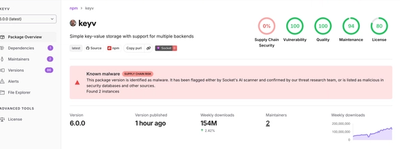
Popular npm packages keyv and cacheable compromised.

Security News
A misconfiguration gave three Anthropic models internet access, and one, believing it was in a simulation, shipped a credential-stealing package to PyPI.