@tokenlens/helpers




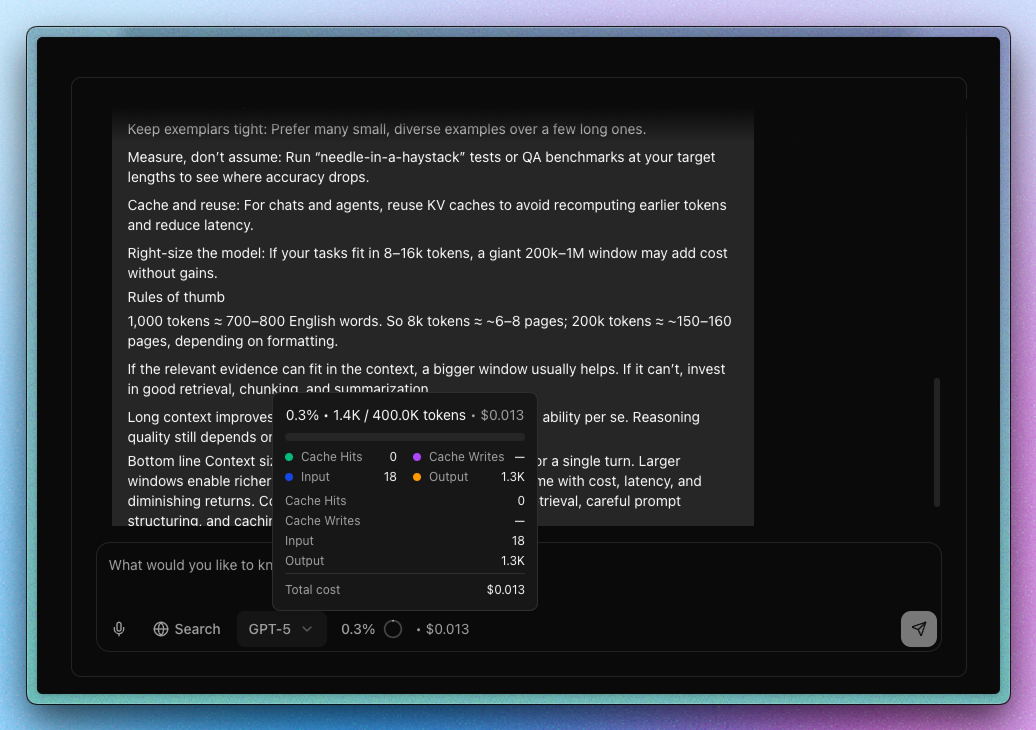
Utility helpers focused on context caps and rough cost estimation.
DI‑first: pass providers from fetchModels() (or getModels() for a static set).
Install
- npm:
npm i @tokenlens/helpers
- pnpm:
pnpm add @tokenlens/helpers
- yarn:
yarn add @tokenlens/helpers
Focused Exports
- Context:
getContext({ modelId, providers })
- Cost:
getTokenCosts({ modelId, usage, providers })
- Combined:
getUsage({ modelId, usage, providers, reserveOutput? })
- Types:
ContextData, TokenCosts, UsageData
Deprecated (use focused exports instead)
- Context:
getContextWindow, remainingContext, percentRemaining, fitsContext
- Usage:
normalizeUsage, breakdownTokens, consumedTokens
- Cost:
estimateCost
- Compaction:
shouldCompact, contextHealth, tokensToCompact
- Conversation:
sumUsage, estimateConversationCost, computeContextRot, nextTurnBudget
- DI:
sourceFromModels, sourceFromCatalog, selectStaticModels
Usage
import { fetchModels } from 'tokenlens';
import { getContext, getTokenCosts, getUsage } from '@tokenlens/helpers';

const openai = await fetchModels('openai');
const modelId = 'openai/gpt-4o-mini';
const usage = { prompt_tokens: 1000, completion_tokens: 500 };

const { maxInput, maxOutput, maxTotal } = getContext(modelId, openai);
const {
  inputUSD,
  outputUSD,
  reasoningUSD,
  cacheReadUSD,
  cacheWriteUSD,
  totalUSD,
} = getTokenCosts(modelId, usage, openai);
const summary = getUsage(modelId, usage, openai);
Notes
- IDs can be
provider/model, provider:id, or providerless model.
- Version dots normalize to dashes in the model segment.
- Cost outputs are estimates based on models.dev pricing fields. For authoritative cost numbers, read pricing and usage metrics from your model provider's API responses at runtime.
Back‑compat via tokenlens
import { getContext, getTokenCosts, getUsage } from 'tokenlens';
// These wrappers inject a default providers set if not supplied.
License
MIT