

Product
PHP and Composer Support Is Now in Beta
Socket’s PHP and Composer support is now in Beta for all customers, with PHP reachability analysis generally available.
By Trevor Norris, Benjamin Barslev - Aug 21, 2026
@towles-tool/comment-budget
Advanced tools
A budget for comment volume: AI writes comments faster than anyone can review them, so cap how much commentary a reader wades through to reach the code.
A budget for comment volume, written for a codebase an AI writes most of.
A model can emit more commentary in one pass than a human could ever accurately review, and it keeps adding — narrating each step, restating the line below it, heading every block, layering the next pass over the last — until there is too much of it to read. Commentary nobody reads is not documentation; it is what the code is hiding behind.
So the budget is a cap on what review can actually absorb. One question: how much commentary must a reader wade through to reach the code?
comment_lines / (comment_lines + code_lines) blank lines ignored
So 0.15 means "1 line in 7 is comment" — not comments-per-code-line. Two other
signals sit beside the ratio: an over-long unbroken run of comment, and an
over-long .md. It never reads what a comment says, so it can't tell you one
is stale or wrong — that is not the check. Volume is, and nothing else measures
it.
cargo install comment-budget                   # or, for a prebuilt binary:
bun add -d @towles-tool/comment-budget         # npm/pnpm/yarn work too
comment-budget                    # the gate: only the lines this branch adds over `main`
comment-budget --all              # the standing backlog, repo-wide
comment-budget --report           # thresholds in effect, surface table, worst files
comment-budget --format json      # findings as an array, for CI to consume
comment-budget --surface web      # one surface, for a session spent fixing it

comment-budget --new-from-merge-base release   # gate against a branch other than main
comment-budget --new-from-rev HEAD~3           # gate against a revision itself
Exit status is 0 when nothing errored, 1 when something did, 2 on a bad
invocation. Warnings never fail the run — they are the standing hit list.
Repo-wide, an established codebase reports hundreds of errors, and a gate that fails every run is one nobody reads. So the default judges only what a branch adds, and the ratio is the added lines' own — a branch can neither add commentary nor inherit the file's existing debt. An over-long run is the exception: it is measured whole and merely has to touch an added line to be reported, because a reader wades through all of it however much you wrote.
The comparison is against the working tree, so a local run judges what you
are about to push, not only what you have committed. --whole-files opts back
into judging every touched file whole. The --new-from-* flag names are
golangci-lint's, which is where the idea is best known from.
Everything measured — and how hard, and why — lives in comment-budget.toml at
the root of the tree, found by searching upward from the working directory.
rust, typescript, tsx,
hcl, or prose. exempt prefixes are invisible to every signal, neither
comment nor code, so a Rust //! header can hold the decision it records —
but only for a file's first exempt_free lines, past which they count
normally. That cap is what stops exempt being a hiding place: without it the
cheapest way to pass is to move prose from /// into //!, shortening
nothing for a reader. counted is the bloat being measured; a comment
matching neither list counts, so a new syntax can't slip through unmeasured.surface.file fires only when ratio and line count both exceed a tier.
Mass alone flags a big well-commented file; ratio alone flags a tiny stub
whose three doc lines are 40% of nothing. Neither is the thing being hunted.A file may opt out with a top-of-file comment-budget: allow(<reason>). The
reason is required — an unexplained opt-out is the failure mode it exists to
prevent. A minimal config:
skip = ["node_modules", "target", "dist"]

[kinds.rust]
grammar     = "rust"              # the tree-sitter grammar whose comment nodes are read
extensions  = ["rs"]
exempt      = ["//!"]             # module docs: where hard-won "why" lives
exempt_free = 12                  # ...but only this many lines of it are free
counted     = ["///", "//"]       # item docs and narration: the bloat being measured

[kinds.markdown]
grammar    = "prose"              # parses nothing; measures length instead
extensions = ["md"]

[[surface]]
name   = "crates"
paths  = ["crates/*/src/**/*.rs"]
goal   = "Document the module and the crossing points; not every pub item."
target = 0.15                     # reported per surface, not enforced
[surface.file]
warn  = { ratio = 0.20, lines = 50 }
error = { ratio = 0.30, lines = 100 }
[surface.run]
warn  = 8
error = 14

[[surface]]
name   = "docs"
paths  = ["**/*.md"]
goal   = "Prose has no code to sit against, so length is the only signal it offers."
target = { lines = 150 }
warn   = { lines = 150 }
error  = { lines = 250 }

[escape]
directive = "comment-budget: allow(<reason>)"
The binary is a thin shell over the crate; Finding keeps its fields rather
than only a rendered line, so a consumer can emit GitHub annotations or editor
diagnostics without parsing text back out.
let (cfg, root) = Config::discover(&std::env::current_dir()?)?;
let diff = Diff::open(&root, &Since::MergeBase("main".into()), false)?;
let analysis = comment_budget::analyze(&root, &cfg, Some(&diff))?;
for finding in comment_budget::judge(&cfg, &analysis.stats) {
    println!("{finding}");
}
Delete, don't reflow. Cut history — git already holds it — and keep only what looks forward: the why, and the how where the code leaves it unclear. Squeezing under a threshold just moves an error onto the warning list, and the budgets are not the thing to lower.
MIT OR Apache-2.0, at your option.
FAQs
A budget for comment volume: AI writes comments faster than anyone can review them, so cap how much commentary a reader wades through to reach the code.
The npm package @towles-tool/comment-budget receives a total of 7 weekly downloads. As such, @towles-tool/comment-budget popularity was classified as not popular.
We found that @towles-tool/comment-budget demonstrated a healthy version release cadence and project activity because the last version was released less than a year ago. It has 1 open source maintainer collaborating on the project.
Product
Socket’s PHP and Composer support is now in Beta for all customers, with PHP reachability analysis generally available.
Product
Socket is bringing experimental protection to Firefox, scanning 97,000+ extensions in Mozilla's official directory for malware and risky updates.
Research
/Security News
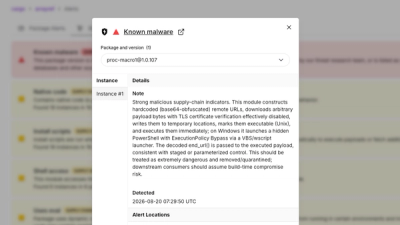
Three compromised Rust crates pulled in a malicious dependency that downloaded and executed cross-platform malware during Cargo builds.