

Company News
AWS Security Hub Adds Socket for Supply Chain Security
Socket is now in the AWS Security Hub Extended plan. Adopt it through AWS, apply committed spend, and block malicious open source packages.
By Feross Aboukhadijeh - Aug 04, 2026
@trackunit/graphql-build-tools
Advanced tools
`@trackunit/graphql-build-tools` provides a CLI and reusable transformer helpers for producing Manager-compatible GraphQL SDL in service build pipelines.
@trackunit/graphql-build-tools provides a CLI and reusable transformer helpers for producing Manager-compatible GraphQL SDL in service build pipelines.
Run the CLI in two steps when publishing a service schema:
bundle collects all raw .graphqls files into one SDL file.build renders that bundled SDL into the Manager-compatible schema for a gateway.graphql-build-tools bundle "src/**/*.graphqls" target/schema.graphqls
graphql-build-tools build --server=public target/schema.graphqls target/schema.public.graphqls
graphql-build-tools bundle "src/**/*.graphqls" target/schema.graphqls
The bundle command:
.graphqls filesgraphql-build-tools build --server=public target/schema.graphqls target/schema.public.graphqls
The build command:
internal, public, report, or v3-mobileUse - as the build output path to write the transformed SDL to stdout:
graphql-build-tools build --server=public target/schema.graphqls - > target/schema.public.graphqls
- run:
    name: Build public GraphQL schema
    command: |
      npx --yes @trackunit/graphql-build-tools bundle "src/**/*.graphqls" target/schema.graphqls
      npx --yes @trackunit/graphql-build-tools build --server=public target/schema.graphqls target/schema.public.graphqls
Use npm exec from frontend-maven-plugin when rendering schemas from a Maven build:
<execution>
  <id>bundle-graphql-schema</id>
  <phase>generate-resources</phase>
  <goals><goal>npm</goal></goals>
  <configuration>
    <arguments>exec --yes -- @trackunit/graphql-build-tools bundle src/main/graphql/**/*.graphqls target/graphql/schema.graphqls</arguments>
  </configuration>
</execution>
<execution>
  <id>render-public-graphql-schema</id>
  <phase>generate-resources</phase>
  <goals><goal>npm</goal></goals>
  <configuration>
    <arguments>exec --yes -- @trackunit/graphql-build-tools build --server=public target/graphql/schema.graphqls target/graphql/schema.public.graphqls</arguments>
  </configuration>
</execution>
Publish target/schema.public.graphqls or target/graphql/schema.public.graphqls to the schema registry from the next CI step.
The package also exports the SDL directive transformer chain used by buildGraphqlSchema.
const { buildGraphqlSchema, bundleSchemas } = require("@trackunit/graphql-build-tools");
The package root resolves to the library API. The CLI stays available through the graphql-build-tools bin command.
For more info and a full guide on Iris App SDK Development, please visit our Developer Hub.
This package was developed by Trackunit ApS. Trackunit is the leading SaaS-based IoT solution for the construction industry, offering an ecosystem of hardware, fleet management software & telematics.

FAQs
`@trackunit/graphql-build-tools` provides a CLI and reusable transformer helpers for producing Manager-compatible GraphQL SDL in service build pipelines.
The npm package @trackunit/graphql-build-tools receives a total of 2,437 weekly downloads. As such, @trackunit/graphql-build-tools popularity was classified as popular.
We found that @trackunit/graphql-build-tools demonstrated a healthy version release cadence and project activity because the last version was released less than a year ago. It has 6 open source maintainers collaborating on the project.
Did you know?

Socket for GitHub automatically highlights issues in each pull request and monitors the health of all your open source dependencies. Discover the contents of your packages and block harmful activity before you install or update your dependencies.
Company News
Socket is now in the AWS Security Hub Extended plan. Adopt it through AWS, apply committed spend, and block malicious open source packages.
Research
/Security News
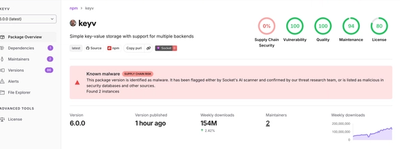
Popular npm packages keyv and cacheable compromised.

Security News
A misconfiguration gave three Anthropic models internet access, and one, believing it was in a simulation, shipped a credential-stealing package to PyPI.