
Product
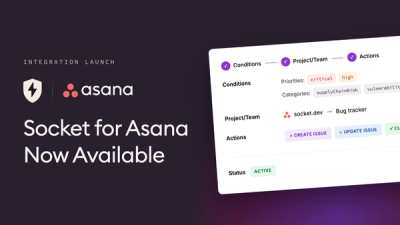
Socket for Asana Is Now Available
Create and manage Asana tasks directly from Socket alerts, with manual task creation, automated ticketing rules, and two-way sync.
By Jeppe Hasseriis - Aug 25, 2026
@trigguard/execution-sdk
Advanced tools
Execution gateway client: POST /execute, local receipt verification via /.well-known/trigguard/keys.json
@trigguard/execution-sdkNode.js client for the execution gateway (POST /execute, GET /.well-known/trigguard/keys.json) with local Ed25519 receipt verification.
Authorize (decide) only:
import { authorize, verifyReceiptOffline, createExecutionClient } from "@trigguard/execution-sdk";

await authorize({
  gatewayUrl: process.env.TRIGGUARD_GATEWAY_URL!,
  surface: "deploy.release",
  actorId: "my-agent",
  apiKey: process.env.TRIGGUARD_API_KEY,
});
Gate a side effect — withExecute calls /execute and runs your function only on PERMIT:
import { withExecute } from "@trigguard/execution-sdk";

await withExecute(
  "deploy.release",
  async () => {
    await doDeploy();
  },
  {
    gatewayUrl: process.env.TRIGGUARD_GATEWAY_URL!,
    apiKey: process.env.TRIGGUARD_API_KEY, // optional tg_live_…
    actorId: "ci",
    context: { repository: "org/repo" },
  }
);
On DENY / SILENCE, it throws ExecutionNotPermittedError (see error.trigguardResult). Also re-exported from @trigguard/runtime.
| Goal | API | Notes |
|---|---|---|
| Protect a side effect (fail-closed) | withExecute | Canonical — matches examples/canonical-first-execution/. |
| Authorize, then branch yourself | createExecutionClient → authorize | Same HTTP surface; you handle DENY/SILENCE. |
| One-shot authorize | authorize() | Thin wrapper over the client. |
All paths accept gatewayUrl plus either apiKey (tg_live_…) or
getBearerToken. Prefer apiKey for customer keys. Env cheat-sheet:
docs/infrastructure/ENVIRONMENT_REFERENCE.md.
As of Wave 5, the SDK exposes a categorical error vocabulary so integrators can route failures by category instead of by string-matching. All typed errors inherit from TrigGuardSdkError; the pre-existing ExecutionNotPermittedError is now also a TrigGuardSdkError (purely additive — existing instanceof Error and instanceof ExecutionNotPermittedError checks keep working).
import {
  attemptExecute,
  TrigGuardSdkError,
  TrigGuardAuthError,
  TrigGuardTimeoutError,
  ExecutionNotPermittedError,
} from "@trigguard/execution-sdk";

try {
  await attemptExecute("deploy.release", { gatewayUrl, apiKey });
} catch (e) {
  if (e instanceof ExecutionNotPermittedError) {
    /* policy DENY / SILENCE — do not retry */
  } else if (e instanceof TrigGuardAuthError) {
    /* expired or wrong credential — do not retry */
  } else if (e instanceof TrigGuardTimeoutError) {
    /* retryable */
  } else if (e instanceof TrigGuardSdkError) {
    /* any other typed failure — use e.category, e.retryable */
  }
}
Categories: auth | forbidden | network | timeout | malformed | http | trust | policy | verification | client-config. The retry-safety flag (e.retryable) is a deterministic function of the category — see docs/infrastructure/SDK_OPERATIONS.md for the full table.
verifyReceiptSignatureDetailed returns a categorical reason instead of boolean:
import { verifyReceiptSignatureDetailed } from "@trigguard/execution-sdk";

const r = verifyReceiptSignatureDetailed(receipt, keysDoc);
if (!r.ok) {
  // r.reason is one of: unsigned | missing-signing-key | missing-key-id |
  // malformed-signature | signature-invalid | crypto-error
}
The legacy verifyReceiptSignature(...) boolean signature is unchanged.
Set TRIGGUARD_SDK_VERBOSE=1 to enable structured stderr diagnostics. Off by default. The SDK never logs the auth token, the request body, or the response body — only URL, HTTP status, decision string, classified failure category, and retryable flag.
TRIGGUARD_SDK_VERBOSE=1 node my-app.js
# trigguard-sdk: authorize decision=PERMIT, failureCategory=<none>, httpStatus=200, retryable=<none>, url=https://gateway
apiKey, no getBearerToken) — convenient for local dev. In production this almost always indicates a misconfiguration. Enable TRIGGUARD_SDK_VERBOSE=1 during local development to surface a one-time no-auth-token warning.withExecute runs the protected function only on decision === "PERMIT". Any other outcome — DENY, SILENCE, missing decision, non-2xx HTTP, network failure, timeout — does not run the function.verifyReceiptSignature / verifyReceiptSignatureDetailed perform Ed25519 verification locally using keys from /.well-known/trigguard/keys.json. No external network call is made during verification once the keys document is in hand.Canonical, runnable, offline. From the repo root:
node examples/sdk-onboarding/00-minimal-authorize.mjs
node examples/sdk-onboarding/01-fail-closed-withexecute.mjs
node examples/sdk-onboarding/02-verify-receipt-locally.mjs
node examples/sdk-onboarding/03-local-dev-diagnostics.mjs
node examples/sdk-onboarding/04-typed-error-routing.mjs
See examples/sdk-onboarding/README.md for details and docs/infrastructure/SDK_OPERATIONS.md for the operator/integrator companion.
npm ci && npm run build
npm test
trigguard (sdk/trigguard-js) — hosted site verification API (/protocol/verify-receipt, etc.).@trigguard/execution-sdk — Cloud Run execution gateway (authorize → receipt).Protocol semantics remain in trigguard-protocol; this package is a thin HTTP + crypto wrapper.
FAQs
Execution gateway client: POST /execute, local receipt verification via /.well-known/trigguard/keys.json
We found that @trigguard/execution-sdk demonstrated a healthy version release cadence and project activity because the last version was released less than a year ago. It has 1 open source maintainer collaborating on the project.
Product
Create and manage Asana tasks directly from Socket alerts, with manual task creation, automated ticketing rules, and two-way sync.

Security News
Open VSX has removed three extension IDs from its malicious-extension list as the legitimate publishers they impersonated move to claim the names for themselves.

Product
Socket’s PHP and Composer support is now in Beta for all customers, with PHP reachability analysis generally available.