

Product
PHP and Composer Support Is Now in Beta
Socket’s PHP and Composer support is now in Beta for all customers, with PHP reachability analysis generally available.
By Trevor Norris, Benjamin Barslev - Aug 21, 2026
@ultimat3/auth
Advanced tools
The output of authentication is an Actor from @ultimat3/core. Nothing downstream
authorizes on a session row, a user row or an api key — http, actions, jobs and MCP all read
ctx.actor and hand it to @ultimat3/policy. One authz system, never two.
import { BuiltinAdapter, defineAuth, login, oauthLogin } from '@ultimat3/auth';

export const auth = defineAuth({
  adapter: new BuiltinAdapter(),          // or MemoryAdapter, or your Better Auth binding
  session: { absoluteTtlMs: 30 * 864e5, idleTtlMs: 7 * 864e5 },
  password: { minLength: 12 },
  mfa: { issuer: 'Acme' },                // the authenticator app's name; `required` only as `false`
  providers: ['github', 'google'],       // REQUIRED to serve any OAuth route — the default is []
  link: 'verified-email',                 // the default; `'never'` is the only other value
});

const { actor, token, cookie } = await login(auth, { email, password, ip });

// "Log in with GitHub" is a link to /auth/oauth/github. These two routes are what serves it.
const { start, callback } = oauthLogin(auth);
loginFailed() from rate-limit.ts. Never a specific message.sha256(secret) reaches the database.OAuthProvider.usesPkce is the literal true, so
usesPkce: false does not typecheck and there is no branch that skips the verifier.(purpose, identifier, tokenHash). Consuming first and comparing afterwards made an
unauthenticated wrong guess destroy the victim's live reset link.scopes column reaches Actor.scopes, so a human can hold a scope. permissions is a
different field and hasScope() does not read it.verifySession writes at most once per idleSlideMs, not once per request.AuthLimiter
is async on every member and declares the policy it enforces; defineAuth refuses a limiter
that disagrees with the app's declaration.createAuthLimiter keeps its table in the process, so maxAttempts: 5 at replicas: 3 lets an
account survive 15 guesses and hides each replica's lockout from the other two. An app that runs
more than one process says so and brings a limiter that says the same:
defineAuth({
  adapter,
  rateLimit: { maxAttempts: 5, scope: 'shared' },  // the whole fleet's allowance
  limiter: myLimiter,                              // whose policy says exactly the same
});
Auth.rateLimit is what an operator reads as "what this deployment enforces", so defineAuth
refuses any pairing that would make it a lie:
| Declared | Limiter's own policy | Result |
|---|---|---|
scope: 'process' (default) | anything, same numbers | boots; the lockout is per replica |
scope: 'shared' | scope: 'shared', same numbers | boots; one count for the fleet |
scope: 'shared' | scope: 'process' | X_AUTH_LIMITER_NOT_SHARED |
maxAttempts/windowMs/lockoutMs | any of the three different | X_AUTH_LIMITER_POLICY_MISMATCH |
account:<email> and ip:<addr> were the only key shapes, so one tenant's misconfigured
integration hammering login from 400 addresses was capped by neither — each IP bucket allowed its
own quota, the account buckets protected individuals, and the shared limiter saturated behind
them. orgKey(orgId) is the third shape, checked in login() once the address resolves to an org
and still before the KDF runs.
rateLimit.orgMaxAttempts is its own number, defaulting to maxAttempts * 20: a whole tenant
sharing five attempts is a denial of service against that tenant. A success on one member's
account clears the account window and deliberately not the tenant one — otherwise the traffic
that proves the tenant is alive is also the traffic that resets its cap. Pass orgLimiter to
defineAuth to share those counters across replicas; unlike limiter, it is not required under
scope: 'shared', because a tenant cap is a throughput ceiling and not a guessing allowance.
verifyWorkloadToken is the one function, and it reads all three shapes because they are all the
same JWT: a Kubernetes projected service-account token, a SPIFFE JWT-SVID, and a cloud IMDS token.
It is also the shape RFC 8693's subject_token takes.
const { identity } = await verifyWorkloadToken({
  token,
  issuers: ['https://kubernetes.default.svc'],
  audience: 'https://ledger.internal',
  keys: createJwksClient({ provider: 'k8s', jwksUri: 'https://kubernetes.default.svc/openid/v1/jwks' }),
  clock,
});
const actor = actorFromService(identity);   // kind: 'service', id: the caller's own sub
Signature first, then issuer, audience, exp and nbf. scope (space-delimited) or scp (an
array) become the actor's scopes; a token with neither carries none. There is no trusted-channel
exemption here — the token arrived in a header.
mTLS is out of scope. TLS termination is the mesh's job (axiom
7); the framework's part is reading a trusted
x-forwarded-client-cert through @ultimat3/http's trusted-proxy seam, which that package owns.
maxKeys is not compared — it bounds one process' table, not a limit. A custom limiter therefore
does not own its own configuration: the policy stays the app's single statement of the limits,
and the boot check is what keeps it true.
A shared limiter ships, As of 2026-08 — postgresAuthLimiter({ executor, clock, policy }),
two tables, a row per failure so the window still SLIDES across replicas. Until it landed,
scope: 'shared' was a declaration nothing in the framework could satisfy while x new scaffolded
replicas: 2 — maxAttempts × 2 guesses per account. executor is a PgExecutor, anything
speaking query(text, values); never Bun.sql, whose .query is undefined.
import {
  type AuthAdapter,
  type AuthRateLimitPolicy,
  DEFAULT_AUTH_RATE_LIMIT,
  defineAuth,
  orgRateLimit,
  type PgExecutor,
  postgresAuthLimiter,
} from '@ultimat3/auth';
import { type Clock, systemClock } from '@ultimat3/core';
import { db, type SqlFragment } from '@ultimat3/db';

declare const adapter: AuthAdapter;
const clock: Clock = systemClock;

// The client this process already opened, wrapped in one line.
const client = db();
const executor: PgExecutor = {
  query: <R>(text: string, values: readonly unknown[]): Promise<readonly R[]> =>
    client.query<R>({ text, values } satisfies SqlFragment),
};

const rateLimit: AuthRateLimitPolicy = { ...DEFAULT_AUTH_RATE_LIMIT, scope: 'shared' };

defineAuth({
  adapter,
  clock,
  rateLimit,
  limiter: postgresAuthLimiter({ executor, clock, policy: rateLimit }),
  orgLimiter: postgresAuthLimiter({ executor, clock, policy: orgRateLimit(rateLimit) }),
});
Both limiters share one table: the keys are prefixed (account:, ip:, org:) and every limit
travels as a statement parameter, so the tenant bucket's wider allowance cannot leak into the
account bucket's. It reports maxKeys: undefined — there is no in-process table to bound — and
neither table forgets on its own.
An app does not have to write any of that, As of 2026-08-22. The boot fills a seam and every
defineAuth in the process picks it up:
import { configureAuthLimiters, type PgExecutor, postgresAuthLimiter } from '@ultimat3/auth';
import type { Clock } from '@ultimat3/core';

declare const bootExecutor: PgExecutor;
declare const bootClock: Clock;

// In the HOST, before the app's modules import.
configureAuthLimiters((policy) =>
  postgresAuthLimiter({ executor: bootExecutor, clock: bootClock, policy }),
);
A factory and not a limiter, because the host runs before the app: defineAuth compares what a
limiter enforces against what the app declared, so a limiter built at boot on the framework
defaults would be X_AUTH_LIMITER_POLICY_MISMATCH for every app that tuned its numbers. The
factory is called once per bucket, with the resolved policy, so the two halves cannot disagree.
Precedence is defineAuth({ limiter }) → the installed factory → createAuthLimiter, and
resetAuthLimiters() puts the per-process default back. @ultimat3/cli's startServices calls it
on every boot, so a scaffolded app gets a fleet-wide lockout with nothing to remember.
Neither table forgets on its own, and purgeAuthLimits() is the framework's reader for that:
it drops failures past the window and lockouts that have expired, measured against the clock the
host handed the limiter, and it sweeps only the WIDEST window installed — a sweep on a narrower
one deletes failures another limiter is still counting, which hands a sprayer its attempts back.
@ultimat3/jobs' purge() job is what calls it hourly; x dev and every role container declare
that sweep at boot.
OAuthProviderId is string, and registerOAuthProvider() is the one way a provider gets in —
the three built-ins go through the same call. Before 1.3.0 the id was keyof typeof OAUTH_PROVIDERS over github | google | apple, so an enterprise OP was unrepresentable: the
constraint was a type, there was no runtime escape, and the only ways out were forking the package
or bypassing OAuth entirely and losing PKCE, the sealed handshake, issuer pinning and account
linking with it.
import { discoverOAuthProvider, registerOAuthProvider } from '@ultimat3/auth';

// By hand, when you know the four endpoints:
registerOAuthProvider({
  id: 'bigco-sso',
  authorizeUrl: 'https://sso.bigco.test/oauth2/v1/authorize',
  tokenUrl: 'https://sso.bigco.test/oauth2/v1/token',
  userInfoUrl: 'https://sso.bigco.test/oauth2/v1/userinfo',
  userEmailsUrl: null,
  issuers: ['https://sso.bigco.test'],
  jwksUri: 'https://sso.bigco.test/oauth2/v1/keys',
  scopes: ['openid', 'email', 'profile'],
  usesPkce: true,          // the literal `true`; `false` does not typecheck, for anyone
  usesNonce: true,
  clientIdEnv: 'BIGCO_SSO_CLIENT_ID',
  clientSecretEnv: 'BIGCO_SSO_CLIENT_SECRET',
});

// Or read them once at boot, from the issuer's own discovery document:
registerOAuthProvider(await discoverOAuthProvider({ id: 'bigco-sso', issuer: 'https://sso.bigco.test' }));
| Call | Answers |
|---|---|
registerOAuthProvider(provider) | the frozen provider; X_OAUTH_PROVIDER_DUPLICATE on a second claim of one id |
providerFor(id) | the provider, or throws X_OAUTH_PROVIDER_UNKNOWN — never undefined |
hasOAuthProvider(id) | whether the id is registered |
BUILTIN_OAUTH_PROVIDER_IDS | the three shipped ids — the only list an anonymous refusal names |
oauthProviderIds() | every registered id, live. NOT what defineAuth({ providers }) defaults to — that is [], so an app names what it enabled |
discoverOAuthProvider refuses a document with no jwks_uri: without a key set there is nothing
to check an id token's signature against, and the token-endpoint TLS exemption below is a thing a
caller declares, not one a provider inherits by omission.
SAML is out of scope and will stay out of scope. XML-DSig canonicalisation has no Bun native
and implementing it would mean a real dependency in the primitive vocabulary, which
docs/idea/18-build-vs-wrap.md does not permit. The honest
answer is to put an OIDC-speaking SAML bridge (Okta, Entra, Keycloak, Dex, a SAML-to-OIDC proxy) in
front and register that as a provider.
verifyIdToken({ keys }) is required to say where its trust comes from. There is no default,
because a default is what silently makes a second door as trusting as the first.
keys | Means |
|---|---|
'token-endpoint-tls' | this token came off a TLS response from the provider's own token endpoint — the one case OIDC Core 3.1.3.7 exempts. exchangeOAuthCode passes it, and that is the only shipped call site that may |
a JwksKeySource | the signature is checked. providerJwks(providerFor(id)), or createJwksClient({ provider, jwksUri }) |
const keys = providerJwks(providerFor('bigco-sso'));
const claims = await verifyIdToken({ provider: 'bigco-sso', idToken, clientId, nonce, clock, keys });
crypto.subtle covers RS256 and ES256, so this costs no dependency. HS256 and alg: none are
refused before a key is even looked up — a symmetric algorithm verified against a public key set
is the classic algorithm-confusion forgery. Keys are cached by kid with a TTL and one unknown
kid triggers exactly one refetch, so a rotation heals itself.
Wire an unsolicited token — IdP-initiated login, response_mode=form_post, back-channel logout,
token exchange — to anything that does not check the signature and an attacker posts a
self-minted JWT with the right iss, your aud, a VP's sub and tomorrow's exp, and gets a
session. That is account takeover with no credential, and it is what this exists to stop.
oauthLogin(auth, { resolveGrants }). Omit it and a first-time SSO user is created with
roles: [] and orgId: null — an actor every can() denies, and a tenant-scoped read that
throws before the query is built. SSO "works" and the person can do nothing until somebody runs
SQL, so the omission logs auth.oauth.user_created_without_grants rather than passing silently.
oauthLogin(auth, {
  resolveGrants: async (profile) => {
    const member = await directory.lookup(profile.email);
    return { orgId: member.orgId, roles: member.groups.map(toRole), scopes: [] };
  },
});
It is a seam and not a group-to-role table: which IdP group means which role is business convention and business convention never ships (axiom 8). What the framework owns is calling it on every login — so removing somebody from a group in the IdP takes effect at their next sign-in, rather than never. A seam that returns the stored answer writes nothing.
Pure functions over a secret and a clock. This package mints, checks and de-duplicates a code;
it persists nothing — the secret, the recovery-code hashes and the spent steps are the app's
rows, because AuthAdapter has no MFA member and adding one would break every third-party
adapter.
import type { Auth } from '@ultimat3/auth';
import { createTotpReplayGuard, enrolTotp, generateRecoveryCodes, verifyTotp } from '@ultimat3/auth';
import { systemClock } from '@ultimat3/core';

declare const auth: Auth;   // the `defineAuth` at the top — `enrolTotp` reads `auth.mfa.issuer`

const enrolment = enrolTotp(auth, { account: 'ada@example.com' });   // issuer: auth.mfa.issuer
// enrolment.uri  -> otpauth://…  the QR code
// enrolment.secret -> base32, store it against the user

const recovery = generateRecoveryCodes();   // { codes, hashes } — show `codes` ONCE, store `hashes`
const guard = createTotpReplayGuard();

export function secondFactorHolds(userId: string, secret: string, code: string): boolean {
  const at = systemClock.now();
  const { ok, step } = verifyTotp({ secret, code, at });
  if (!ok || step === null || guard.isUsed(userId, step)) return false;
  guard.remember(userId, step, at);
  return true;
}
| Call | Answers |
|---|---|
enrolTotp(auth, { account, issuer?, secret? }) | { secret, uri, digits, periodSeconds } — issuer omitted is auth.mfa.issuer, secret omitted mints one |
verifyTotp({ secret, code, at, drift?, usedSteps? }) | { ok, step }. step is the window the code belonged to, null on no match |
createTotpReplayGuard(drift?, maxSubjects?) | the in-process { isUsed, remember, size }; a fleet passes a Redis-backed pair of the same two methods |
generateRecoveryCodes(count = 10) | { codes, hashes }. codes is shown once and is never re-derivable |
redeemRecoveryCode(code, hashes) | the remaining hashes, or null. Persisting that array is what makes a code single-use |
totpStep(at, stepSeconds?) / totpCode(secret, step, digits?) | the RFC 6238 halves, for a test that has to mint a valid code. totpCode throws X_MFA_SECRET_INVALID on a secret that decodes to zero bytes |
A secret the decoder cannot read verifies nothing, As of 2026-08. base32Decode answers
zero bytes for any character outside the alphabet and for '', and an HMAC keyed with zero bytes
is a valid HMAC — so totpCode used to hand back a six-digit code derived from no secret at all,
one stream every malformed row in the table verified against, computable by anyone. Three
answers now, and they differ because their callers do: verifyTotp returns { ok: false, step: null } (a broken stored credential is the generic failure, the rule verifyAgainst follows for a
hash Bun cannot read — never a throw into the login path, never an oracle); totpCode throws
X_MFA_SECRET_INVALID, because there is no code an unreadable secret is entitled to; and
enrolTotp throws the same code on an imported secret, so a value nothing can ever check never
reaches the table. A minted secret is readable by construction. Note the direction of the failure:
a mfa_secret text not null default '' column now locks that account out of its second factor
instead of accepting a code nobody had to know — re-enrol it with enrolTotp(auth, { account }).
TOTP_DIGITS (6), TOTP_STEP_SECONDS (30) and TOTP_DRIFT_STEPS (±1 window) are exported so an
app's own copy of the parameters cannot disagree with the verifier's.
A step is remembered per subject, not globally: a code is valid for drift windows either
side of now, so without the guard the same six digits log in twice inside a minute. verifyTotp
answers { ok: false, step } — the step still named — when usedSteps already holds it, which is
how a replay is told apart from a wrong code.
The guard's table is bounded (DEFAULT_MAX_TOTP_SUBJECTS, 10,000), because a per-subject map
that only ever grows is one process' lifetime away from an OOM. A subject whose every remembered
step has fallen below the drift floor is forgotten — verifyTotp can never offer that step
again, so the entry answers exactly as a missing one — and only if that is not enough does the cap
evict live state, furthest from the live window first. The order is the guarantee: evicting a
subject makes a step they have already spent replayable, so the subject who just authenticated is
always the last one out.
mfa.required is accepted only as false, and that is deliberate. The field exists and is
typed as the literal false, so required: true is a compile error; a true that reaches
defineAuth from JavaScript or from JSON — where the type cannot — is refused at boot with
X_CONFIG_INVALID naming the key, never an unknown-key error and never a silent accept. Nothing
read it: both credential paths branch on user.mfaSecret alone, so an un-enrolled user was handed
a full session under a config that read as "this deployment requires a second factor". Enforcing it
at login() instead is a lockout — actorFromUser degrades only a user who HAS a secret, and this
package ships no enrolment route to send the rest to. Gate it in your own sign-in handler —
if (user.mfaSecret === null) send them to enrolTotp before you call createSession.
The second leg of login is the app's, As of 2026-08. login() and completeOAuthLogin()
throw X_MFA_REQUIRED before any session exists; finishing the flow is verifyTotp followed by
createSession({ mfaSatisfied: true }) in the app's own route. The framework ships no
POST /auth/mfa/verify, deliberately — see CLAUDE.md for the three things that
would have to land together, and why fewer is worse than none.
One issue/consume pair, two purposes. The token is mailed and only its sha256 is stored, and
consuming it is a single conditional statement — the hash is an argument to the consume, never
a comparison after one.
import {
  consumeVerification,
  issueVerification,
  type MailSender,
  MemoryAdapter,
  type VerificationRuntime,
} from '@ultimat3/auth';
import { systemClock } from '@ultimat3/core';

declare const mail: MailSender;   // the app wires @ultimat3/mail's `send` here

const runtime: VerificationRuntime = { store: new MemoryAdapter(), clock: systemClock, mail };

const issued = await issueVerification(runtime, {
  purpose: 'password-reset',
  identifier: 'ada@example.com',       // the address; also the store key
  locale: 'en',
  link: (token) => `https://acme.test/reset?token=${token}`,
});

const verification = await consumeVerification(runtime, {
  purpose: 'password-reset',
  identifier: 'ada@example.com',
  token: issued.token,                 // in production this arrives off the link
});
| Name | Is |
|---|---|
VERIFICATION_PURPOSES | ['email-verify', 'password-reset'] — the whole set, and VerificationPurpose is derived from it |
VERIFICATION_TEMPLATES | purpose → catalog key (auth.email-verify, auth.password-reset), never copy: the body lives in the app's i18n catalog |
DEFAULT_VERIFICATION_TTL_MS | 24 h for email-verify, 1 h for password-reset — a reset link is a password |
MailSender | the injected port: send(template, to, data, locale). @ultimat3/mail is tier 4 and this package is tier 2, so the app wires it |
issueVerification(runtime, input) | { token, expiresAt }. The token comes back for a test or a CLI; production only ever mails it |
consumeVerification(runtime, input) | the AuthVerification row, or X_UNAUTHENTICATED. Unknown, spent, expired and mismatched are one answer |
One live token per (purpose, identifier). A wrong guess destroys nothing: the store's
takeVerification(purpose, identifier, tokenHash) matches before it consumes, so an
unauthenticated POST with any token cannot kill the victim's live link.
| Call | Blast radius |
|---|---|
revokeSession(runtime, id) | one session |
revokeOtherSessions(runtime, userId, keep) | every session but the caller's |
revokeUserSessions(auth, userId, reason) | one person, their current session included |
revokeOrgSessions(auth, orgId, reason) | one tenant, at 03:00, without touching another |
revokeSessionsCreatedBefore(auth, at, reason) | everything minted under a rotated secret |
disableUser(auth, userId, reason) | stamps disabledAt and kills the sessions |
listOrgUsers(auth, orgId, { role }) | the quarterly access review, as safe summaries |
updatePrivileges(auth, userId, patch, session?) | the grant, plus the session rotation it requires |
reason is a required argument on every revocation, for the reason crossTenant() requires one:
an incident review asks who killed these sessions and why, and a delete with no line answers
neither. Each one logs auth.revocation before it runs.
deleteSessionsForOrg joins through x_users and x_sessions deliberately does not gain an
org_id: a denormalised copy of the membership goes stale the moment somebody moves org, and a
stale row means the sweep leaves live exactly the sessions it was run to kill.
describeUser is an allow-list, never a delete-list — a column added to AuthUser later must not
appear in an admin response by default. No password hash, no TOTP secret, no recovery-code hash.
AuthAdapter (adapter.ts) is the only persistence interface. Better Auth binds here — it is
an adapter implementation, not a dependency of this package.
| Driver | Use |
|---|---|
BuiltinAdapter | Postgres via @ultimat3/db; takes an injected DbClient |
MemoryAdapter | x new before a database exists, and every test in this package. new MemoryAdapter(clock) — systemClock by default — stamps every instant it writes |
| your own | implement AuthAdapter; DDL in tables.ts shows what the columns mean |
An adapter stores and matches the address it is handed — it never folds case. x_users.email
is a plain case-sensitive text ... unique, so an adapter that lowercased found accounts Postgres
would not. Normalisation happens once, above the seam, in normaliseEmail (email.ts): trim and
lowercase, nothing else. Call it before findUserByEmail/createUser in any login route of your
own, and key any bucket of your own with it — accountKey does.
The seam's newer members — findUserByExternalId, listUsersByOrg, deleteSessionsForUser,
deleteSessionsForOrg, deleteSessionsCreatedBefore — are optional, so a 1.2-era adapter
still satisfies the interface. Calling one an adapter has not implemented is X_NOT_IMPLEMENTED
with the method named, not a silent no-op.
x_users gained two columns in 1.3.0 — scopes text[] and external_id text unique — plus an
org_id index. X_USERS_MIGRATION_1_3 is those statements for an app already on 1.2; both
columns are additive with a default, so the migration takes no table rewrite.
Nothing wires those statements into a migration for you, As of 2026-08. AUTH_TABLES is the
DDL as plain strings (AUTH_TABLE_NAMES is what they create, and X_USERS_TABLE,
X_SESSIONS_TABLE, X_ACCOUNTS_TABLE, X_API_KEYS_TABLE, X_VERIFICATIONS_TABLE are the
individual ones). x db gen <name> diffs describeEntities() against the newest migration's
snapshot — these tables are not entity() declarations, so nothing outside tables.ts reads the
constant and the command cannot see them. Paste each statement into its own file under
packages/db/migrations/, one statement per migration, then x db migrate.
verifySession used to UPDATE x_sessions … RETURNING * on every authenticated request: one
request was a SELECT, a write and a second SELECT before the app's own first query. At 20k rps
that is 20k writes a second on one hot table, autovacuum falls behind, and the incident reads as
"the database is slow".
SessionPolicy.idleSlideMs — defaulting to idleTtlMs / 20 — is how far lastSeenAt may drift
before a request writes it forward. A second request inside that window issues no write at all. A
changed IP or user agent is still written immediately, because that is the row a device list and
an incident review read. The trade is bounded and explicit: idle expiry is now precise to within
one idleSlideMs.
Revocation is unaffected, and deliberately so. authenticate re-reads the user row on every
request, so a revoked role takes effect on the very next one with no token-expiry lag — a better
property than any claims-in-a-JWT design. Throttling the session write is safe; caching the user
row would not be, and nothing does.
__Host-x_session, set by sessionCookie(token, policy).
| Attribute | Attack it closes |
|---|---|
HttpOnly | XSS reading document.cookie and exfiltrating the session |
Secure | a network attacker lifting it off a plaintext request |
SameSite=Lax | CSRF — the cookie is not attached to cross-site POSTs |
__Host- + Path=/ + no Domain | a sibling subdomain overwriting it (session fixation) |
Max-Age | a client keeping it past the server's absolute ceiling |
oauthLogin(auth) is the flow. Two route descriptors, mounted at two fixed paths, composing
beginOAuth, the handshake cookie and completeOAuthLogin. Provider configs stay pure data —
importing oauth.ts performs no network I/O and reads no env.
const { start, callback } = oauthLogin(auth);

Bun.serve({
  fetch(request) {
    const { pathname } = new URL(request.url);
    if (pathname.endsWith('/callback')) return callback.handle(request);
    if (pathname.startsWith('/auth/oauth/')) return start.handle(request);
    return new Response(null, { status: 404 });
  },
});
start | callback | |
|---|---|---|
| path | /auth/oauth/:provider | /auth/oauth/:provider/callback |
| success | 302 to the provider, Set-Cookie: __Host-x_oauth_<provider> | 303 to successPath, Set-Cookie: __Host-x_session and the handshake cleared |
| failure | the coded JSON body, status per code | the same, handshake cleared either way |
A descriptor, never a mounted handler — the same category as mcpHttpRoute(). @ultimat3/http
is tier 2 like this package, so auth may not import it, and defineRoute is tier 4 and describes
a rendered page. A bare Request in, a Response out: drivable from a test, mountable by any
router that can match a :param.
The Bun.serve above is library usage, not app usage. An Ultimate app's server is runRole
(apps/web/server.ts is three lines that call it), and As of 2026-08 ServeOptions has no
routes seam — the route list is built inside serveApp and closed. So a second Bun.serve in an
app does not extend that server, it stands beside it: on its own socket, outside the pipeline, and
therefore outside configureAuthenticator, the rate limiter, the security headers and the
SIGTERM drain. A login flow is the last surface that should be the one running unthrottled and
unheadered.
Until the seam exists, an app serving these descriptors serves them itself and pays for all of
that itself — a second port to publish and health-check, its own throttle in front of callback,
its own security headers, and a drain that does not strand a handshake mid-flight. There is no
mounting API to call today; do not write one, and do not read this section as promising one.
The paths are not configurable. X_OAUTH_STATE_INVALID has always told the caller to restart
at GET /auth/oauth/<provider>; it now quotes oauthStartPath(), the same declaration the mount
reads. A movable base path is that sentence going stale again.
Failure is JSON, not a redirect carrying ?error=. The callback is the one request whose
failure a developer must read, and there is no ?next= on the success hop either: an
attacker-supplied return target on the endpoint that hands out a session is the classic open
redirect, and nextAfterSignIn in @ultimat3/http is the one implementation of that check.
beginOAuth / handshakeCookie / completeOAuthLogin stay exported for a flow that needs the
seams — but they are the seams, not the path.
defineAuth({ adapter, providers: ['github'], link: 'verified-email' }) // the default
link | a provider identity becomes an existing user when |
|---|---|
'verified-email' (default) | the provider asserted the address verified and that account had verified it too |
'never' | never — a collision is X_UNAUTHENTICATED and the caller uses their own credentials |
There is deliberately no third value. "Link on whatever address the provider sent" is not
spelled here at all: a provider that does not verify addresses turns it into account takeover —
register the victim's address there, press the button, inherit the account. Unrepresentable beats
explicit, the same way PkcePair.method is the literal 'S256' and never 'plain'. An app that
truly wants something looser wraps signInWithOAuth and resolves the user itself.
The handshake carries state, nonce and the PKCE verifier across two requests, so it needs a
home. handshakeCookie is that home — sealed with SESSION_SECRET, HttpOnly; Secure; SameSite=Lax under a __Host- name, and expired against the server's clock rather than the
client's copy of Max-Age. sealHandshake / openHandshake are the same codec without the
cookie, for an app that would rather keep it server-side.
One cookie per provider: handshakeCookieName(provider) → __Host-x_oauth_github. A browser
is one cookie jar and a user is allowed two tabs, so a single shared name means the google
redirect overwrites a github handshake still in flight — and the github callback then opens
google's and fails X_OAUTH_STATE_INVALID for a reason no restart clears. handshakeCookie takes
the name off handshake.provider, clearHandshakeCookie(provider) clears only that provider's,
and readHandshakeCookie(request, provider) reads only that provider's. Pass { name } to
override all three at once.
| Refused | Because |
|---|---|
| a handshake with no signature, or one signed with another secret | a browser that can mint a handshake can pair its own code with someone else's session |
a github handshake opened on the google callback | openHandshake(sealed, provider) requires the provider, so it cannot be forgotten |
a handshake older than DEFAULT_HANDSHAKE_TTL_MS (10 min) | a client may ignore Max-Age; the server's clock decides |
| a callback with no handshake cookie | there is nothing to check state against |
| a cookie value that is not valid percent-encoding | the header is the client's; the raw value reaches the signature check and fails it, never a bare URIError |
| Provider | PKCE | id token | Env |
|---|---|---|---|
github | S256 | — profile + verified-emails call | GITHUB_CLIENT_ID / GITHUB_CLIENT_SECRET |
google | S256 | required, nonce-bound | GOOGLE_CLIENT_ID / GOOGLE_CLIENT_SECRET |
apple | S256 | required, nonce-bound | APPLE_CLIENT_ID / APPLE_CLIENT_SECRET |
Apple alone rejects a static secret: APPLE_CLIENT_SECRET must hold the ES256 client-secret
JWT signed with the .p8 key, which Apple expires every six months.
| Step | Does | Fails with |
|---|---|---|
oauthLogin(auth) | the two routes: redirect out, session back | X_OAUTH_PROVIDER_UNKNOWN, X_OAUTH_DENIED |
handshakeCookie / readHandshakeCookie | seals the handshake onto the redirect, opens it on the callback | X_OAUTH_STATE_INVALID, X_ENV_MISSING |
exchangeOAuthCode | POSTs the code + PKCE verifier, verifies the id token | X_OAUTH_EXCHANGE_FAILED, X_OAUTH_TOKEN_INVALID |
oauthProfile | id-token claims, else userinfo → one normalised identity | X_OAUTH_EXCHANGE_FAILED |
signInWithOAuth | links the account, applies MFA, mints the session | X_UNAUTHENTICATED, X_MFA_REQUIRED |
state is checked before anything reaches the network; nonce is checked inside the id
token, because that is where the code flow actually carries it.error field. Trusting
the status alone there mints a session from a failed exchange.link: 'verified-email'). Otherwise whoever registered the address first inherits the login.ult_<env>_<id>_<secret>. The plaintext is shown once; the row holds sha256(secret) and is
looked up by the non-secret id.
const { plaintext, record } = issueApiKey({ env: 'prod', scopes: ['post:publish'], orgId });
await auth.adapter.putApiKey(record);
const actor = apiKeyActor(await verifyApiKey(auth.adapter, plaintext));  // kind: 'agent'
An api key's scopes become exactly the agent actor's scopes — never the owning user's roles.
| Code | When |
|---|---|
X_UNAUTHENTICATED | no actor, unknown session, or any failed credential path |
X_SESSION_EXPIRED | idle or absolute expiry, named in cause |
X_MFA_REQUIRED | password proven, second factor outstanding |
X_OAUTH_STATE_INVALID | state, nonce or PKCE verifier did not match |
X_OAUTH_EXCHANGE_FAILED | the provider refused the exchange, or returned no usable identity |
X_OAUTH_TOKEN_INVALID | the id token failed its signature, issuer, audience or expiry check, or no key in the published set matched its kid |
X_OAUTH_PROVIDER_UNKNOWN | the URL named a provider nothing registered, one defineAuth({ providers }) did not enable, or one whose *_CLIENT_ID/*_CLIENT_SECRET are unset — all three answer 404 with the same body, because telling an anonymous caller which is which describes this deployment for free. The real reason is logged. The refusal lists only the three built-ins, never your registry |
X_OAUTH_PROVIDER_DUPLICATE | two registerOAuthProvider calls claimed one id — at boot, never at a login |
X_OAUTH_DENIED | the user pressed Cancel, or the provider declined — 403, never a 502 |
X_PASSWORD_WEAK | strength check rejected the password |
X_ACCOUNT_LOCKED | the per-ip, per-account or per-org bucket is inside its lockout |
X_API_KEY_INVALID | key unknown, revoked, expired or wrong |
X_ENV_MISSING | oauthCredentials() found no client id or secret for an enabled provider |
X_NOT_IMPLEMENTED | an AuthAdapter has not implemented an optional seam member (revokeOrgSessions, listOrgUsers, …), or lost a write it accepted — emailVerifiedNotStored(provider, userId) when updateUser drops the OAuth verified stamp |
bun test packages/auth
bun run --filter @ultimat3/auth typecheck
FAQs
Sessions, passwords, OAuth, MFA and api keys — resolved to one Actor
We found that @ultimat3/auth demonstrated a healthy version release cadence and project activity because the last version was released less than a year ago. It has 1 open source maintainer collaborating on the project.
Product
Socket’s PHP and Composer support is now in Beta for all customers, with PHP reachability analysis generally available.
Product
Socket is bringing experimental protection to Firefox, scanning 97,000+ extensions in Mozilla's official directory for malware and risky updates.
Research
/Security News
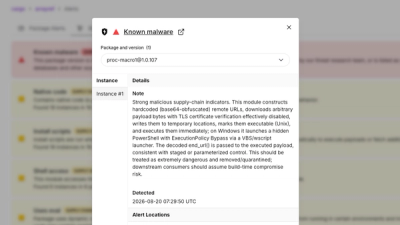
Three compromised Rust crates pulled in a malicious dependency that downloaded and executed cross-platform malware during Cargo builds.