

Product
PHP and Composer Support Is Now in Beta
Socket’s PHP and Composer support is now in Beta for all customers, with PHP reachability analysis generally available.
By Trevor Norris, Benjamin Barslev - Aug 21, 2026
@ultimat3/db
Advanced tools
Postgres access for Ultimate: parameterised SQL, transactions, migrations, drift detection, branch databases, and a read-only client for anything an LLM drives.
Tier 1. Imports @ultimat3/core only. No runtime dependencies; @electric-sql/pglite is an
optional peer, loaded at first query and only by the embedded driver. No ORM backs any of
this — @ultimat3/entity's hand-written postgresDriver() compiles every statement out of the
sql / identifier / join fragments below; this package declares the narrow structural types it
consumes (DbClient, SqlFragment, EntityDescriptionLike) so the SQL stays readable and the
boundary stays thin.
import { db, sql, raw, withTransaction, currentTx, readOnly, setDbClient } from '@ultimat3/db';

const rows = await db().query<Post>(sql`select * from posts where org_id = ${orgId}`);

await withTransaction(async (tx) => {
  await tx.execute(sql`update posts set likes = likes + 1 where id = ${id}`);
  tx.onRollback(() => cache.restore(id));      // fires in reverse order on rollback
}, { isolation: 'serializable', readOnly: false });
| Export | |
|---|---|
sql / raw / identifier / literal / join | fragment builders |
db() / baseClient() / setDbClient() | the ambient client; db() returns the open tx if any |
DbTx.origin | As of 2026-08: the client the transaction was opened on — options.client or baseClient(), never the reservation it runs statements through. @ultimat3/entity compares a pinned repository's client against it, so a pinned repo joins its own shard's transaction instead of being refused |
withTransaction() / currentTx() | transaction scope; currentTx() is the outbox seam. { retry: n } (As of 2026-08) re-runs fn from the top on a 40001/40P01 and on nothing else — default 0, so fn must be idempotent before you ask for it. Each re-run waits first, As of 2026-08-23: exponential from 10ms, capped at 500ms, full jitter (@ultimat3/core's backoffDelay). A budget of 0 waits not at all |
sqlState() / sqlStateCode() / isRetryableState() / SQLSTATE | As of 2026-08: the SQLSTATE a driver error carries, and the closed table from it to a code. Bun.SQL puts it on errno; PGlite puts it on code; one reader answers for both |
migrate() / rollback() / readLedger() | the x_migrations ledger |
statementsOf() | As of 2026-08: a SQL script → the statements a driver sends one at a time. One send is one statement, so migrate() splits with this — a ; inside a literal, an identifier, a dollar-quoted body or a comment is data |
checkDrift() / diffSchema() / assertNoDrift() | drift, with a --json report. checkDrift() is the post-migrate verification — the live database against the ledger: columns, declared indexes (columns, uniqueness, direction, and whether a predicate is there at all — never its text) and declared foreign keys, matched on where the key points and not on its constraint name, with the on delete rule compared through one normalisation As of 2026-08-19 |
declaredSchema() / expectedSchema() | As of 2026-08: the schema the migrations write down, or undefined when the newest one carries no snapshot — never an older snapshot standing in for it |
parseSnapshot() | As of 2026-08: a <id>.snapshot.json sidecar validated to the last nested field, or undefined. {"tables":[null]} is valid JSON and is not a schema |
snapshotJson() | As of 2026-08: the sidecar's bytes — the JSON Biome would have printed, trailing newline included. The one writer of a <id>.snapshot.json, because JSON.stringify(…, null, 2) is not formatter-clean and an app's lint step rejected the file x db gen had just written |
isLedgerMissing() | As of 2026-08: whether an error is Postgres' undefined_table for x_migrations — the one condition a caller may read as "nothing applied" |
appTables() / FRAMEWORK_TABLE_PREFIX | As of 2026-08: the live schema minus the x_ namespace — no migration declares the ledger, the queue, the outbox or an auth table, so none of them is drift |
generateMigration() | x db gen "<name>" — reversible up/down SQL, and destructive for the marker the file must carry. As of 2026-08 a foreign key is its own alter table … add constraint, emitted after every table statement: inline, a references() had to point at a table entity registration order happened to create first, and down had to drop them in an order it did not control. As of 2026-08-19 a removed references() emits its drop constraint (it emitted nothing, and the snapshot then denied a constraint the database still held), a changed onDelete is a drop-and-add rebuild, and a declared on delete rule reaches the clause at all |
destructiveStatements() / hasDestructiveMarker() / isDestructive() / DESTRUCTIVE_MARKER | As of 2026-08: the destructive-SQL rail — does this up drop, truncate or retype, and does the file declare it with -- destructive: true? One classifier, read by x db gen when it writes the marker and by x verify when it demands one |
stripSqlNoise() | comments, literals, dollar-quoted bodies and quoted identifiers blanked in source order, so a reader sees the operation and not the prose. Shared by readOnlyQuery() and the destructive rail |
introspect() | live schema → SchemaDescription |
createBranch() / dropBranch() / reapBranches() | copy-on-write branch databases. As of 2026-08-19 the marker comment records the base as well as the instant (ultimate:branch:<base>:<iso>, on BranchInfo.base), and reapBranches() sweeps only branches of the database it is connected to — one Postgres hosting two Ultimate apps used to mean one app's nightly reap dropped the other's branches. A pre-3.x marker records no base and is skipped, never dropped |
createPgliteClient() / branchPglite() | the embedded database — Postgres in this process |
ensureReadOnlyRole() / grantReadOnlySql() / READONLY_ROLE | a NOLOGIN, SELECT-only Postgres role — layer 1 of db.query's defence |
readOnlyQuery() / READONLY_TIMEOUT_MS | one statement inside BEGIN READ ONLY with a statement timeout — layer 2 |
setStatementObserver() / statementObserver() | As of 2026-08: one event and one db.<verb> span per settled statement, both drivers; uninstalled is one branch |
expectedQueryLoop() / expectedQueryLoopReason() | As of 2026-08: the one way to declare a loop of queries deliberate — the reason rides on every statement it issues as StatementEvent.expected |
withStatementAttribution() / statementAttribution() | As of 2026-08: the { entity, op } pair on StatementEvent.attribution, scoped exactly like expectedQueryLoop() — @ultimat3/entity's postgresRepo is the one producer |
STATEMENT_ATTRIBUTE | As of 2026-08: db.statement, the OTel attribute each span carries its text under — declared here, read by x dev's timeline |
statementFingerprint() / statementKind() / statementVerb() | As of 2026-08: what shape a statement is — entity.op when attributed else its own collapsed text, read or write from the leading verb. One rule, so two detectors group identically |
createRecordingClient() | in-memory DbClient that records SQL, for tests |
sql is parameters-onlyString interpolation is how every SQL injection ships, and an agent writing SQL cannot be trusted to remember the difference between a value and a fragment. So:
string, number, boolean, bigint, Date, Uint8Array, arrays, null) become
$1..$n and never touch .text;X_SQL_UNSAFE — including an object shaped like a SqlFragment that
sql/raw did not produce;raw(trusted) is the one audited escape hatch, identifier(name) the safe way to interpolate
a table or column, literal(text) for utility statements that reject bound parameters.As of 2026-07: a bug in one defence must not become a write, so db.query on the MCP dev
server stacks independent layers rather than trusting a single gate. This package owns the two
layers that are Postgres facts rather than MCP facts — the tool-boundary layers (pre-parse scan,
policy) live above it, and @ultimat3/mcp never imports this package directly.
import { ensureReadOnlyRole, readOnlyQuery } from '@ultimat3/db';

const role = await ensureReadOnlyRole(db());                   // layer 1, once at boot
const { rows, guards } = await readOnlyQuery(statement, { role }); // layer 2, per statement
| Layer | Export | |
|---|---|---|
| 1 | ensureReadOnlyRole() | idempotent DDL (grantReadOnlySql()) for READONLY_ROLE, a NOLOGIN role granted SELECT on every table and nothing else. Returns null instead of throwing when the connection cannot create or grant roles — a managed Postgres where the app user isn't a role admin |
| 2 | readOnlyQuery() | runs one statement inside BEGIN READ ONLY, assumes role via SET LOCAL ROLE when given one, bounds it with SET LOCAL statement_timeout (READONLY_TIMEOUT_MS default, timeoutMs: 0 to disable), and always exits via ROLLBACK |
readOnlyQuery() reports which guards actually engaged (result.guards, e.g. ['txn:read-only', 'timeout:5000ms', 'role:ultimate_readonly']) instead of assuming every layer held — a silently
degraded layer is a caller's problem to surface, never this package's to hide.
Only layer 1 degrades. readOnlyQuery() throws — a pool that cannot reserve a connection
(X_DB_UNAVAILABLE), a refused SET LOCAL ROLE, a failed transaction command, or the
statement's own error. Every caller handles that failure; nothing here swallows it.
ALTER DEFAULT PRIVILEGES is scoped to whoever creates an object, so pass
creators: ['migrator'] when migrations run as a different DB user than the one that ran
ensureReadOnlyRole() — otherwise a table created later is not selectable by the role, and
layer 1 covers only what existed at grant time.
checkDrift() compares introspect() against the snapshot the newest applied migration carries —
expectedSchema(migrations, ledger). declaredSchema(migrations) is the same read with the ledger
left out: the schema the files declare, applied or not, which is what x db gen diffs the app's
entities against so generation needs no database at all. One implementation, two callers — a
snapshot that meant one thing to the generator and another to drift is exactly the divergence the
ledger exists to prevent.
One X_DB_DRIFT, two detectors, and which is which matters. checkDrift() is the post-migrate
verification: it needs a database, so it runs where one is open — runMigrations in
@ultimat3/cli, which is x db migrate, x db reset and ROLE=migrate alike. It is the only one
that can see a column added by hand. The other, checkSourceDrift() (also @ultimat3/cli), hashes
the entity source against what x db gen recorded, opens nothing, and is x verify's drift step
— the gate runs in CI with no database, so a check that needed one could not run at all.
A migration the ledger has not recorded is not drift: expectedSchema reads the ledger's own
subset, so a database that simply has not migrated yet is pending, not divergent. Neither is a
table in the x_ namespace — x_migrations, the queue's tables, the outbox and every
@ultimat3/auth table are created by create table if not exists at boot and appear in no
snapshot, so appTables() drops them before the diff. introspect() keeps its own narrower
exclusion (the ledger alone), because the admin schema view and the MCP schema.describe tool
legitimately show x_users.
Rendered output is pinned byte-for-byte:
X_DB_DRIFT: schema differs from migrations
  cause: table "posts" has column "publish_at" not present in any migration
  fix:   x db gen "add publish_at"
| Difference | cause | fix |
|---|---|---|
| live column, no migration | table "T" has column "C" not present in any migration | x db gen "add C" |
| migrated column, not live | table "T" is missing column "C" that migrations declare | x db migrate |
| live table, no migration | table "T" is not present in any migration | x db gen "add T" |
| migrated table, not live | table "T" is declared by migrations but does not exist | x db migrate |
| index rebuilt differently | index "I" on "T" covers (…) / is unique / is descending / is partial, not what migrations declare | x db migrate |
| foreign key, rule moved | foreign key on "T" (C) to "R" is on delete cascade, not what migrations declare | the drop constraint + add constraint pair, in a new migration |
checkDrift() returns every difference; assertNoDrift() throws the first. x db migrate renders
them all as findings and exits non-zero; a ROLE=migrate container throws the first one
(assertNoDrift, in runRole) and exits non-zero too, because the release phase has one channel —
the exit code — and a deploy that rolled on past a schema nobody can reconstruct is the failure
drift exists to catch. There is no x db drift, and x verify's drift step is the source
detector (checkSourceDrift), which needs no database and never calls this.
No DATABASE_URL means no Docker: createPgliteClient() runs Postgres as WASM inside this
process. The module is resolved on the first statement, never at import, so an image that only
ever talks to a managed Postgres never loads it.
const dev = createPgliteClient({ dataDir: pgliteDataDir(services.db.url) });  // or memory://
await dev.ping();                                       // pay the ~3s boot before serving
setDbClient(dev);

const branch = await branchPglite('feature_x', { from: '.x/pgdata' });
setDbClient(createPgliteClient({ dataDir: branch.dataDir }));
PGlite has no CREATE DATABASE ... TEMPLATE, so branchPglite() copies the data directory —
close the source first, and expect X_NOT_IMPLEMENTED on memory://, which has no directory to
copy. Branch names go through the same assertBranchName() as the Postgres path: here the name
lands in a filesystem path, so an unvalidated one is traversal rather than a typo.
Embedded Postgres is a single session, not a pool. createPgliteClient() is therefore
ReservableClient: withTransaction() and readOnlyQuery() pin it, and every other statement
waits for its turn. Without that pin two concurrent units of work each run BEGIN on the same
connection — the second COMMIT commits the first's rows and the first ROLLBACK finds no
transaction left to undo.
| On a pooled server | Embedded, on one session |
|---|---|
| concurrent transactions run side by side | they run consecutively; throughput is one at a time |
| a statement outside a transaction gets its own connection | it waits for the open transaction to finish |
enqueue(input, { outbox: false }) inside a transaction survives its rollback | it joins that transaction, and rolls back with it |
The last row is the one divergence a second connection would remove and PGlite cannot: a statement issued inside an open transaction's scope runs immediately rather than waiting for a turn that scope is already holding, because waiting would be a deadlock with no error to explain it.
ROLE picks the profile — a worker draining a queue must not size like a web process.
| Role | max | statement timeout | idle timeout | lock timeout | acquire timeout |
|---|---|---|---|---|---|
web | 20 | 10s | 30s | none | 5s |
sync | 10 | 10s | 60s | none | 5s |
worker | 8 | 120s | 30s | none | 10s |
scheduler | 2 | 15s | 60s | none | 10s |
migrate | 1 | none | 10s | 3s | none |
replicator | 4 | none | 60s | none | none |
The statement timeout is pinned per connection via libpq options=-c statement_timeout=, and it
does reach the backend: client.live.test.ts asserts current_setting('statement_timeout'), which
is the only reading a DSN test cannot fake. Bun.SQL is reached lazily, so importing this package
never opens a socket.
That setting is MERGED into the operator's own options, never assigned over them (As of 2026-08). ?options=-c search_path=app in DATABASE_URL survives on every role, and the role's
statement_timeout is appended to it; if the URL sets statement_timeout itself, the role
wins — it is a bound the pool is sized around — and every other flag is kept. It is emitted for
all six roles, migrate's and replicator's 0 included: 0 is "this role may take as long as
it takes", and left unsaid a server-side alter database … set statement_timeout would kill the
one role that has to outlive it. Before this, set replaced the whole value and only on the roles
with a non-zero timeout, so a search_path survived on migrate and vanished on web — the role
that runs the migrations and the role that serves the traffic reading different schemas.
DATABASE_POOL_MAX overrides max (As of 2026-08), and it is the only pool knob an operator
can turn without shipping an image — 400 web pods × the frozen max: 20 is 8,000 backends. A
value that is not a positive integer refuses at boot rather than falling back.
acquireTimeoutMs bounds reserve(), because queueing turns exhaustion into a hang: /readyz's
select 1 joins the same queue, the kubelet kills the pod, and the replacement inherits the same
saturated database. 0 waits, which is what a run-once role wants.
lockTimeoutMs bounds a wait, never the work. alter table … add column takes ACCESS EXCLUSIVE; a long SELECT holding ACCESS SHARE makes it queue, and Postgres' lock queue is FIFO,
so every later query on that table queues behind the ALTER. migrate runs statement_timeout = 0,
so nothing else would ever end that wait. migrate() emits it as SET LOCAL lock_timeout inside
each migration's own transaction — it reverts at COMMIT, so a DDL value never leaks onto the session
the ledger insert runs on.
migrate() takes the advisory lock by polling pg_try_advisory_lock(4919202607) every 500ms
until lockWaitMs (default 60s) and then throwing X_MIGRATE_CONCURRENT (As of 2026-08).
pg_advisory_lock has no timeout, and a predecessor OOM-killed on a partition keeps its backend —
and the lock — for hours, so a deploy hook sat inside one statement printing nothing while
helm upgrade --wait blocked and backoffLimit never fired, because a job that never finishes
never fails. It then ensures x_migrations
(id, name, checksum, applied_at, app_version, duration_ms), audits, then applies each pending
migration inside its own transaction. It refuses before applying anything when:
app_version differs from
the running one — another version owns the database; orup SQL no longer matches its recorded checksum.Report (--json): { applied: [{ id, name, durationMs }], skipped: [id], durationMs, appVersion }.
As of 2026-08:
return expectedQueryLoop('one indexed lookup per text field beats one unindexed OR', async () => {
  for (const field of fields) hits.push(...(await repo.list({ where: [match(field)] })));
  return hits;
});
One mechanism, and only one: no comment pragma, no config list of exempt call sites (axiom 1).
reason is required and non-blank — an exemption with no argument is a pragma, and the next
reader cannot tell a considered loop from a silenced one.
| Scope | core's asyncContext<string>('the expected-loop reason'), never a new AsyncLocalStorage here: it survives every await at any depth, and two loops running at once never read each other. Nesting keeps the innermost reason |
| What it carries | StatementEvent.expected, stamped by both funnels at settle time — a diagnostic judging a whole request runs after every scope in it closed |
| What it suppresses | a verdict, never a statement. The SQL is still sent, still observed, still a span: only the thing that warns is told the author already answered |
| What it costs | nothing without a diagnostic — the reason is read inside the branch that already checks for an installed observer |
The framework's own deliberate loops declare themselves at source: migrate() and rollback()
(one transaction per migration, so a failure leaves an exact ledger) and @ultimat3/admin's
cross-entity search (one indexed lookup per text field).
Every ambient scope in this package opens through asyncContext<T>(subject) from
@ultimat3/core — the transaction store, the attribution pair and this reason — and none of the
three constructs an AsyncLocalStorage, As of 2026-08. What changed is what a browser bundle
does with these three modules: a bundler stubs node:async_hooks to {}, so the module-scope new
threw TypeError: undefined is not a constructor at module evaluation — before a line of app
code ran, and taking every importer of the file with it. Now the module evaluates, a read answers
undefined (nothing is in flight in a browser, so that is the true answer), and a write throws
X_ASYNC_CONTEXT_UNAVAILABLE naming the scope it could not open. A server saves no allocation —
the store is built on the first get() or run(), so a read constructs it too. What the
laziness costs is nothing observable: getStore() outside a scope answers undefined whether the
storage was ever constructed or not. Not a claim that the whole package
bundles: pglite-branch.ts imports node:fs/promises, which is a separate question.
The rule is a build error, not a convention: scripts/async-context-guard.ts refuses a
new AsyncLocalStorage — and the import that binds the class, aliased or namespaced — anywhere but
packages/core/src/async-context.ts, and scripts/async-context-guard.test.ts runs it over the
tree in the gate's unit step.
As of 2026-08: StatementEvent.attribution is no longer always undefined.
return withStatementAttribution('members', 'findById', () =>
  client.query(sql`select * from members where id = any(${ids})`),
);
| Scope | core's asyncContext<StatementAttribution>(), expectedQueryLoop()'s own shape: it survives every await at any depth, and nesting keeps the innermost pair |
| What it carries | StatementEvent.attribution, stamped by both funnels at settle time, next to expected |
| Producer | @ultimat3/entity's postgresRepo — the last caller that still knows the entity and the operation once the SQL exists |
| What it costs | nothing uninstalled — statementObserver() is read first, and with nothing installed fn runs directly; no scope entered, no object allocated |
Hand-written SQL, a migration, a health probe, x db commands and @ultimat3/jobs' own queue
statements still carry no attribution — nothing above them knows an entity to name, so the field
is optional and a detector must fall back to the statement text either way.
Every driver failure is typed by the SQLSTATE the server sent, As of 2026-08. The state was
always on the error and nothing read it, so a 23505 from two clicks racing a signup answered
"cannot reach the database" and paged on-call for an outage that never happened. The table
(sqlstate.ts) is closed; everything outside it is still X_DB_UNAVAILABLE, unchanged.
Four of them carry retry: "retryable" in --json, As of 2026-08-23 — DB_ERROR_RETRY:
X_DB_SERIALIZATION_FAILURE, X_DB_LOCK_TIMEOUT, X_DB_POOL_EXHAUSTED, X_MIGRATE_CONCURRENT.
Each is a resource that frees, so the same call has a real chance of a different answer with no edit
in between. Everything else keeps core's fail-closed terminal, and is deliberately left
UNREGISTERED rather than registered as terminal: @ultimat3/jobs dead-letters a registered
terminal on attempt 1, so classifying X_DB_UNAVAILABLE that way would dead-letter every in-flight
job the moment Postgres fails over.
| Code | Meaning |
|---|---|
X_DB_UNAVAILABLE | no reachable database, or a SQLSTATE the table does not name; fix: names DATABASE_URL |
X_DB_UNIQUE_VIOLATION | 23505 — fix: names upsertAll(rows, { onConflict: [...] }) and the constraint the server named |
X_DB_FOREIGN_KEY_VIOLATION | 23503 |
X_DB_SERIALIZATION_FAILURE | 40001 / 40P01, and an exhausted withTransaction(fn, { retry: n }) budget |
X_DB_STATEMENT_TIMEOUT | 57014 — the statement ran past statement_timeout |
X_DB_LOCK_TIMEOUT | 55P03 — it waited past lock_timeout for a lock it never got |
X_DB_POOL_EXHAUSTED | 53300 / 53200, or reserve() past acquireTimeoutMs |
X_DB_DRIFT | live schema differs from migrations |
X_MIGRATION_CONFLICT | ledger app-version fence or checksum mismatch |
X_MIGRATE_CONCURRENT | another migrator still held the lock when the wait ran out |
X_MIGRATION_IRREVERSIBLE | generated down would lose data |
X_SQL_UNSAFE | non-bindable interpolation, or an unsafe identifier/branch name |
X_BRANCH_EXISTS | branch database already exists (or is the connected one) |
X_NOT_IMPLEMENTED | branching an in-memory PGlite — a copy needs a directory |
X_ENV_MISSING | core's — DATABASE_POOL_MAX is set to something that is not a positive integer |
x db migrate --json
x db gen "add publish_at"
x db branch ls --json
x db branch create feature_x
x db branch drop feature_x
Drift has no subcommand of its own. The database half runs inside x db migrate, which calls
checkDrift() on the connection it already holds and exits non-zero on a difference; the source
half is the drift step of x verify, which hashes entity source against what x db gen recorded
and opens no database. Two questions, two owners, and no drift subcommand under x db — the
DB_SUBCOMMANDS set is gen, migrate, reset, studio, branch, backfill.
FAQs
Postgres access, transactions, migrations and drift detection
We found that @ultimat3/db demonstrated a healthy version release cadence and project activity because the last version was released less than a year ago. It has 1 open source maintainer collaborating on the project.
Product
Socket’s PHP and Composer support is now in Beta for all customers, with PHP reachability analysis generally available.
Product
Socket is bringing experimental protection to Firefox, scanning 97,000+ extensions in Mozilla's official directory for malware and risky updates.
Research
/Security News
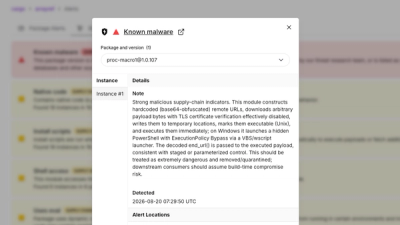
Three compromised Rust crates pulled in a malicious dependency that downloaded and executed cross-platform malware during Cargo builds.